



Beef Cheek Roll Calories: Portions, Frequency & Weight Guide for Dogs
Beef cheek rolls can provide a long chewing session, but they still count as food. Understanding the calories actually eaten helps you choose portions and frequency without letting a chew quietly take over your dog’s daily calorie budget.
The most useful number is not the length of the roll or the number of minutes your dog chews. It is the approximate weight of the portion actually consumed.
Brutus & Barnaby Original Beef Cheek Rolls are currently listed at 100 calories per ounce, or approximately 3.5 calories per gram. There is no single verified calorie number for every roll because natural pieces can vary in weight. A practical approach is to weigh the chew before and after the session, estimate the calories consumed, and count those calories with every other treat your dog receives. Veterinary nutrition guidance generally recommends keeping treats below about 10% of daily calories.
How Many Calories Are in a Beef Cheek Roll?
The current Brutus & Barnaby nutrition panel lists Original Beef Cheek Rolls at 100 kcal per ounce and 3,500 kcal/kg of metabolizable energy. The current Peanut Butter version is also listed at 100 calories per ounce.
That does not mean every beef cheek roll contains 100 calories. It means every ounce eaten contributes approximately 100 calories. A natural roll weighing several ounces can therefore contain several hundred calories in total.
Do not estimate by “one roll” alone: Brutus & Barnaby does not currently list one fixed weight or calorie total for every individual natural roll. Weighing the amount eaten provides a more useful estimate.
A Simple Beef Cheek Roll Calorie Calculator
Using the current 100-calorie-per-ounce listing, estimating intake is straightforward:
Ounces consumed × 100 = estimated calories eaten
For gram measurements, the current 3,500 kcal/kg listing works out to approximately 3.5 calories per gram.
0.25 oz eaten
≈ 25 calories
Roughly 7 grams of the chew.
0.50 oz eaten
≈ 50 calories
Roughly 14 grams of the chew.
1.00 oz eaten
≈ 100 calories
Roughly 28 grams of the chew.
Example: if a roll weighs 4.2 ounces before the session and 3.7 ounces afterward, approximately 0.5 ounce was consumed. At 100 calories per ounce, that is about 50 calories.
Beef Cheek Roll Portion Guide by Dog Weight
The World Small Animal Veterinary Association provides an example treat-calorie table for an average healthy adult dog in ideal body condition. The final column below converts that treat allowance into an approximate amount of Brutus & Barnaby beef cheek at 100 calories per ounce.
This is not a recommended serving size or a reason to use the entire allowance on one chew. It shows how quickly beef cheek calories can use the day’s treat budget. Training treats, table scraps, toppers and every other extra share the same allowance.
*WSAVA figures are examples for average healthy adult dogs in ideal body condition. Individual calorie requirements can differ substantially.
Weight Alone Does Not Determine the Right Portion
Two dogs at the same body weight can have different calorie needs. Age, activity, neuter status, body condition, environment and medical history can all change energy requirements. Veterinary references note that dogs of the same weight may require considerably different calorie amounts.
Start with the actual daily calorie intake
If your dog maintains an appropriate body condition on a known number of calories, use that daily intake to calculate the treat allowance rather than assuming every dog of the same weight should receive the same amount.
Use the veterinary calorie target
Do not automatically calculate treats from the dog’s current overweight body weight. When your veterinarian has prescribed a calorie target, beef cheek calories need to fit inside that plan.
Body condition matters: veterinarians commonly assess body condition in addition to scale weight. On a nine-point body condition scale, scores around 4–5 are generally considered ideal.
How to Portion a Beef Cheek Roll Without Guessing
A beef cheek roll does not have to be finished in one sitting. Focus on the amount consumed, your dog’s chewing behavior and the daily diet.
How Often Can Dogs Have Beef Cheek Rolls?
There is no universal schedule such as “one roll every day” that fits every dog. Frequency should follow the amount actually consumed, the rest of the treat routine, body condition, digestive tolerance and chewing behavior.
Only when intake stays small
A dog may be able to have supervised chew sessions more frequently when only a modest amount is eaten and the total treat calories remain within the diet plan.
A practical option for larger portions
Spacing sessions can make calorie management easier when your dog consumes a meaningful portion each time or receives other treats throughout the week.
Medical needs come first
Dogs on weight-loss, prescription or medically restricted diets may need a smaller allowance, a different chew or no unplanned extras at all.
Frequency cannot fix an oversized portion: one very large chew session once a week can still provide more calories than several carefully measured sessions.
Chew Size and Calorie Portion Are Two Different Decisions
Brutus & Barnaby currently offers Original Beef Cheek Rolls in 5–7-inch and 10–12-inch options. Choose physical size around your dog’s mouth and chewing behavior, then manage calories according to how much material is actually eaten.
More compact does not mean low calorie
The shorter format may be easier for an appropriately sized dog to handle, but the exact calories still depend on the individual roll’s weight and how much is consumed.
More length is not a serving instruction
The longer format can provide more physical length for larger mouths and stronger chewers, but it should not automatically be treated as one meal-sized portion.
Important distinction: choose a chew that remains safely oversized for the dog’s mouth, but control calorie intake through supervision and the amount eaten. A smaller calorie portion does not require beginning with a dangerously small chew.
Beef Cheek Rolls for a Measured Chewing Routine
Both current beef cheek roll options list the same calorie density. The main choice is ingredient simplicity versus added flavor rather than one version being lower calorie.
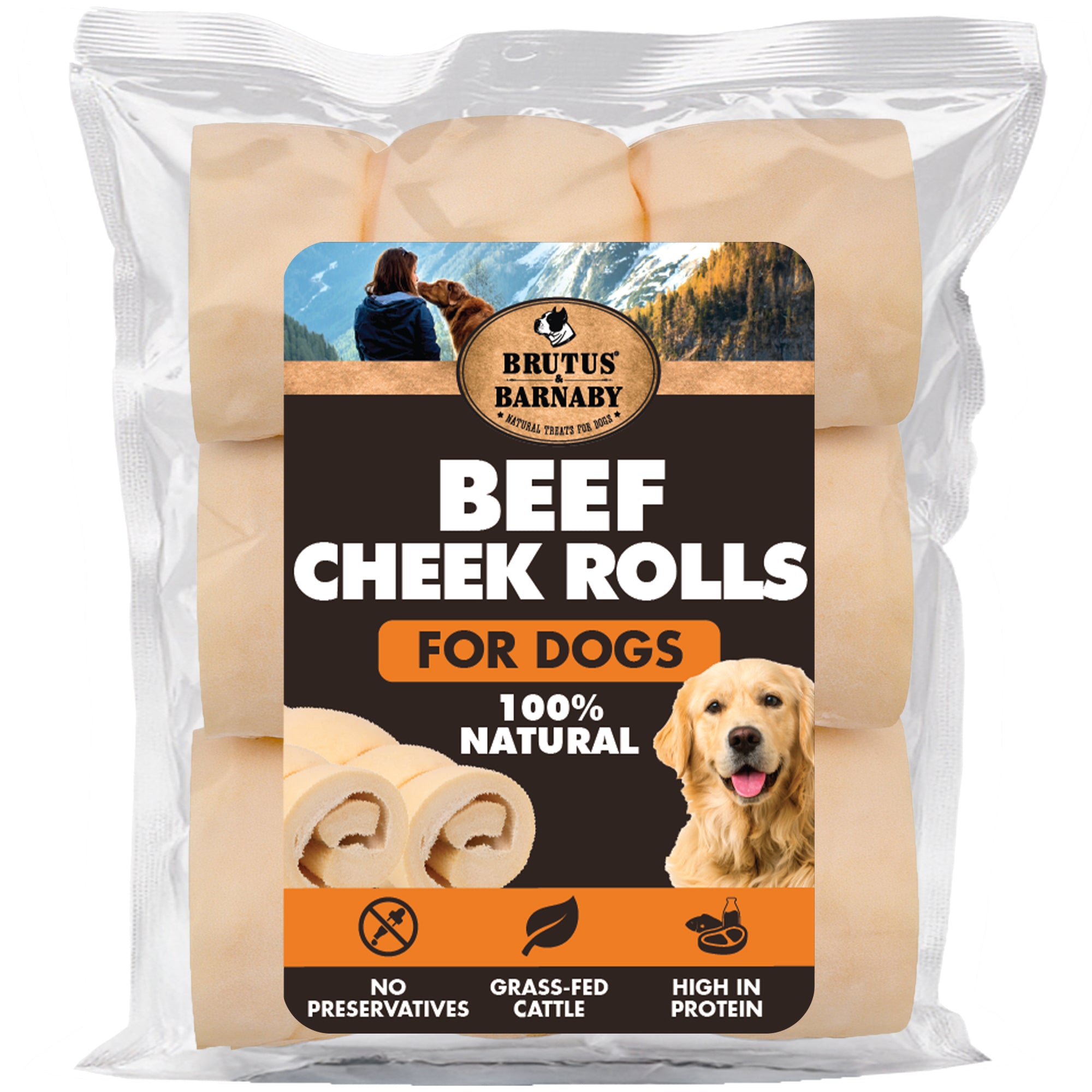
Original Beef Cheek Rolls for Dogs
A dense, rawhide-free beef cheek chew for dogs that tolerate beef and can safely work through a substantial roll under supervision.

Peanut Butter Beef Cheek Rolls for Dogs
The same general beef cheek roll format with added peanut butter flavoring for dogs that benefit from more flavor interest during supervised chew time.
Original vs. Peanut Butter: Does Flavor Change the Calories?
Not according to the current live nutrition panels. Both versions are listed at 100 calories per ounce, so flavor choice does not currently provide a lower-calorie option.
Using Beef Cheek Rolls During Weight Management
A beef cheek roll is not a weight-loss food. It can only fit a weight-management routine when its calories are deliberately included in the dog’s overall plan.
A calorie-aware approach
Common calorie traps
Example: if a veterinarian has set a dog’s daily diet at 500 calories, a 10% treat ceiling would be about 50 calories. At 100 calories per ounce, approximately 0.5 ounce of beef cheek would use that entire allowance before counting any other treats.
Calorie Control Still Requires Safe Chewing
Do not make a chew physically too small just to create a smaller calorie portion. Chew size and calorie intake need to be managed together.
When to Reduce or Pause Beef Cheek Rolls
Reconsider the routine when
Contact a veterinarian promptly when
Build a Better Beef Cheek Roll Routine
Continue with sizing, frequency, digestion and chew-time guidance before making beef cheek rolls part of your dog’s regular routine.
Helpful Nutrition & Weight Resources
Use these veterinary resources for treat-calorie guidance, body-condition assessment and individualized calorie planning.
World Small Animal Veterinary Association — Feeding Treats to Your Dog Practical guidance on keeping treats below 10% of daily calories, with example calorie allowances by body weight. VCA Animal Hospitals — Treat Calories and the 10% Guideline Why treats and extras should remain a small part of the overall complete diet. VCA Animal Hospitals — Body Condition Scoring in Dogs How veterinarians assess body fat and condition rather than relying on scale weight alone. Merck Veterinary Manual — Nutritional Requirements of Small Animals Veterinary reference explaining why calorie requirements can vary substantially between dogs of the same body weight.Beef Cheek Roll Calories: Common Questions
How many calories are in a beef cheek roll?
Brutus & Barnaby currently lists its Original Beef Cheek Rolls at 100 calories per ounce. There is no fixed calorie number listed for every individual roll because natural pieces can vary in weight.
How much beef cheek roll should my dog eat?
Base the portion on your dog’s individual calorie target, other treats, body condition and veterinary guidance. A useful method is to weigh the roll before and after chewing, then count the amount consumed toward the day’s treat calories.
Can dogs have a beef cheek roll every day?
A daily session is not automatically appropriate or inappropriate. What matters is how much your dog actually eats, whether all treats stay within the calorie plan, how the chew affects digestion and body condition, and whether your dog manages the chew safely.
Are beef cheek rolls good for dogs that need to lose weight?
They are not weight-loss foods. A measured amount may fit some veterinarian-directed weight plans, but the calories must be counted. Ask your veterinarian before adding chews when your dog is actively losing weight or eating a therapeutic diet.
Should a small dog finish an entire beef cheek roll?
Not automatically. Because the current calorie listing is 100 calories per ounce, even part of a natural roll may use much of a small dog’s treat allowance. Portion calories separately from physical chew sizing and always supervise.
Does a 10–12 inch beef cheek roll have more calories than a 5–7 inch roll?
Both sizes currently use the same 100-calorie-per-ounce nutrition listing, but a fixed total calorie amount is not published for each natural roll. The longer roll may contain more material, but weighing the individual chew is more reliable than estimating from length alone.
How do I count calories if my dog only chews part of the roll?
Weigh the roll before the session and again afterward. Multiply the ounces consumed by 100 to estimate calories. For example, 0.4 ounce eaten would equal approximately 40 calories using the current listing.
Do Peanut Butter Beef Cheek Rolls have more calories than Original?
Not according to the current Brutus & Barnaby nutrition panels. Both Original and Peanut Butter Beef Cheek Rolls are currently listed at 100 calories per ounce.
Count the Portion Eaten, Not Just the Roll Offered
Brutus & Barnaby Beef Cheek Rolls are currently listed at 100 calories per ounce, making the amount actually consumed the most useful number for portion control. Weigh the chew when calorie accuracy matters, keep all treats within your dog’s overall calorie plan, choose physical size around safe chewing rather than calories alone, and adjust frequency according to body condition, diet, digestion and veterinary guidance.
Choose Original or Add Peanut Butter Flavor
Review the current ingredient panel, calorie information, available sizes and feeding directions before choosing the right beef cheek roll for your dog.
Educational disclaimer: This article provides general educational information and is not veterinary, nutritional, diagnostic, weight-loss, or emergency advice. Individual calorie needs vary according to age, size, body condition, activity, reproductive status, health history and diet. Dogs that are overweight, underweight, growing, pregnant, nursing, highly active, eating a prescription diet, or managing a medical condition may need individualized feeding guidance. Always supervise chewing, provide fresh water, remove pieces that become small enough to swallow, and contact your veterinarian if you have concerns about weight, digestion, dental health, choking, or possible obstruction. Product ingredients, nutrition information, sizes, packaging, availability and feeding directions can change, so review the current product page and package before feeding.