



Are Beef Cheek Rolls Digestible? What Dog Owners Should Know
Learn what “digestible” really means for a dense dog chew, why the size of a swallowed piece still matters, and how to make beef cheek sessions safer for your individual dog.
If your dog has started softening, peeling, or swallowing pieces of a beef cheek roll, it is reasonable to wonder where those pieces go next. Beef cheek rolls are intended to be edible chews, but that does not make the words edible, digestible, and safe to swallow whole interchangeable. Digestion takes time, and a large piece can become lodged in the throat, esophagus, stomach, or intestines before the body finishes breaking it down.
What “Digestible” Means for a Beef Cheek Roll
Digestibility describes whether the digestive system can break material into smaller components that can be absorbed or passed. It does not tell you exactly how quickly a particular piece will break down inside one dog.
A beef cheek roll begins as a dense, dried chew. Saliva and repeated chewing usually soften the worked end while the center remains firmer. Once small, thoroughly chewed material reaches the stomach, acid and digestive enzymes continue processing it. The amount swallowed, the thickness of the piece, and the dog’s individual digestion all affect what happens next.
Digestible Does Not Mean Instant
A piece may remain large for some time after it is swallowed. Its ability to break down eventually does not remove the immediate risk created by its size or shape.
Chewing Is Part of the Process
Biting, moistening, and shredding the chew reduce its size before swallowing. A dog that gulps thick pieces skips much of that mechanical preparation.
Tolerance Is Individual
Two dogs can respond differently to the same chew. Size, chewing style, digestive history, diet, and underlying health conditions all matter.
No Edible Chew Is Risk-Free
Edible material can still become a choking hazard or gastrointestinal obstruction when a dog tears off or swallows a piece that is too large.
Digestible, Tolerated, and Safe to Swallow Are Different
Much of the confusion comes from using one word to answer three separate questions. A chew can be made from edible material while still being the wrong size, texture, or format for a particular dog.
| Question | What It Actually Means | What Owners Should Watch |
|---|---|---|
| Is it edible? | The product is intended to be consumed as a treat rather than used as a permanent toy. | Verify the ingredient panel and avoid proteins your dog has been told not to eat. |
| Is it digestible? | The digestive system can process appropriately chewed material, although the rate can vary. | Dense chunks may not break down quickly enough to eliminate choking or blockage concerns. |
| Does my dog tolerate it? | Your dog can eat a controlled amount without recurring vomiting, diarrhea, itching, or discomfort. | Introduce gradually and observe your dog during and after the first several sessions. |
| Is this piece safe to swallow? | The piece is small and sufficiently chewed relative to the dog, rather than a detached gulp-sized chunk. | Remove loose flaps, thick torn sections, and the final shortened piece before they are swallowed. |
The Most Important Distinction
A material can be digestible and still create a mechanical obstruction. Digestibility should never be treated as permission to let a dog swallow a large piece.
What Affects How a Dog Handles Beef Cheek?
Chewing Style
A patient dog that gradually moistens and scrapes the surface presents a different risk profile from a dog that crushes, tears, and gulps. Watch what your dog actually does rather than relying on breed or body weight alone.
Starting Size and Final Size
The chew should begin clearly oversized relative to the dog’s mouth. The risk changes as it shortens, flattens, unrolls, or develops detachable sections.
Quantity Consumed
Eating a large amount during one session may be harder on a dog’s digestive routine than slowly consuming a limited portion over multiple supervised sessions.
Health and Diet History
Dogs with diagnosed beef allergies, previous obstructions, swallowing difficulties, chronic digestive symptoms, pancreatitis risk, or prescription diets need veterinary guidance before receiving a new chew.
Digestibility Does Not Cancel Out the Calories
The current Brutus & Barnaby product panels list both Original and Peanut Butter Beef Cheek Rolls at 100 calories per ounce. A per-roll calorie amount is not currently listed, and natural pieces can vary in weight. If calorie control matters, weigh the amount consumed rather than assuming every roll supplies the same number of calories.
The World Small Animal Veterinary Association advises that treats should account for no more than about 10% of a dog’s daily calorie intake. Your veterinarian can help set a more specific allowance for a puppy, senior dog, weight-management plan, prescription diet, or dog with a medical condition.
How to Introduce a Beef Cheek Roll Safely
- Check the ingredient panel. Start with the Original version if you want the shortest current ingredient list: 100% beef cheek. Avoid beef cheek if your veterinarian has instructed you to exclude beef.
- Choose an oversized starting chew. Select a roll your dog cannot comfortably fit entirely inside the mouth. Brutus & Barnaby currently offers 5–7-inch and 10–12-inch options.
- Begin with a short session. A limited first session helps you observe chewing behavior and digestive tolerance before allowing more.
- Supervise at close range. Stay near enough to see whether the roll is softening gradually, peeling into layers, cracking, or producing a large detachable piece.
- Inspect the worked end. Pause the session if a thick flap, loose strip, brittle fragment, or gulp-sized piece develops.
- Remove the shortened remainder. Take the chew away before the final portion becomes small enough to swallow whole. Trading it for a familiar reward may be easier than grabbing it unexpectedly.
- Observe after chewing. Watch for vomiting, diarrhea, repeated swallowing, appetite changes, abdominal discomfort, unusual itching, or lethargy before offering another session.
Do Not Rely on a Timer Alone
Ten minutes can be uneventful for one dog and enough time for another to tear off a large piece. End the session based on the chew’s condition and your dog’s behavior, not only the clock.
What If Your Dog Swallowed a Piece?
First, remove the remaining chew and assess your dog. A tiny, thoroughly chewed piece is different from a thick section swallowed whole, but appearance alone cannot confirm that a piece will pass.
Dog Is Breathing Normally
Note the approximate size and shape of the missing piece, when it was swallowed, the product ingredients, and your dog’s weight. Contact your veterinarian for case-specific guidance, particularly if the piece was large or your dog has a relevant medical history.
Dog Is Gagging or Struggling to Breathe
Treat breathing difficulty, blue or gray gums, collapse, or an inability to move air as an emergency. Contact the nearest emergency veterinary hospital immediately.
Do not give extra food, oil, bread, or another chew in an attempt to push the piece through. Do not attempt to make your dog vomit unless a veterinarian specifically instructs you to do so.
When to Stop the Chew and Call a Veterinarian
Stop the session immediately if you notice:
- Repeated gagging, coughing, drooling, regurgitation, or attempts to swallow
- A large section being torn off or swallowed without adequate chewing
- Bleeding from the mouth, a visibly damaged tooth, or sudden mouth sensitivity
- Facial swelling, hives, intense itching, or breathing changes
- Repeated vomiting, diarrhea, loss of appetite, abdominal pain, lethargy, or difficulty passing stool
Ask your veterinarian before offering beef cheek if your dog has:
- A diagnosed beef or peanut allergy
- A history of intestinal obstruction or foreign-body surgery
- Swallowing problems, chronic regurgitation, or esophageal disease
- Pancreatitis risk, a prescription diet, or chronic digestive symptoms
- Damaged teeth, painful gums, recent dental work, or a tendency to fracture hard chews
Puppies, seniors, small dogs, and dogs that gulp may need a different chew format or much closer management. Age alone does not determine suitability; tooth development, chewing behavior, size, and health are more useful considerations.
Brutus & Barnaby Beef Cheek Options
The current collection includes two closely related beef cheek products. Neither option removes the need for supervision, appropriate sizing, controlled treat calories, and removal of the final small piece.
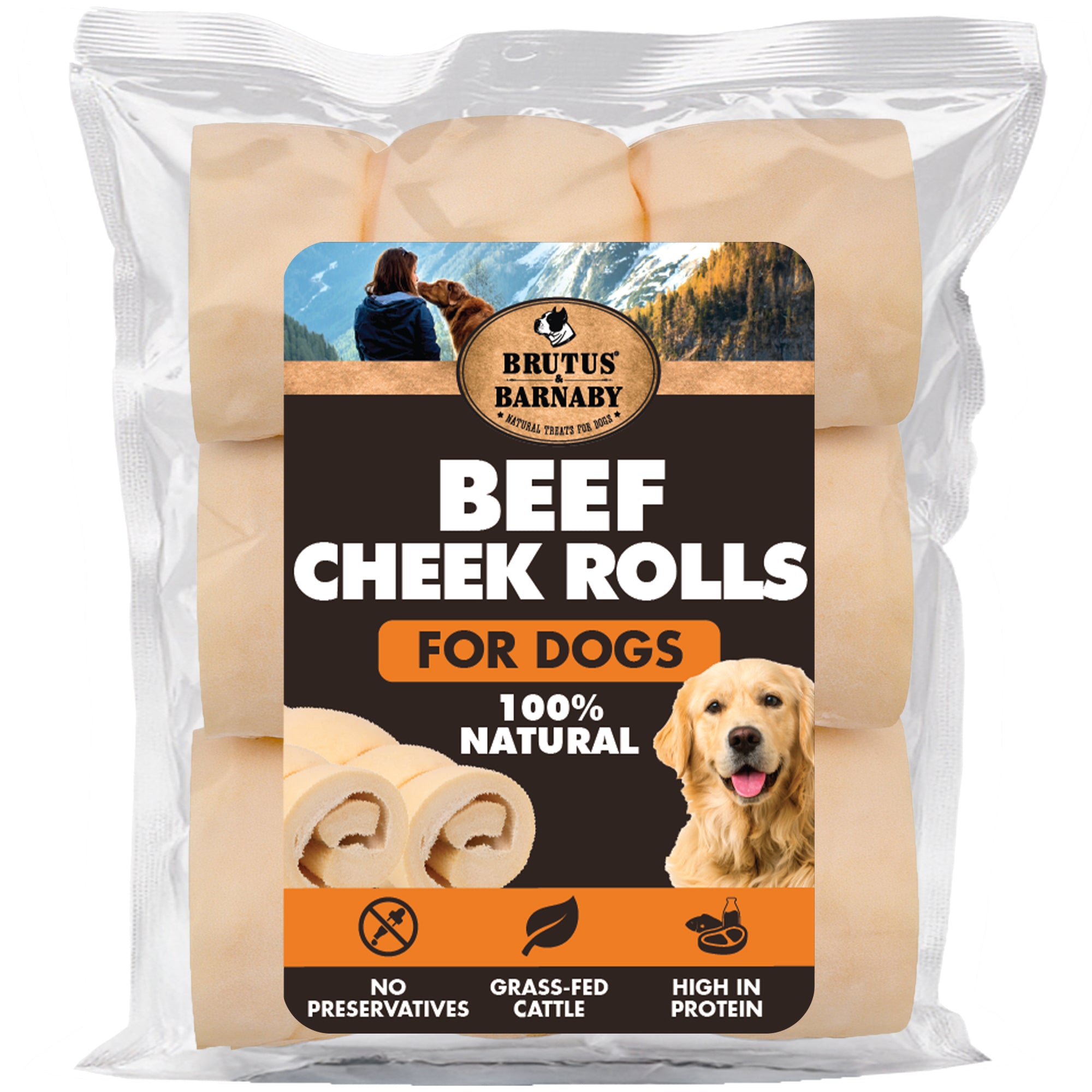
Beef Cheek Rolls for Dogs | Long-Lasting Rawhide-Free Chews
A dense, rawhide-free chew currently made from 100% beef cheek and offered in two length ranges.
- Ingredient: 100% beef cheek
- Current lengths: 5–7 inches and 10–12 inches
- Current calorie listing: 100 calories per ounce
- Crude protein: 81.2% minimum

Peanut Butter Beef Cheek Rolls for Dogs | Long-Lasting Rawhide-Free Chews
A flavor-forward beef cheek chew with peanut butter flavoring, currently offered in short and long variants.
- Ingredients: beef cheek and peanut butter flavoring
- Current lengths: 5–7 inches and 10–12 inches
- Current calorie listing: 100 calories per ounce
- Crude protein: 81.2% minimum
More Beef Cheek Guides
- Original vs. Peanut Butter Beef Cheek Rolls — Compare current ingredients, flavors, lengths, and calorie listings.
- Collagen Sticks vs. Beef Cheek Rolls for Dogs — Compare starting shapes, handling, softening patterns, and removal points.
- Beef Cheek Rolls for Dogs: Natural Plaque Fighter — Learn how chewing fits into a broader dental-care routine.
Trusted Reading
Frequently Asked Questions
How long does a beef cheek roll take to digest?
There is no reliable universal digestion time. The answer depends on the amount swallowed, how thoroughly it was chewed, its thickness, and the dog’s digestive health. A large piece should not be assumed safe simply because beef cheek is edible.
Can beef cheek rolls cause a blockage?
Any chew can contribute to an obstruction if a sufficiently large piece is swallowed. Vomiting, appetite loss, abdominal pain, lethargy, diarrhea, dehydration, or difficulty passing stool warrant prompt veterinary advice.
Should dogs eat an entire beef cheek roll in one sitting?
Not automatically. Session length and quantity should reflect the individual dog’s size, calorie allowance, chewing behavior, and tolerance. Remove the roll when loose sections develop or the remainder becomes small enough to gulp.
Are beef cheek rolls the same as rawhide?
Brutus & Barnaby’s current products are listed as rawhide-free and made with a beef cheek base. However, a rawhide-free label does not eliminate the need for supervision or make large swallowed pieces harmless.
Why did my dog vomit after eating beef cheek?
Vomiting can have many causes, including eating too much, swallowing a large piece, sensitivity to an ingredient, or an unrelated illness. Remove the chew and contact your veterinarian if vomiting repeats, your dog cannot keep water down, or other warning signs appear.
Can puppies digest beef cheek rolls?
A puppy may be able to digest appropriately chewed beef material, but suitability also depends on tooth development, size, chewing control, diet, and the ability to manage a dense chew. Ask your veterinarian before introducing one and supervise closely.
How do I know when to throw a beef cheek roll away?
Remove it when the remainder can fit deeply inside your dog’s mouth, when layers detach, or when the chew becomes cracked, brittle, heavily soiled, or difficult to inspect. There is no single safe remaining length for every dog.
Can dogs with sensitive stomachs have beef cheek rolls?
“Sensitive stomach” is not a diagnosis, and tolerance varies. Introduce only a small amount after veterinary approval if your dog has chronic vomiting, diarrhea, pancreatitis risk, a prescription diet, or an established food allergy.
Digestible Does Not Mean Swallow Whole
Beef cheek rolls are edible beef chews that can soften and be digested when dogs work them into appropriately sized material. The key limitation is mechanical: a dog can swallow a piece faster than the digestive system can break it down.
Choose an oversized starting roll, supervise the entire session, count the consumed portion toward daily treat calories, and remove loose sections and shortened ends. If your dog gulps a large piece or develops gagging, repeated vomiting, appetite loss, abdominal pain, lethargy, or breathing difficulty, contact a veterinarian promptly.
Explore Beef Cheek Rolls for Your Dog
Compare Original and Peanut Butter options in the Brutus & Barnaby beef cheek collection, then select a size that stays clearly oversized during supervised chewing.
Shop Beef Cheek Rolls