



Collagen Sticks vs Beef Cheek Rolls: Which Chew Is Better?
Both are single-ingredient, rawhide-free beef chews—but they start in different shapes, soften differently, and fit different dogs. The better choice depends on mouth size, chewing technique, session goals, and how the chew changes under supervision.
Choose collagen sticks when you want a narrower six-inch stick for a controlled chew rotation and your dog works through rolled layers steadily. Choose beef cheek rolls when you need a broader, more substantial starting shape—especially for a medium or large dog that handles dense chews deliberately. Neither option is universally better, risk-free, or guaranteed to last a specific amount of time.
Collagen sticks are the more compact option; beef cheek rolls are the more substantial option.
Brutus & Barnaby Beef Collagen Sticks are six-inch rolled sticks made from 100% beef collagen and currently sold in 5-, 10-, and 25-packs. Original Beef Cheek Rolls are made from 100% beef cheek and currently come in 5–7 inch and 10–12 inch variants. Start with collagen when a narrow stick is easier for your dog to hold and manage. Start with a cheek roll when your dog needs a broader chew that remains clearly oversized relative to the mouth. In either case, supervise actively, inspect how the material softens, and remove the chew before the remaining portion or any loose piece becomes easy to swallow.
How This Comparison Differs From Other Brutus & Barnaby Guides
The Brutus & Barnaby archive already compares bully sticks with collagen sticks and includes collagen and cheek rolls in broader long-lasting-chew roundups. This guide answers a narrower shopping question: when the final choice is specifically between a collagen stick and an original beef cheek roll, which starting shape, texture, size, softening pattern, calorie profile, and handling routine better fit the individual dog?
Direct Two-Product Decision
This article does not rank every chew category. It compares only collagen sticks and beef cheek rolls so owners can make a practical purchase and sizing decision.
What Happens During Chewing
The focus is not only what each chew is made from. It is also how the starting shape changes, where loose material appears, when mess develops, and when the session should end.
Collagen Sticks vs Beef Cheek Rolls Comparison
| Feature | Beef Collagen Sticks | Original Beef Cheek Rolls |
|---|---|---|
| Live ingredient listing | 100% all-natural beef collagen | 100% beef cheek |
| Starting format | Narrow, rolled six-inch stick | Broad, rolled chew in 5–7 inch or 10–12 inch variants |
| Current pack options | 5, 10, or 25 sticks | 5–7 inch: 3 or 5 pack; 10–12 inch: 3, 5, or 10 pack |
| Current calorie listing | 110.6 calories per ounce | 100 calories per ounce |
| Typical handling feel | Easier to grip for dogs that manage a narrower stick calmly | More substantial in the paws and mouth, particularly in the longer variant |
| How it may change | Rolled layers may soften, peel, or loosen as the dog works along the stick | The worked end may soften, flatten, shred, or unroll while the center remains denser |
| Better starting direction | Dogs suited to a compact chew rotation and controlled stick-shaped sessions | Medium and large dogs or strong chewers that need a visibly broader starting piece |
| Primary watch point | Loose strips, brittle fragments, or a shortened swallow-sized end | Softened flaps, detached layers, large torn pieces, or a reduced final section |
| Guaranteed chew time? | No—individual dogs and natural pieces vary | No—individual dogs and natural pieces vary |
What Are Collagen Sticks and Beef Cheek Rolls Made From?
Beef Collagen Sticks
The live Brutus & Barnaby product page lists one ingredient: 100% all-natural beef collagen. The material is formed into a compact rolled stick rather than presented as a broad sheet or large roll.
- Single-ingredient beef chew
- Rawhide-free format
- Six-inch starting length
- Current page lists 110.6 calories per ounce
Original Beef Cheek Rolls
The live Brutus & Barnaby product page lists one ingredient: 100% beef cheek. The cheek is rolled into a broad cylindrical chew and offered in two current length ranges.
- Single-ingredient beef chew
- Rawhide-free format
- 5–7 inch and 10–12 inch variants
- Current page lists 100 calories per ounce
Both come from cattle and both should be treated as beef when considering food allergies or elimination diets. A dog that reacts to beef should not be switched from one to the other without veterinary guidance simply because the tissue or product name is different.
Which Texture Is Better for Your Dog?
Texture should be judged dynamically. The important question is not only how the chew feels when dry; it is what your dog makes it become after five, ten, or twenty minutes of chewing.
Collagen: Narrow Rolled Layers
A collagen stick begins as a compact cylinder. Depending on the individual piece and dog, the outer material may soften first and expose curled or loosened layers.
Cheek: Broader Rolled Structure
A beef cheek roll gives the dog a larger surface and thicker body to work. The wet end may flatten or loosen while the unworked section remains firmer.
The Dog Decides the Real Texture
A methodical chewer may soften either product gradually. A crushing or tearing chewer may create loose pieces much sooner. Observe the result rather than trusting the category name alone.
How Each Chew May Soften During a Session
| Stage | Collagen Stick | Beef Cheek Roll | What the Owner Should Do |
|---|---|---|---|
| Dry starting stage | Firm, narrow, and relatively uniform | Firm, broad, and visibly layered or rolled | Confirm the entire item is too large to swallow and inspect for damage before offering |
| Early chewing | The worked end may become damp and slightly flexible | The outer edge may moisten, compress, or develop tooth marks | Watch whether the dog scrapes and softens or attempts to bite through |
| Developing soft area | Rolled strips may begin to peel, curl, or separate | The worked end may flatten, shred, or partially unroll | Remove detached pieces and stop if the dog is tearing off chunks rather than chewing deliberately |
| Late session | The stick may be shorter, thinner, or uneven | The roll may have a softened end attached to a denser remaining core | End the session before any remaining section or loose material becomes easy to swallow |
| Stored for later | May dry firmer after saliva exposure | Softened areas may also dry and change texture | Follow package storage guidance, refrigerate only when directed, and re-inspect before reuse; discard dirty or spoiled pieces |
Which Dogs May Fit Collagen Sticks Better?
Dogs That Manage a Six-Inch Stick Well
The narrow shape can be convenient for a dog that braces a stick between the paws, chews from one end, and does not attempt to swallow or snap through the whole piece.
Dogs Needing Variety in a Beef-Chew Rotation
Collagen sticks can provide a different structure from bully sticks, ears, and cheek rolls without changing away from beef. Rotation still requires portion tracking and individual tolerance.
Owners Wanting a Compact Session
The smaller starting footprint can be easier to manage on a washable mat or in a supervised chew station than a broad roll, although saliva and loose material are still possible.
Not Automatically Right for Gulpers
A narrow stick can become swallow-sized sooner for a large dog. Size up to a different format or skip the chew if the dog tries to gulp, crush, or detach large pieces.
Which Dogs May Fit Beef Cheek Rolls Better?
Medium or Large Deliberate Chewers
The broader roll can give larger dogs a more substantial object to hold and work on, particularly when a six-inch stick looks too easy to fit deeply into the mouth.
Dogs Needing a Larger Starting Format
The 10–12 inch variant provides more initial length than the collagen stick. Length alone is not enough, so diameter, thickness, and the dog’s chewing method still matter.
Structured Longer Sessions
A cheek roll may suit owners who want to offer one substantial chew across controlled sessions rather than expecting the dog to finish it. Exact longevity cannot be promised.
Not for Every Mouth
Dogs with worn, fractured, loose, or painful teeth may need a softer reward. Ask a veterinarian before offering dense chews to seniors or dogs with known dental disease.
Decision Table: Which One Should You Choose?
| Your Priority | Better Starting Direction | Why | Important Limitation |
|---|---|---|---|
| A compact, stick-shaped chew | Collagen stick | Six-inch narrow format is easy to recognize and portion into a supervised rotation | May become too short or narrow sooner for a large gulper |
| A broader chew for a medium or large dog | Beef cheek roll | Wider rolled shape and two available length ranges offer a more substantial starting piece | Broad rolls can become wet, flattened, or messy during longer sessions |
| More pack-count flexibility | Collagen stick | Current product page offers 5-, 10-, and 25-pack choices | Pack count does not determine the right physical size for the dog |
| More starting-length flexibility | Beef cheek roll | Current page offers 5–7 inch and 10–12 inch variants | Natural pieces can vary within the listed ranges |
| Lowest listed calories per ounce between these two | Beef cheek roll | Current page lists 100 calories per ounce versus 110.6 for collagen | Total intake depends on the actual weight and amount consumed, not only calories per ounce |
| A guaranteed longer-lasting chew | Neither | Chew time depends on size, thickness, moisture, dog strength, technique, and natural variation | Do not use marketing duration as a substitute for supervision |
| A chew for a dog with dental disease or swallowing problems | Neither without veterinary guidance | Individual medical and dental risk matters more than category | A softer non-chew reward may be more appropriate |
Which Chew Is Cleaner Around the House?
Neither chew is guaranteed to be clean. Saliva, softened tissue, crumbs, loose strips, and natural odor can vary by dog and piece. The more important difference is the shape of the mess.
Collagen Stick Mess
Expect possible curled strips, small dry crumbs, a damp worked end, or fragments if the dog crushes rather than softens the stick. Check the floor for detached pieces.
Beef Cheek Roll Mess
The larger wet surface may transfer more saliva to rugs or bedding. Softened cheek can flatten, shred, or leave stringy material around the chew station.
Which Is Better for Portion and Calorie Awareness?
The current product pages list collagen sticks at 110.6 calories per ounce and original beef cheek rolls at 100 calories per ounce. That difference is useful, but it does not tell you how many calories your dog consumes in a session. A large cheek roll may weigh much more than one collagen stick, and most dogs consume only part of a chew before it is removed.
Weigh the chew before the first session
A small kitchen scale provides a starting weight for that individual natural piece.
Let the cleaned surface dry as directed before reweighing
Saliva can temporarily increase weight, so immediate post-session weighing can mislead. Follow the package’s storage instructions and use the measurement only as a practical estimate.
Estimate the amount consumed
Subtract the later weight from the starting weight. Multiply the ounces consumed by the calories-per-ounce listing for an approximate intake.
Count the chew within all daily extras
Add training rewards, toppers, table food, dental treats, and other chews. A common veterinary guideline keeps treats and extras within about 10% of daily calories, but individual limits may be lower.
Choose the Starting Format That Fits Your Dog
These cards reflect the current live product formats. Select by mouth size and chewing behavior—not by pack value alone—and actively supervise every session.
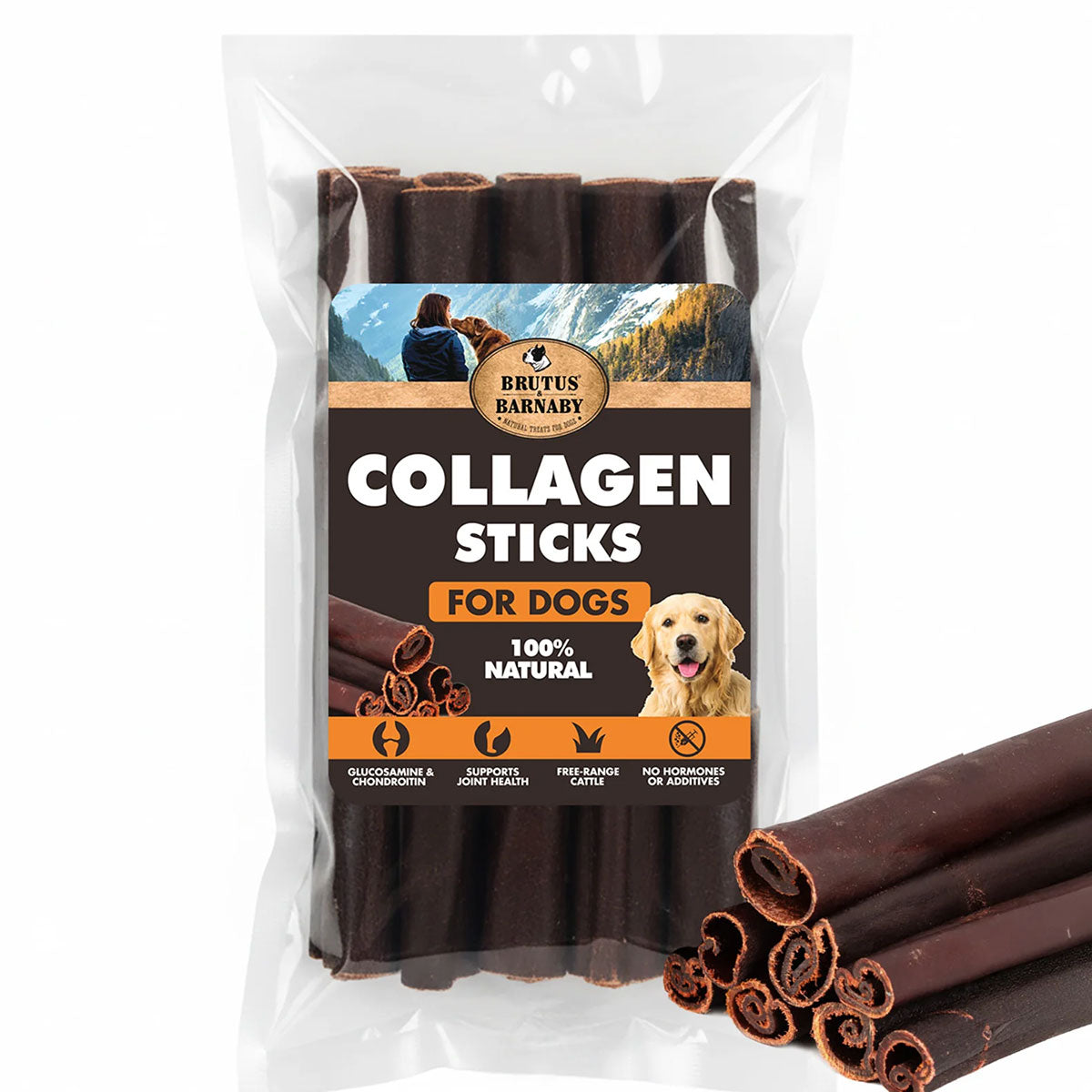
Beef Collagen Sticks
A six-inch rolled collagen format for dogs that work a narrower stick steadily under supervision.
- 100% beef collagen
- Six-inch stick format
- 5-, 10-, and 25-pack options
- 110.6 calories per ounce
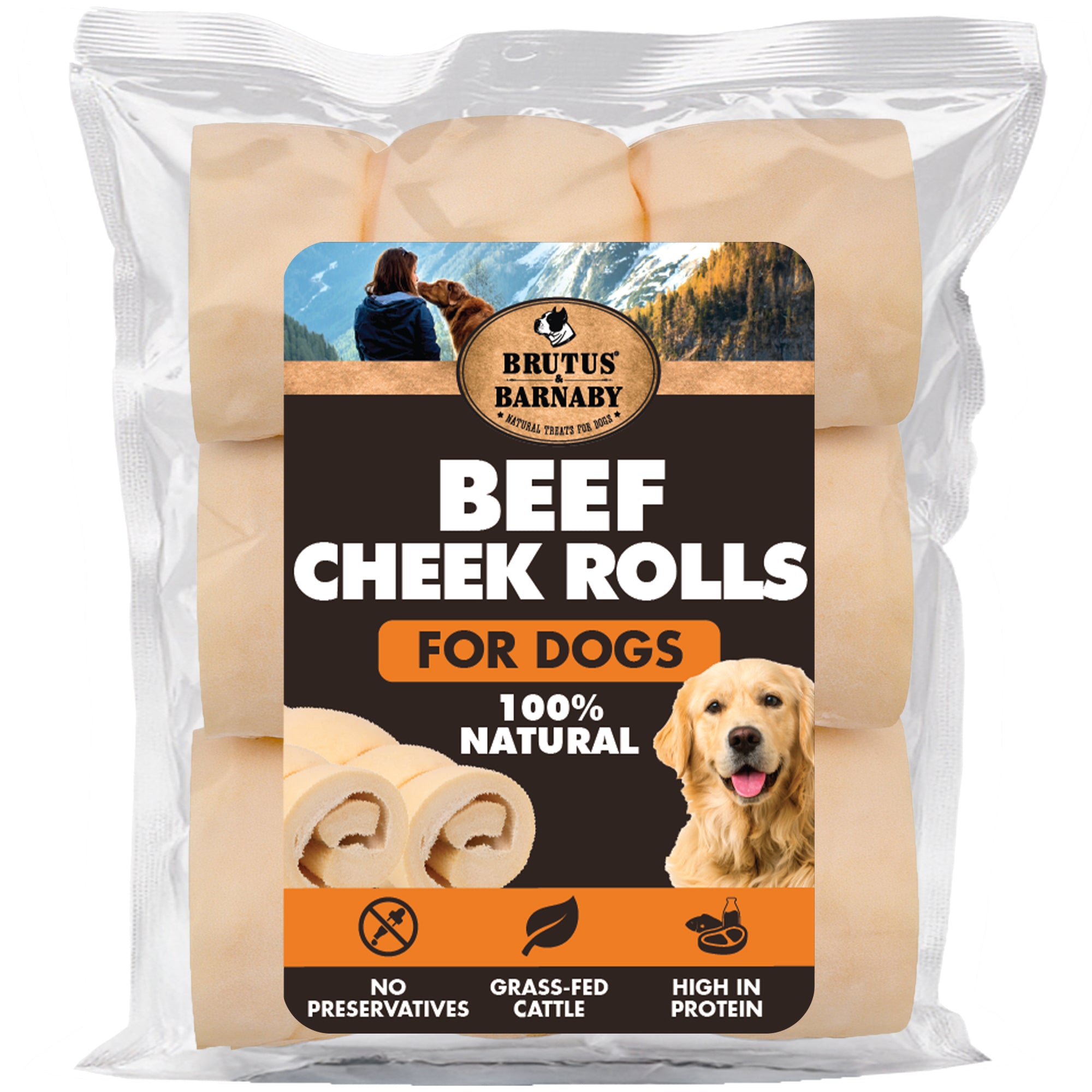
5–7 Inch Beef Cheek Rolls
The shorter original cheek-roll option for appropriately sized dogs that need a broader shape than a narrow stick.
- 100% beef cheek
- 5–7 inch natural range
- 3- and 5-pack options
- 100 calories per ounce

10–12 Inch Beef Cheek Rolls
A longer original cheek-roll variant for medium and large dogs that require a more substantial starting piece.
- 100% beef cheek
- 10–12 inch natural range
- 3-, 5-, and 10-pack options
- Remove softened layers and small ends
How to Introduce Either Chew Safely
Inspect the dry chew
Check for damage, unusual odor, mold, contamination, sharp exposed areas, or pieces already loose in the package. Natural variation is normal, but damaged or spoiled items should not be offered.
Confirm that the starting piece is oversized
The dog should not be able to fit the entire chew deeply inside the mouth or position it for an easy whole-piece swallow. When uncertain, choose a larger format or another reward.
Use a short introductory observation period
For a new chew, focus on technique rather than duration. Watch whether the dog licks and scrapes, chews methodically, crushes, tears, gulps, or attempts to hide the item.
Check the changing material
Pause the session to inspect peeling collagen layers, softened cheek flaps, brittle fragments, large torn pieces, and the size of the remaining end.
End with a practiced trade-up
Offer a separate high-value reward away from the chew and pick it up after the dog moves. Do not chase, corner, intimidate, grab at the mouth, or punish growling.
Monitor digestion after the introduction
Stop and contact a veterinarian for repeated vomiting, abdominal pain, marked lethargy, appetite loss, persistent diarrhea, difficulty passing stool, or concern that a large piece was swallowed.
Exactly When Should You Remove the Chew?
Remove It When
- The remaining piece can fit fully inside the dog’s mouth
- A collagen strip or cheek layer detaches
- The dog starts trying to swallow rather than chew
- The material becomes sharply broken or excessively brittle
- The softened end forms a large flap or chunk
- The dog shows dental pain, bleeding, guarding, panic, or distress
Do Not Wait For
- The dog to finish the entire chew
- A timer to reach a marketing claim
- The last two inches as a universal removal rule
- Coughing or gagging before intervening
- Another dog to approach and create competition
- A loose piece to disappear before checking the floor
Which One Is Better for Strong Chewers?
A strong chewer does not automatically need the hardest possible item. Strong dogs differ: some scrape and soften patiently; others clamp down, fracture material, or tear away large pieces. A broader 10–12 inch cheek roll may provide a more suitable starting shape than a six-inch collagen stick for a large dog, but it is not automatically safe. The chew must remain intact enough for deliberate chewing and must not be so hard that it threatens the dog’s teeth.
What About Puppies, Seniors, and Dogs With Health Conditions?
Neither product should be chosen from age alone. Puppies vary in tooth development and gulping behavior. Senior dogs vary in dental wear, missing teeth, gum comfort, and medical history. Ask a veterinarian before offering dense edible chews to puppies, seniors, or dogs with:
- Broken, loose, worn, painful, or recently treated teeth
- Previous choking, obstruction, pica, or swallowing problems
- Food allergies or a veterinary elimination diet involving beef
- Pancreatitis risk, gastrointestinal disease, or a restricted-fat plan
- Prescription diets in which extra food can interfere with treatment
- Weight-management needs requiring a precise treat allowance
- A tendency to guard, gulp, hide, or consume chews frantically
A softer training treat, food puzzle using part of the dog’s balanced meal, or veterinarian-approved dental product may be more appropriate than either natural chew.
Continue Comparing Chews Safely
Veterinary Chew and Treat Guidance
These resources support the article’s recommendations on individual chew matching, active observation, tooth-fracture awareness, dental care, and keeping treats within a balanced calorie budget.
Collagen Stick vs Beef Cheek Roll FAQ
Are collagen sticks or beef cheek rolls better for dogs?
Neither is universally better. Collagen sticks provide a narrow six-inch format, while beef cheek rolls provide broader 5–7 inch and 10–12 inch options. Choose according to the dog’s mouth size, chewing technique, dental condition, and tendency to gulp.
Which lasts longer: collagen sticks or beef cheek rolls?
There is no reliable universal winner. A broad cheek roll may outlast a narrow collagen stick for some strong chewers, but another dog may tear through softened cheek quickly. Thickness, natural variation, moisture, dog size, and technique all affect total chew life.
Do collagen sticks and beef cheek rolls soften?
They can. Collagen layers may become damp, flexible, curled, or peeled. A cheek roll’s worked end may flatten, shred, or partially unroll. Remove loose material and stop before any portion becomes easy to swallow.
Which one is less messy?
Collagen sticks have a smaller starting footprint, but they can leave curls, fragments, and saliva. Beef cheek rolls may create a larger wet area or stringy softened material. Use a washable chew mat and inspect the floor after either product.
Which has fewer calories?
The current Brutus & Barnaby pages list Original Beef Cheek Rolls at 100 calories per ounce and Beef Collagen Sticks at 110.6 calories per ounce. Total calories still depend on the weight of the natural piece and how much the dog consumes.
Can small dogs have beef cheek rolls?
Some small dogs may manage the 5–7 inch variant, but length alone does not determine suitability. The roll must be appropriate for the dog’s mouth and dental condition, and the dog must chew rather than gulp. Ask your veterinarian when uncertain.
Can I leave either chew with my dog in a crate?
Not unattended. A crate can help create a calm chew station, but an adult must actively supervise and be able to remove loose pieces or end the session. Do not leave an edible chew with a dog when you leave the room or home.
When should I throw the chew away?
Discard it when it becomes swallow-sized, develops detached layers or sharp fragments, smells spoiled, becomes contaminated, or no longer has a structure your dog can work safely. Also discard any chew associated with repeated gulping or dental discomfort.
Choose by Starting Shape, Then Judge by How Your Dog Changes It
Collagen sticks make sense when a narrow six-inch chew fits the dog’s mouth and the owner wants a compact beef-chew rotation. Beef cheek rolls make sense when a broader 5–7 inch or 10–12 inch piece provides a more appropriate starting size. The final decision should always be revised after watching how the individual dog softens, tears, carries, and reduces the chew.
A Compact Stick Fits
Your dog works a six-inch rolled stick steadily and does not gulp shortened ends or loose layers.
A Broader Format Fits
Your medium or large dog needs a more substantial starting piece and chews it deliberately.
Risk Outweighs the Session
Your dog has dental pain, swallowing problems, guarding, frantic gulping, or medical restrictions.
Start With the Format That Fits—Then Let Supervision Confirm the Choice
Compare compact Beef Collagen Sticks with broader Original Beef Cheek Rolls and choose a size your dog cannot swallow whole.
Shop Natural Dog Chews