



Whole vs. Half Pig Ears: Which Size Is Right for Your Dog?
Whole vs. half pig ears is not simply a large-dog versus small-dog decision. The right starting format depends on your dog's size, chewing behavior, calorie needs, dental comfort, and whether you want a longer or shorter supervised session.
A smaller piece may look more manageable, but size alone does not make a chew suitable. A determined gulper may need a larger starting piece—or a different type of enrichment altogether—while a careful chewer may handle a half comfortably.
Choose a whole pig ear when your dog can hold and chew a larger piece calmly and the full portion fits the dog's diet. Choose a half pig ear when you want a smaller starting format for a smaller dog, lighter chewer, shorter session, or more deliberate portion planning. In either case, supervise continuously, provide fresh water, and remove the chew when the remaining piece could be swallowed whole.
Whole vs. Half Pig Ears at a Glance
Both current Brutus & Barnaby products list one ingredient: pig ear. The important difference for this decision is the starting format. Natural ears are not identical molded pieces, so dimensions, thickness, weight, chew time, and calories per individual piece can vary.
Do not decide by breed label alone: two dogs of the same weight can chew very differently. Watch what your dog actually does with the ear—holds and gnaws, rapidly tears pieces, or tries to swallow it.
When a Whole Pig Ear May Be the Better Fit
A whole ear provides a larger object for the dog to hold between the paws and work from the edges. That can make it easier for some medium or large dogs to chew deliberately instead of immediately fitting the entire piece in the mouth. A larger starting format may also support a longer session than a half, although no fixed duration can be promised because chewing strength, technique, thickness, and moisture vary.
A calm, capable chewing style
The full piece is not manageable
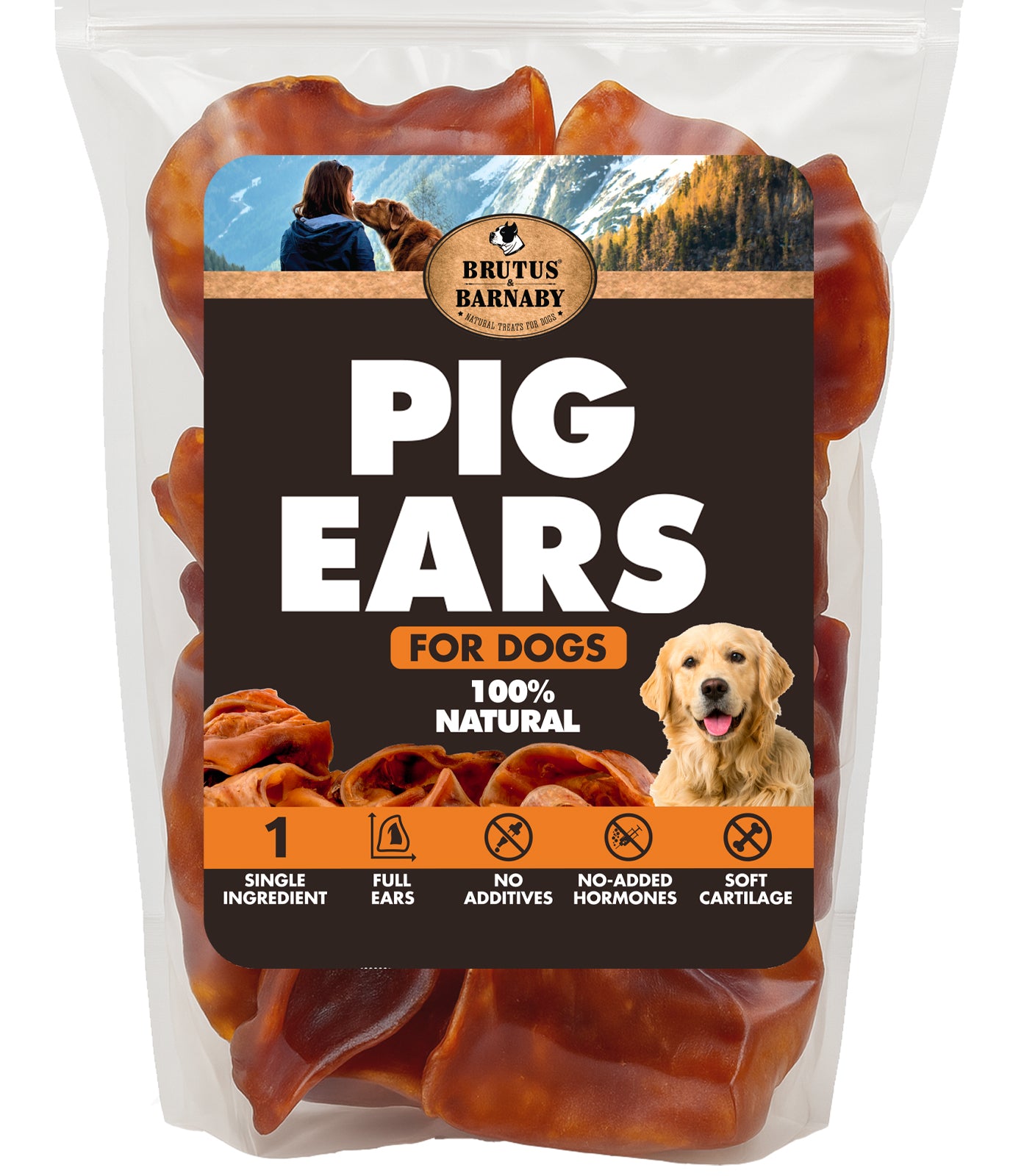
Pig Ears for Dogs | Natural Rawhide-Free Chews
A whole-ear format for supervised chew sessions when a larger starting piece is appropriate for the individual dog.
When Half Pig Ears May Be the Better Fit
Pig ear halves remove one step: you begin with a pre-cut smaller format. That can be useful for small dogs, lighter chewers, dogs receiving a shorter supervised chew session, or households that prefer not to store a partly chewed whole ear. A half may also make portion planning more straightforward, but it is not an automatic serving size.
Important: “Half” describes the cut, not a universal portion. Natural pieces differ in weight, and the current whole-ear and half-ear products have different calorie values per ounce. Weigh the piece when calorie control matters.
A smaller planned starting piece
Smaller encourages swallowing

Pig Ear Halves for Dogs
A pre-cut half-ear format that may be practical for small dogs, lighter chewers, shorter sessions, or more controlled portion planning.
Five Factors That Matter More Than the Label
Use the package format as a starting point, then make the final decision based on the dog in front of you.
A Simple Size-Selection Test
The first session should be treated as an observation, not proof that the same format will always work.
Check the actual piece
Inspect the ear for size and condition, confirm the ingredient and calorie information on the current package, choose a quiet chewing area, provide water, and remove competing pets or children.
Watch the method, not the clock
A good match allows controlled holding and gnawing. End the session if the dog tries to gulp, breaks off a risky chunk, guards the chew, shows mouth pain, or reaches the planned portion.
The key question: Can your dog work this particular piece slowly while you remain in control of the session? If not, switch size, change the setup, or choose another activity.
Size Does Not Replace Portion Control
The World Small Animal Veterinary Association's guide to dog treats recommends that treats make up no more than 10% of a dog's daily calories, with the dog's veterinary healthcare team helping determine individual energy needs. That limit includes pig ears, training rewards, toppers, table food, and every other extra combined.
Brutus & Barnaby currently lists 133.2 kcal per ounce for Whole Pig Ears and 121.9 kcal per ounce for Pig Ear Halves. Calories per individual piece are not listed. For accurate planning, weigh the amount offered instead of counting “one ear” or “one half.”
Need the math? See the Brutus & Barnaby guide to pig ear calories, portions, and weight control. It explains how to calculate a portion from the current calories-per-ounce or calories-per-kilogram listing without inventing a standard per-ear value.
Safety Rules for Both Sizes
Whole and half pig ears share the same core precautions. A smaller piece is not safer if it encourages swallowing, and a larger piece is not safer if the dog can tear off chunks quickly.
Keep the routine controlled
- Supervise from start to finish.
- Offer a manageable piece and remove swallowable remnants.
- Provide fresh water.
- Introduce pig ear gradually and monitor tolerance.
- Keep dogs separated if food guarding or competition is possible.
Know the warning signs
Stop the session if your dog coughs, gags, drools excessively, repeatedly tries to swallow, regurgitates, shows mouth pain, vomits, or becomes unusually tired.
Trouble breathing, collapse, blue or pale gums, or suspected choking requires immediate emergency veterinary care. The Merck Veterinary Manual lists gagging, excessive salivation, difficulty swallowing, regurgitation, and repeated swallowing attempts among signs of an esophageal foreign body.
Food-handling reminder: Animal-based treats can carry microorganisms. The FDA's pig-ear guidance advises monitoring pets, picking up the treat after the session, keeping it away from small children, cleaning contacted areas, and washing hands after handling.
For a separate discussion of session length, read How Long Should a Dog Chew a Pig Ear?
Sources for Treat Portions, Handling, and Emergencies
Whole vs. Half Pig Ears: Common Questions
Are half pig ears better for small dogs?
They can be a more practical starting format for a small dog, but they are not automatically suitable. Check the actual piece against the dog's mouth size and chewing behavior. If the dog can swallow it with little chewing, choose a larger manageable piece or a different supervised activity.
Should large dogs always get whole pig ears?
No. A large dog that gulps or tears off chunks may not manage a whole ear safely. A half may fit the planned portion better, but a smaller piece can also be swallowed more easily. Base the choice on observed chewing behavior, portion needs, and veterinary guidance—not body size alone.
Does a whole pig ear last twice as long as a half?
Not necessarily. Natural ears vary in thickness and weight, and dogs vary in bite strength and technique. A larger starting piece may last longer for the same dog, but “twice as long” cannot be assumed.
Is one pig ear half exactly half the calories of a whole ear?
No. Individual ears differ in weight, and the current Brutus & Barnaby products list different calorie densities: 133.2 kcal per ounce for Whole Pig Ears and 121.9 kcal per ounce for Pig Ear Halves. Weigh the portion and use the current package value.
Can I cut a whole pig ear into smaller portions?
The current Whole Pig Ears page says the product may be broken into smaller manageable pieces. However, do not create sharp or tiny fragments, and do not assume a home-cut piece will match the size or analysis of the separately sold Pig Ear Halves. When in doubt, use the pre-cut format or contact the manufacturer.
Can puppies have whole or half pig ears?
Puppies differ in tooth development, chewing skill, size, and nutritional needs. Ask your veterinarian before introducing pig ears, choose a piece the puppy cannot swallow whole, supervise continuously, and keep all treats within the puppy's balanced growth plan.
Which size is better for a senior dog?
There is no universal senior-dog size. A half may reduce the starting portion, but dental disease, missing teeth, swallowing changes, digestive conditions, and calorie needs matter more. Ask your veterinarian to assess whether pig ears are appropriate before choosing either format.
When should I take a pig ear away?
Remove it when the remaining piece could be swallowed, the planned portion or session is complete, the dog begins gulping, or you notice coughing, gagging, repeated swallowing, mouth pain, vomiting, guarding, or another concerning change. Breathing difficulty or suspected choking is an emergency.
Choose the Format Your Dog Can Manage Calmly
Whole pig ears provide a larger starting format. Halves provide a pre-cut smaller format. Neither is automatically right based only on breed or weight.
Match the actual piece to the actual dog, then supervise every minute and remove it before it becomes swallowable.
Start With the Size That Fits Your Plan
Review the current product details, calorie information, and count options before choosing whole pig ears or a smaller pre-cut half-ear format.
Disclaimer: This article provides general educational information and is not veterinary or nutritional advice. Every dog is different. Pig-ear suitability depends on age, size, diet, health, dental condition, pork tolerance, eating behavior, and calorie needs. Treats should not replace a complete and balanced diet. Introduce new treats gradually, use manageable portions, provide fresh water, practice safe food handling, and supervise every chewing session. Stop feeding and contact your veterinarian if your dog develops vomiting, diarrhea, appetite changes, unusual tiredness, mouth pain, gagging, repeated swallowing, or another concerning reaction. Seek emergency veterinary care for breathing difficulty, collapse, blue or pale gums, or suspected choking. Product ingredients, analyses, counts, packaging, and availability may change; review the current product page and package before feeding.