



Pig Ear Calories for Dogs: Portions, Frequency & Weight Control
Learn how to calculate the calories in your dog’s pig-ear portion, fit richer chews into the daily treat budget, and make better choices for weight control without relying on an unreliable “ears per week” rule.
Understanding pig ear calories for dogs is difficult if you only count whole ears. Pig ears naturally vary in thickness, shape, and weight, so one ear may not provide the same number of calories as another. The more accurate approach is to use the product’s calories per ounce or kilogram, weigh the portion, and count it alongside every other treat, topper, and chew your dog receives.
Quick Answer
Brutus & Barnaby’s current whole Pig Ears page lists 133.2 kcal per ounce, or 4,700 kcal per kilogram. Pig Ear Halves list 121.9 kcal per ounce, or 4,300 kcal per kilogram. Calories per individual ear or half are not currently listed, so weigh the intended portion instead of estimating by piece count. Treats should generally remain within 10% of the dog’s veterinarian-appropriate daily calorie target.
Why Pig Ear Calories Vary From One Ear to Another
Pig ears are natural chews rather than uniformly molded treats. A broad, thick ear can weigh considerably more than a smaller or thinner one. Even pieces sold in the same count-based package may therefore contribute different calorie totals.
Natural size variation
The length, width, thickness, and amount of cartilage differ between ears. Piece count alone does not reveal the edible weight.
Calories are listed by weight
Brutus & Barnaby lists energy per ounce and kilogram. That provides a reliable calculation method without inventing a per-ear estimate.
Fat affects calorie density
The current whole-ear analysis lists 23.6% crude fat. This is one reason pig ears should be treated as a richer chew rather than a calorie-free activity.
How to Calculate Pig Ear Calories for Dogs
A small digital kitchen scale that measures grams is the simplest tool. Weigh the portion your dog will actually receive before offering it.
The 4.7 figure comes from the listed 4,700 kcal per kilogram. Because one kilogram contains 1,000 grams, the product supplies approximately 4.7 kcal per gram.
| Measured portion | Calculation | Estimated calories |
|---|---|---|
| 5 grams | 5 × 4.7 | 23.5 kcal |
| 10 grams | 10 × 4.7 | 47 kcal |
| 15 grams | 15 × 4.7 | 70.5 kcal |
| 20 grams | 20 × 4.7 | 94 kcal |
| 0.5 ounce | 0.5 × 133.2 | 66.6 kcal |
| 1 ounce | 1 × 133.2 | 133.2 kcal |
These are mathematical examples based on the currently listed energy value—not suggested serving sizes. Your dog’s suitable portion may be smaller, and the appropriate calorie target should come from your veterinarian, particularly during weight loss.
Calculating Pig Ear Halves
The Pig Ear Halves page lists 4,300 kcal per kilogram, equal to approximately 4.3 kcal per gram. A 10-gram piece would therefore provide about 43 kcal. Do not assume every half weighs 10 grams; place the actual piece on a scale.
Fit the Portion Into Your Dog’s Treat-Calorie Budget
Veterinary nutrition guidance commonly recommends keeping treats and other extras at no more than about 10% of total daily calories. The remaining calories should come from complete and balanced food. VCA notes that aiming below the maximum can provide additional room for control.
| Daily calorie target | Maximum 10% treat budget | What this means for pig ears |
|---|---|---|
| 400 kcal | 40 kcal | About 8.5 grams of the whole-ear product would use the entire budget. |
| 600 kcal | 60 kcal | About 12.8 grams would use the entire budget. |
| 1,000 kcal | 100 kcal | About 21.3 grams would use the entire budget. |
These daily calorie targets are examples, not weight-based feeding recommendations. Two dogs of the same weight can have different needs because of age, body condition, activity, neuter status, health, and metabolism.
How Often Can Dogs Have Pig Ears?
There is no accurate universal answer such as one ear every day or two ears per week. Frequency should follow the calories in the portion, your dog’s tolerance, and everything else consumed that day.
Small dogs
A whole ear may exceed the day’s treat allowance. A weighed smaller portion or pig-ear half can make calorie tracking more manageable.
Medium and large dogs
A larger calorie allowance does not automatically make a whole ear appropriate. Weigh it, include other rewards, and watch for gulping.
Dogs managing weight
Use the calorie target established for weight loss—not the calories previously maintaining the higher weight—and confirm the treat allowance with the veterinarian.
If the selected portion fits within that day’s treat budget and your dog tolerates it, it may be used as an occasional supervised chew. If it consumes the entire budget, skip other treats and toppers that day. If it exceeds the budget, choose a smaller portion rather than “banking” several days of treat calories.
A Six-Step Pig Ear Portion Routine
- Confirm daily calories. Use your veterinarian’s target when available. Feeding-chart amounts are starting points and may not match an individual dog.
- Calculate the treat limit. Multiply the daily target by 0.10 to find the maximum 10% allowance. Your veterinarian may recommend less.
- Count every extra. Include training rewards, dental treats, table food, toppers, supplements with calories, and other chews.
- Weigh the pig-ear portion. Multiply whole-ear grams by 4.7 or Pig Ear Halves grams by 4.3.
- Choose frequency from the result. Offer only a portion that fits the day’s remaining treat calories and supervise the entire session.
- Monitor the outcome. Track weight and body condition consistently. Contact your veterinarian if weight is rising, falling unexpectedly, or not responding to the plan.
Whole Pig Ears vs. Pig Ear Halves
Both current Brutus & Barnaby options are single-ingredient pork chews, but their listed analyses and portion formats differ.
| Product | Listed energy | Listed crude fat | Per-piece calories | Practical difference |
|---|---|---|---|---|
| Pig Ears for Dogs | 133.2 kcal/oz 4,700 kcal/kg |
23.6% | Not currently listed | Whole-ear format for an appropriately sized, supervised chew session. |
| Pig Ear Halves for Dogs | 121.9 kcal/oz 4,300 kcal/kg |
17.0% | Not currently listed | Smaller format that can simplify portion planning, especially for shorter sessions. |
The halves have a lower listed calorie value per ounce than the whole-ear product, but that does not guarantee that every individual half contains fewer calories than every whole-ear portion. Actual piece weight still matters.
Pig Ear Safety: When to Stop and Call a Veterinarian
Pig ears should always be offered under direct supervision. Select a chew that cannot be swallowed whole, provide fresh water, and remove fragments that become small enough to gulp.
Stop giving the chew
- Your dog repeatedly tries to swallow large pieces.
- Vomiting, diarrhea, excessive gas, or discomfort develops.
- Itching, hives, facial swelling, or another possible pork reaction appears.
- The chew causes gum bleeding, tooth pain, or reluctance to eat.
- Your dog becomes possessive in a way that creates a safety risk.
Seek urgent veterinary help
- Difficulty breathing, blue or pale gums, collapse, or unresolved choking signs.
- Persistent vomiting, marked lethargy, loss of appetite, or obvious abdominal pain.
- A large piece was swallowed and your dog develops gagging, retching, pain, or cannot keep food or water down.
- Facial swelling or breathing difficulty suggests a severe allergic reaction.
Dogs that need veterinary guidance first
Ask your veterinarian before offering pig ears to dogs with a history of pancreatitis, prescribed fat restriction, obesity under treatment, chronic digestive symptoms, pork allergy, previous gastrointestinal obstruction, swallowing problems, severe dental disease, or a prescription diet. Puppies and seniors also require extra attention to calorie needs, teeth, and chewing behavior.
Brutus & Barnaby Pig Ear Options
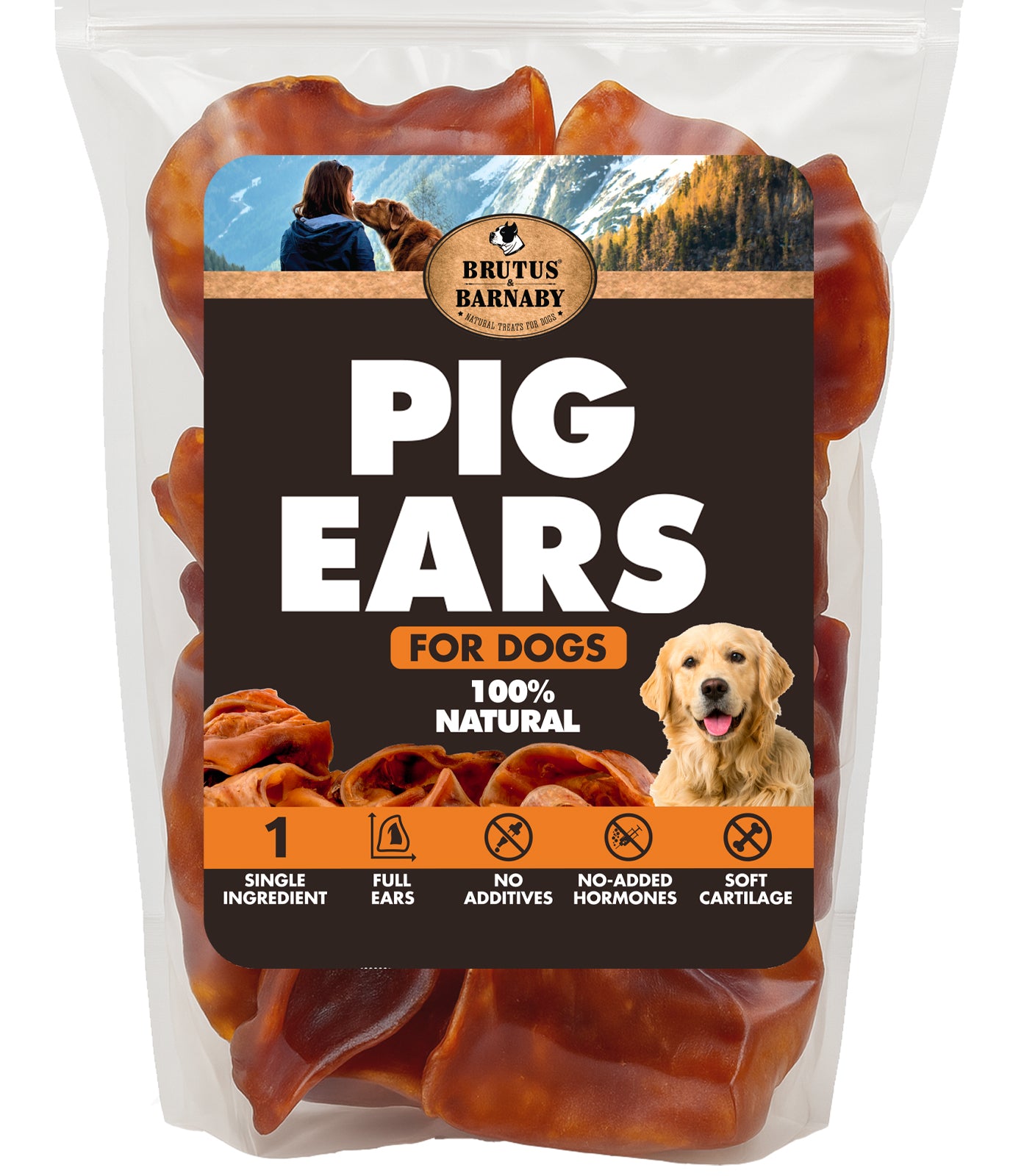
Pig Ears for Dogs | Natural Rawhide-Free Chews
A whole-ear, single-ingredient pork chew intended for supervised treat time.
- Ingredient: 100% pig ear
- 133.2 kcal per ounce
- 67.5% crude protein and 23.6% crude fat
- Current page lists 12-, 25-, and 100-piece options

Pig Ear Halves for Dogs | Easy-to-Chew Fully Digestible Treats
A smaller single-ingredient pig-ear format for shorter, supervised chew sessions.
- Ingredient: 100% pig ears
- 121.9 kcal per ounce
- 71.3% crude protein and 17.0% crude fat
- Current page lists 15-, 40-, and 100-count options
Related Brutus & Barnaby Guides
Trusted Reading
Frequently Asked Questions
How many calories are in one pig ear for dogs?
Brutus & Barnaby currently lists 133.2 kcal per ounce for its whole Pig Ears, but it does not list a standard number of calories per individual ear. Because natural ears vary in weight, weigh the actual ear or portion and multiply its gram weight by 4.7.
Are pig ears high in calories?
They can contribute a substantial number of treat calories. A half-ounce of the current whole-ear product supplies approximately 66.6 kcal. Whether that is “high” for your dog depends on the dog’s daily calorie target and remaining treat allowance.
Can dogs have a pig ear every day?
A whole pig ear will not fit every dog’s daily treat budget. Daily use may also be unsuitable for dogs that do not tolerate richer chews. Calculate the portion first and ask your veterinarian about frequency if your dog is overweight, fat-restricted, or has digestive problems.
How much pig ear should a small dog have?
There is no single portion for all small dogs. Establish the dog’s daily calorie target, calculate the maximum treat calories, and weigh a portion that fits. A pig-ear half is smaller in format, but it must still be weighed.
Do pig ears cause weight gain?
No single treat automatically causes weight gain, but regularly consuming more total calories than the dog uses can. Pig-ear calories must be included with meals, training treats, chews, toppers, and table food.
Are pig-ear halves lower in calories?
The current Pig Ear Halves product lists 121.9 kcal per ounce compared with 133.2 kcal per ounce for the whole-ear product. The calories in an individual piece still depend on its weight, so “half an ear” does not automatically equal half the calories of another ear.
Can an overweight dog have pig ears?
Possibly, but the portion must fit the veterinarian’s weight-loss calorie plan. Ask before using pig ears if the dog is on a prescription diet or strict fat restriction. Smaller measured portions may be more practical than a full ear.
Can puppies have pig ears?
Puppies require age-appropriate treats that protect balanced growth nutrition and suit their developing teeth and chewing skills. Ask your veterinarian before introducing pig ears, supervise closely, and never offer a piece the puppy could swallow whole.
Final Takeaway
Pig ear calories for dogs are best calculated by weight, not by counting ears. Brutus & Barnaby whole Pig Ears currently provide 133.2 kcal per ounce, while Pig Ear Halves list 121.9 kcal per ounce. Weigh the intended portion, keep all extras within the dog’s treat-calorie budget, and select frequency based on individual calorie needs, tolerance, and veterinary guidance.
Whatever portion you choose, stay nearby, remove swallowable fragments, introduce the chew gradually, and stop if digestive, allergic, dental, or choking concerns appear.
Choose the Right Pig Ear Portion
Compare whole pig ears and smaller pig-ear halves for your dog’s supervised chew routine.
Shop Pig Ear Treats