



Beef Lung Treat Guide
Beef Lung Dog Treats: Benefits, Calories & Safe Serving Sizes
Understand what beef lung treats provide, how their calories add up, and how to calculate a sensible portion for your individual dog.
Beef lung dog treats feel light and airy, so it can be easy to underestimate how quickly several pieces add up. Dog owners also need to know whether beef lung is appropriate for their dog, how large each reward should be, and whether a crunchy organ treat can fit into an otherwise complete diet. The answer depends less on a universal number of pieces and more on the product’s calorie density, your dog’s total daily calorie plan, every other extra being fed, and how your dog handles the texture.
How much beef lung can a dog have?
Beef lung dog treats can be used as supplemental rewards when your dog tolerates beef and the amount fits the dog’s total diet. Veterinary nutrition guidance generally recommends keeping all treats, chews, toppers, table food, and other extras below 10% of daily calories.
Brutus & Barnaby Beef Lung Bites currently list 119.1 kcal per ounce, equivalent to 4.2 kcal per gram. Calories per individual bite are not currently listed, and pieces can vary in size. Weighing the planned portion is therefore more reliable than assuming every bite contains the same number of calories. The current Beef Lung Filets page does not list calorie information, so its serving should not be calculated using the Bites value.
What Are Beef Lung Dog Treats?
Beef lung treats are made from lung tissue that has been processed into a dry, crunchy format. Their airy structure can produce small bites, larger breakable filets, and crumbs of different sizes. They are treats—not complete and balanced dog food—and should not replace the primary diet.
The live Brutus & Barnaby pages currently list 100% beef lung as the ingredient for both Beef Lung Bites and Beef Lung Filets. A single declared ingredient makes the protein source easier to identify, but it does not mean the product is appropriate for every dog. Beef lung is still beef and should not be used when a veterinarian has instructed you to avoid beef.
Practical Benefits of Beef Lung Dog Treats
The most supportable benefits are based on the verified ingredient, guaranteed analysis, and physical format—not promises that beef lung will prevent or treat a health condition.
Clear declared protein source
A 100% beef lung ingredient statement makes it easier to recognize that the treat introduces beef. This can simplify label checking for dogs whose existing diet already allows beef.
Verified high protein analysis
The current Beef Lung Bites page lists crude protein at a minimum of 66.0%. That describes the treat’s guaranteed analysis, but it does not turn the treat into a complete meal.
Adaptable reward sizes
Bites can be checked and broken smaller when necessary. Filets begin as larger pieces that can be divided before training, allowing the handler to prepare different reward sizes.
Convenient for planned training
Dry pieces can be portioned into a treat pouch before a walk or training session. Pre-measuring the session amount helps prevent repeated, uncounted handfuls from the main bag.
How Many Calories Are in Beef Lung Dog Treats?
The current Brutus & Barnaby Beef Lung Bites page lists metabolizable energy at 4,200 kcal/kg and 119.1 kcal/oz. Dividing 4,200 kcal by 1,000 grams gives a calorie density of 4.2 kcal per gram.
4,200 kcal ÷ 1,000 g = 4.2 kcal per gram
Calories per bite are not currently listed. Because natural pieces can differ in weight, saying that every bite contains a fixed number of calories would be inaccurate. A digital kitchen scale that measures grams provides a more consistent estimate.
| Detail | Beef Lung Bites | Beef Lung Filets |
|---|---|---|
| Declared ingredient | 100% USA beef lung | 100% beef lung |
| Current sizes | 6 oz, 12 oz and 32 oz | 8 oz, 12 oz, 16 oz and 32 oz |
| Crude protein | Minimum 66.0% | Product page states over 60%; a full guaranteed analysis is not currently listed |
| Crude fat | Minimum 20.4% | Not currently listed |
| Crude fiber | Maximum 4.5% | Not currently listed |
| Moisture | Maximum 5.8% | Not currently listed |
| Calories | 4,200 kcal/kg; 119.1 kcal/oz; 4.2 kcal/g | Not currently listed |
| Portion method | Weigh in grams or calculate from total ounces used | Follow current packaging and request calorie information if needed |
How to Calculate a Sensible Beef Lung Serving Size
A useful serving calculation begins with your dog’s established daily calorie allowance—not weight alone. Age, activity, reproductive status, body condition, health, and weight goals can change energy needs. If you do not know your dog’s appropriate calorie target, ask your veterinarian.
-
Find the dog’s total daily calorie plan
Use the amount provided by your veterinarian or a current feeding plan that maintains the dog’s ideal body condition. Do not use the number printed on a food bag as proof that the same amount fits every dog.
-
Calculate the allowance for all extras
Multiply daily calories by 0.10 to find the commonly recommended maximum for all treats and extras combined. This is a ceiling, not a target that must be reached.
-
Subtract every other extra
Include training treats, dental products, chews, toppers, table scraps, puzzle food, and foods used to give medication. Beef lung only receives what remains in the combined allowance.
-
Convert the remaining calories to grams
For the current Beef Lung Bites only, divide the remaining calories by 4.2 kcal/g. Weigh that amount, break pieces as needed, and round down rather than exceeding the planned allowance.
Remaining treat calories ÷ 4.2 kcal/g = maximum grams of Beef Lung Bites
Worked example
Suppose a veterinarian-approved plan provides 400 kcal per day. Ten percent is 40 kcal for all extras. If the dog already receives 15 kcal from another reward, 25 kcal remain. Dividing 25 by 4.2 gives approximately 5.9 grams of Beef Lung Bites. Rounding down to about 5 grams would contribute approximately 21 kcal.
This is a math example, not a universal prescription for every dog consuming 400 kcal. A veterinarian may recommend a smaller treat allowance because of weight management, disease, a prescription diet, or the dog’s nutritional history.
| Established daily calorie plan | 10% maximum for all extras | Approximate Beef Lung Bites amount |
|---|---|---|
| 200 kcal | 20 kcal | Up to about 4.7 g |
| 400 kcal | 40 kcal | Up to about 9.5 g |
| 600 kcal | 60 kcal | Up to about 14.2 g |
| 800 kcal | 80 kcal | Up to about 19 g |
These figures are calorie ceilings, not recommended starting portions. They assume no other treats or extras are being fed. Start with less when introducing the product and subtract other extras before calculating the beef lung amount.
Bites or Filets: Which Format Helps With Portion Control?
Choose Bites for quick rewards
Beef Lung Bites begin as smaller pieces and reduce preparation for walks or frequent training repetitions. Inspect them before use because natural piece sizes can vary, and break larger pieces when necessary.
Choose Filets for custom pieces
Beef Lung Filets begin as larger, breakable sections. They allow you to prepare different reward sizes, but their calories are not currently listed. Do not apply the Bites calorie value to Filets without equivalent product data.
Neither format is automatically better, safer, lower-calorie, or more digestible. The useful choice is the one that helps you prepare manageable pieces, control the full session amount, and match your dog’s eating style.
Five Steps for Serving Beef Lung Responsibly
-
Confirm that beef fits the diet
Avoid beef lung if your veterinarian has diagnosed a beef allergy, excluded beef during a diet trial, or prescribed a diet that does not allow outside treats.
-
Introduce one small piece
Keep the rest of the diet familiar so it is easier to notice a change in stool, appetite, skin, ears, or behavior.
-
Prepare the full session allowance
Weigh or portion the treats before training. Close the main package instead of repeatedly reaching into it throughout the activity.
-
Match pieces to the individual dog
Break oversized or awkward pieces and watch how the dog handles the texture. Dogs that gulp food, have missing teeth, or have swallowing difficulties require extra caution and may need a different reward.
-
Supervise and provide fresh water
Stay close enough to respond to coughing, gagging, rapid swallowing, or distress. Remove small fragments if they create a problem for your dog.
Beef Lung Safety: When to Stop and Call a Veterinarian
Stop offering the treat if your dog develops a concerning reaction or cannot manage the pieces comfortably. Do not keep testing the product to see whether recurring symptoms disappear.
Stop the treat and request veterinary advice
- Repeated vomiting, diarrhea, appetite loss, or abdominal discomfort
- Recurring itching, inflamed skin, ear problems, hives, or facial swelling
- Coughing, gagging, regurgitation, or repeated difficulty swallowing
- Constipation, straining, lethargy, or a meaningful behavior change
- Symptoms that continue, return, or become worse after the treat is stopped
Seek urgent veterinary care
- Difficulty breathing, blue or very pale gums, collapse, or loss of responsiveness
- Severe or persistent choking and gagging
- Repeated unproductive retching or a swollen, hard, or painful abdomen
- Suspected obstruction accompanied by vomiting, pain, appetite loss, or lethargy
Dogs that need individual guidance first
Ask your veterinarian before feeding beef lung to a dog with a diagnosed beef allergy, prescription or elimination diet, chronic digestive symptoms, previous gastrointestinal obstruction, pancreatitis or pancreatitis risk, swallowing or esophageal problems, kidney or liver disease, obesity, or another condition requiring controlled fat, protein, calories, or ingredients. Puppies, seniors, and dogs with dental limitations may also need customized piece sizes and allowances.
Brutus & Barnaby Beef Lung Treats
Choose according to the format you can portion most responsibly. Review the current product page and package before feeding because ingredients, sizes, analysis, availability, and packaging can change.
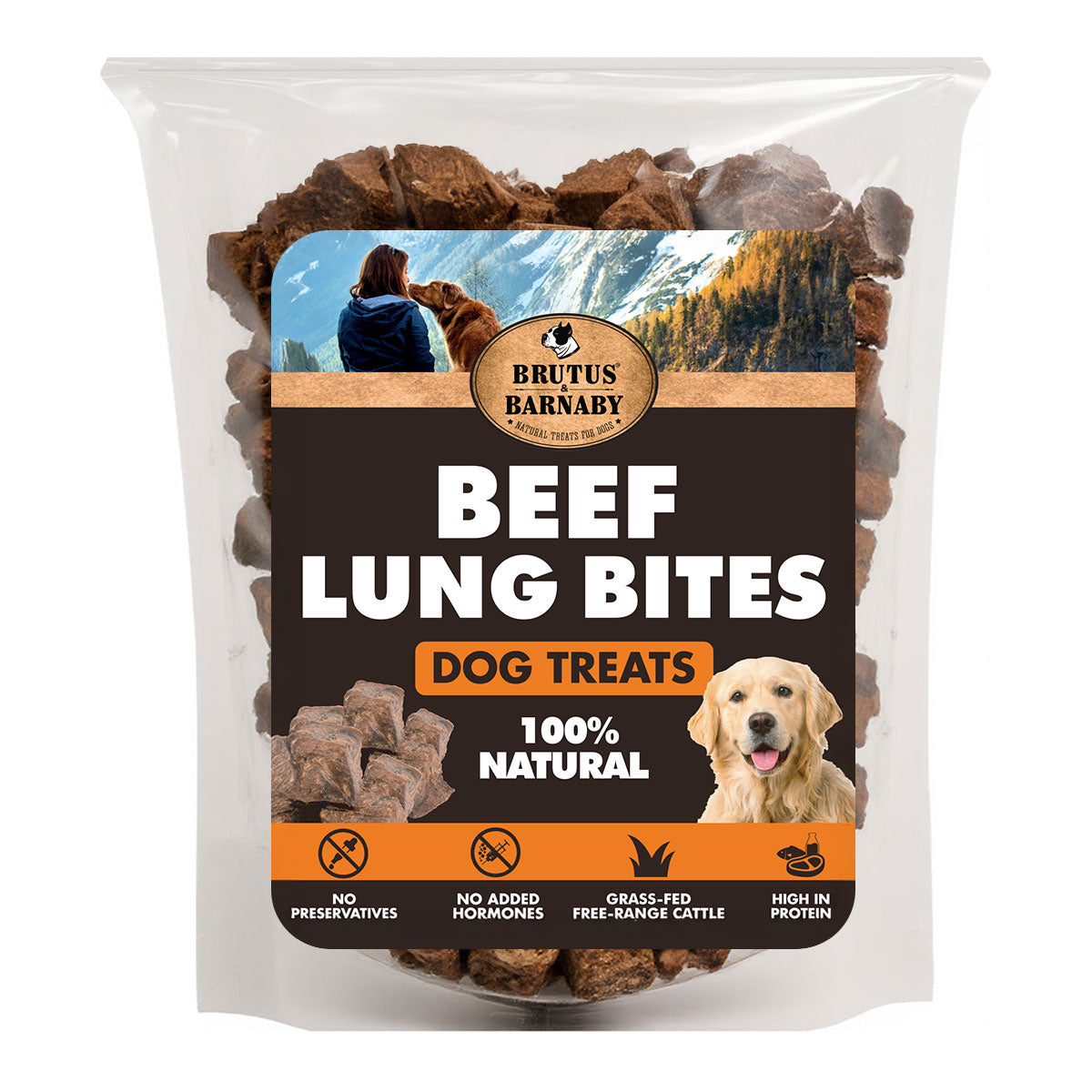
Beef Lung Bites for Dogs | High-Protein Crunchy Training Treats
Smaller crunchy pieces for planned training rewards when beef fits the dog’s diet.
- Ingredient: 100% USA beef lung
- Current sizes: 6 oz, 12 oz and 32 oz
- Crude protein: minimum 66.0%
- 119.1 kcal/oz; 4.2 kcal/g

Beef Lung Filets for Dogs | High-Protein Crunchy Training Treats
Larger beef lung pieces that can be broken into custom portions before training or supervised treating.
- Ingredient: 100% beef lung
- Current sizes: 8 oz, 12 oz, 16 oz and 32 oz
- Product page states over 60% protein
- Calorie content is not currently listed
Trusted Reading
Use veterinary nutrition and emergency resources when deciding how treats fit into your dog’s diet or responding to concerning symptoms.
WSAVA Guide to Feeding Treats
Owner guidance covering daily treat calories and the importance of an individualized energy requirement.
Read the WSAVA guideVCA Treat-Calorie Guidance
Explains why treats should remain a limited part of total daily calorie intake.
Read the VCA guidanceMerck Veterinary Manual
Reviews feeding practices and why most treats should remain below 10% of total calories.
Read the Merck manualVCA Foreign-Body Guidance
Lists signs associated with a possible gastrointestinal foreign body or obstruction.
Read the VCA articleRelated Brutus & Barnaby Guides
Frequently Asked Questions
Are beef lung treats good for dogs?
Beef lung can be a useful supplemental reward for a dog that tolerates beef. The current Brutus & Barnaby Bites list one ingredient and 66.0% minimum crude protein. Suitability still depends on the dog’s complete diet, health, calorie needs, and response to the product.
How many beef lung treats can I give my dog?
There is no accurate universal number because pieces and dogs vary. Establish the dog’s daily calorie plan, reserve no more than the approved allowance for all extras, subtract other treats, and divide the remaining calories by 4.2 kcal/g for the current Beef Lung Bites. Calories per bite are not currently listed.
Are beef lung dog treats low calorie?
Do not assume that from their airy texture. Beef Lung Bites currently contain 119.1 kcal per ounce. Whether a portion is modest depends on its weight and the dog’s daily calorie requirement. Comparable calorie information for Beef Lung Filets is not currently listed.
Can dogs eat beef lung treats every day?
Some dogs may tolerate a planned daily amount, but everyday use must still fit the combined treat allowance and the dog’s health plan. Daily feeding is not appropriate when beef is excluded or a veterinarian has restricted outside treats.
Can puppies have beef lung treats?
The product format can be broken into smaller pieces, but puppies have important growth-related nutritional needs and small calorie allowances. Use an age-appropriate piece, keep treats limited, supervise closely, and ask your veterinarian if the puppy is very young or has dietary or digestive concerns.
Can a dog with a beef allergy eat beef lung?
Beef lung is beef. Do not give it to a dog with a diagnosed beef allergy or during a veterinary elimination trial that excludes beef unless the treating veterinarian specifically approves it.
Can beef lung treats cause diarrhea?
A new food or an excessive amount can be associated with digestive upset in some dogs. Stop the treat if vomiting or diarrhea occurs. Request veterinary advice when symptoms are severe, persistent, recurring, accompanied by pain or lethargy, or involve a medically vulnerable dog.
Is beef lung better than beef liver for training?
Beef lung is usually more convenient as a physical training reward because it comes in bites or breakable filets. The current Brutus & Barnaby Beef Liver product is a powdered food topper intended for measured use over meals. Neither ingredient is universally better for every dog.
Final Takeaway
Beef lung dog treats can provide a single-ingredient, high-protein reward in a convenient crunchy format—but portion control still matters. Beef Lung Bites currently contain 119.1 kcal per ounce, or 4.2 kcal per gram, while per-bite calories are not listed. Calculate the allowance from your dog’s established daily calorie plan, subtract every other extra, weigh the portion, start small, and supervise.
Do not use the Bites calorie value for Beef Lung Filets because comparable calorie information is not currently listed. When allergies, chronic symptoms, weight concerns, pancreatitis risk, swallowing problems, prescription diets, or previous obstruction are involved, obtain veterinary guidance before feeding.
Find the Beef Lung Format That Fits Your Routine
Compare ready-to-use bites and larger breakable treats, then choose a format you can portion and supervise responsibly.
Shop Lung Treats for Dogs