



How Small Should Training Treats Be? A Practical Size Guide
The best training reward is usually much smaller than an everyday snack. Here is how to choose a size that keeps your dog focused without letting the treats take over the session.
Your dog does not need a bigger payment for every correct behavior. During training, several tiny rewards are often more useful than one large treat that takes too long to eat.
Most training treats should be around pea-sized or smaller.
The ideal training treat is the smallest piece your dog can notice, eat quickly, and still find rewarding. For many dogs, that means a pea-sized piece or smaller. Small dogs may need even tinier pieces.
The goal is not to make the reward insignificant. The goal is to keep the session moving so your dog can eat the treat and immediately be ready for the next repetition.
Why Are Training Treats Supposed to Be So Small?
Training is different from ordinary snack time.
During one practice session, you may reward a dog many times for check-ins, recall, loose-leash walking, sitting calmly, entering a crate, or learning a new cue. If every reward is the size of an ordinary biscuit, the amount of food can build up quickly.
Reward and Continue
Your dog should be able to take the treat, finish it quickly, and return attention to the next repetition.
Reward and Wait
Oversized treats can turn every repetition into a chewing break and make it easier for the session to lose momentum.
Humane World for Animals recommends very small training rewards — around pea-sized or even smaller for little dogs — so the dog can eat the reward quickly and return attention to the handler.
VCA guidance makes the same practical point: training rewards should be made as small as possible while still working for the individual dog.
What Does the Right Training Treat Size Actually Look Like?
There is no single measurement that fits every dog. A tiny puppy, a medium adult dog, and a Great Dane do not have identical mouths or calorie needs.
A useful starting rule is simple:
Smaller Than a Pea
Often useful for small dogs, puppies, very frequent repetitions, and treats that are already highly motivating.
Around Pea-Sized
A practical general starting point for many everyday dog training sessions.
Larger Than Needed
Better saved for occasional rewards or broken into several smaller training pieces.
The easiest test is to watch what happens after delivery. If your dog swallows the reward comfortably and immediately looks ready to continue, the size may be working well. If the dog stops to chew for several seconds, searches the floor for crumbs, or becomes full quickly, try a smaller piece.

Sweet Potato & Chicken Training Treats
Soft, bite-sized rewards designed for the kind of repeated delivery used during puppy training and everyday practice.
- Soft bites for quick eating
- Made for frequent rewards
- Useful for puppy training
- Easy to keep ready in a treat pouch
Should Small Dogs Get Smaller Training Treats?
Usually, yes.
A pea-sized piece that looks tiny next to a large dog can represent a much more meaningful portion for a very small dog. When the dog is receiving many rewards, those differences matter.
Start Smaller
Try pieces smaller than a pea when the treat can be divided cleanly and the dog can eat the piece comfortably.
Do Not Automatically Size Up
A large dog does not necessarily need a large treat for every correct behavior. Many large dogs still work happily for tiny rewards.
Think of the reward as information as well as food. The treat tells your dog, “Yes, that choice paid off.” A larger dog does not need a full cookie every time that message is delivered.
Should Large Dogs Get Bigger Training Treats?
Not simply because they are large.
The better question is whether the reward is still noticeable and motivating. If a large dog happily works for a pea-sized treat, making the piece bigger does not automatically improve the training.
For more help choosing the right reward type — not just the size — read our guide to the best dog training treats for faster learning .
Different Training Jobs May Need Different Reward Sizes
Not every training moment works exactly the same way. The size can change slightly depending on how many repetitions you expect and what the dog is being asked to do.
| Training Situation | Better Reward Approach | Why |
|---|---|---|
| Fast indoor repetitions | Very small pieces | Lets you reward repeatedly without long chewing pauses. |
| Puppy training | Tiny, easy-to-eat pieces | Puppies may receive many rewards while learning basic skills. |
| Loose-leash walking | Small pouch-friendly rewards | Makes frequent delivery easier without stopping the walk. |
| Recall practice | Several small high-value pieces | A short sequence of rewards can feel like a jackpot without requiring one giant treat. |
| Difficult distractions | Small but higher-value pieces | The reward may need to become more exciting, not necessarily much larger. |
| Calm end-of-session reward | A separate larger snack or chew | Longer chewing fits downtime better than repeated cue-and-reward practice. |
Why Oversized Training Treats Can Become a Problem
A treat does not have to be unhealthy to be too large for the job.
Large Rewards Can Make It Harder To...
- Complete many repetitions in a short session.
- Keep the dog focused between rewards.
- Control the total amount eaten during long practice sessions.
- Prevent a small dog from filling up quickly.
- Separate easy behaviors from true jackpot moments.
- Notice how much food has accumulated across the day.
This does not mean you should be afraid to reward your dog. Reward-based training relies on giving the dog something they value.
The goal is simply to make each individual food reward efficient.
The American Veterinary Society of Animal Behavior supports reward-based training methods. The size discussion is not about removing rewards; it is about making repeated food rewards easier to use well.
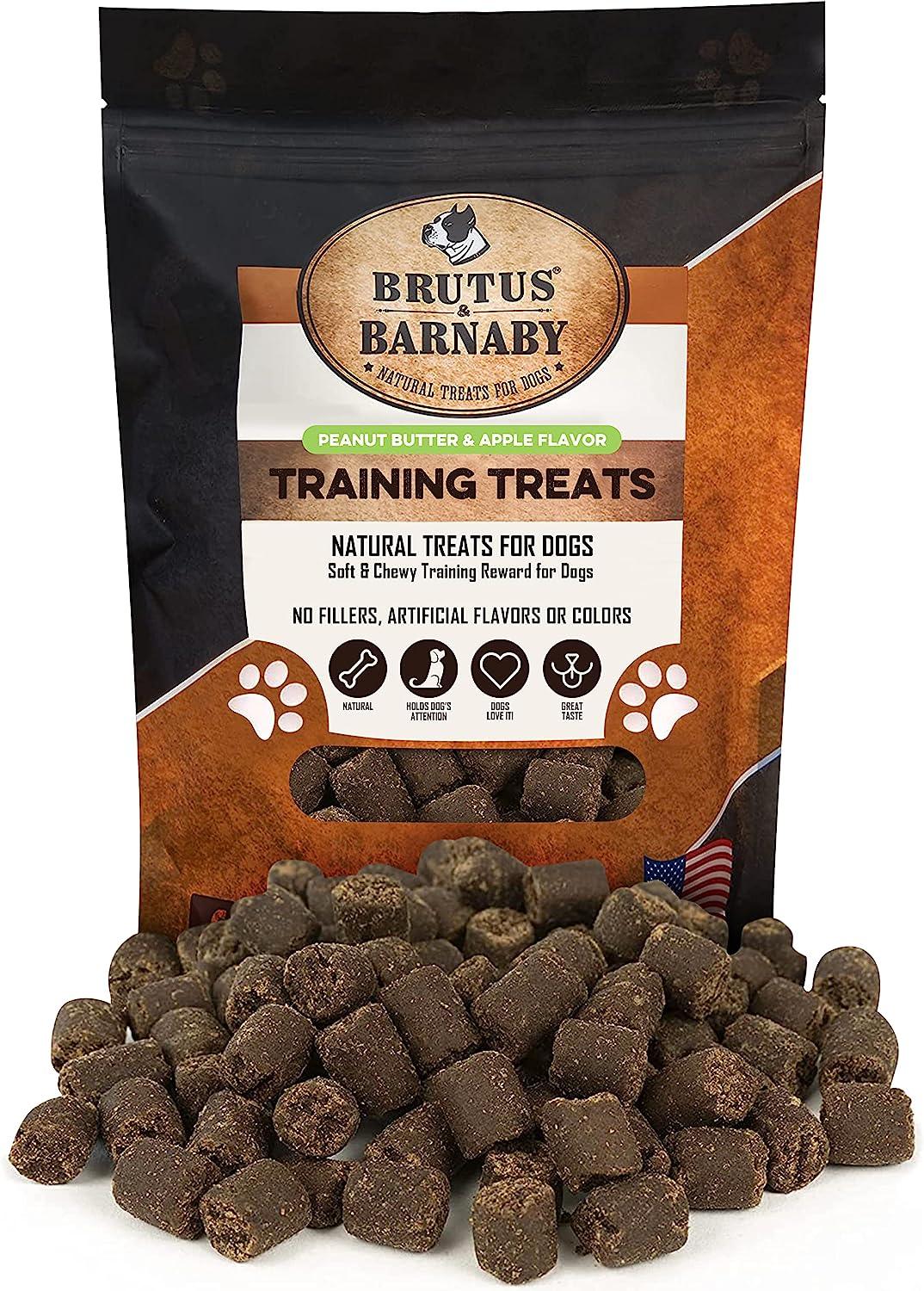
Peanut Butter & Apple Training Treats
Soft, quick rewards for daily practice when you need to reward often without handing over a full snack every time.
- Soft bite-sized pieces
- Designed for fast rewards
- Useful for puppy training
- Good for frequent reinforcement
How to Make Larger Treats Work for Training
You do not necessarily need to throw out a treat just because it is larger than pea-sized.
Many treats can be turned into better training rewards by changing how you prepare them.
Pinch or Break Smaller
Soft treats are often useful for repeated training because they can be divided without creating long chewing pauses.
Watch for Crumbs
If every reward breaks across the floor, your dog may spend more time searching than training.
Prepare Before the Session
Cut or tear portions before training instead of stopping to prepare every reward in the middle of a repetition.
Use Tiny Pieces Strategically
A highly motivating treat may still work when the actual piece is very small.
Before You Start a Training Session
- Prepare the reward pieces before calling your dog over.
- Put only the amount you plan to use into the treat pouch.
- Keep an extra high-value option for harder moments.
- Choose pieces your dog can eat without a long pause.
- Use praise, play, access, and other rewards when they are meaningful to your dog.
How Do You Know When a Training Treat Is Too Big?
Watch the session instead of measuring the treat endlessly.
How Many Tiny Training Treats Can a Dog Have?
Tiny does not mean unlimited.
Twenty tiny rewards may still fit easily into one dog's day, while the same number of richer or larger pieces may be too much for another dog.
The World Small Animal Veterinary Association recommends keeping treats below 10% of a dog's daily calorie intake. The rest of the diet should come primarily from complete and balanced food.
Think About Total Amount
Count training rewards alongside snacks, chews, toppers, and other extras given during the same day.
Counting Pieces Alone
Ten tiny pieces and ten large biscuits are not nutritionally equivalent simply because the number is the same.
For a deeper daily portion guide, read how many treats a dog can have in a day .
Can Training Treats Be Too Small?
Yes, but this is usually an individual handling issue rather than a universal measurement.
A reward may be impractically small when:
Consider Making the Reward Easier to Deliver If...
- Your dog cannot notice or find the reward.
- You repeatedly drop the pieces before delivery.
- The treat crumbles into dust inside the pouch.
- Your dog loses motivation even when the reward value is otherwise appropriate.
- The tiny piece is awkward to deliver safely during fast movement.
The goal is not to win a competition for the world's smallest treat. It is to find the smallest practical reward that still works well for you and your dog.
What About Puppies?
Puppies often receive many rewards because they are learning so much: name response, house training, crate skills, handling, recall, leash manners, and basic cues.
That makes small rewards especially useful.
Tiny and Quick
A puppy should not need to stop the entire session to work through every reward.
Short and Successful
Keep sessions manageable, reward the behavior you want, and stop before the puppy becomes overwhelmed or exhausted.
VCA puppy-training guidance recommends tiny, highly valued rewards and gives the size of a pencil eraser as a practical visual example.
What If Small Training Treats Cause Loose Poop?
Piece size is only one part of the picture.
A dog may still have digestive trouble when many small treats add up to too much total food, when a new ingredient is introduced quickly, or when richer rewards are used heavily during one session.
Our guide on loose poop after training treats explains the digestion side in more detail.
Do You Need to Use Food Forever?
Small treats are a useful training tool, but food does not need to be visible before every behavior for the rest of your dog's life.
Once a behavior is well learned, the reward schedule can change gradually. Praise, play, access to something the dog wants, and occasional food rewards can all become part of the routine.
Do not remove food suddenly while the dog is still learning. Read our guide to when and how to fade treats in training for a separate step-by-step explanation.
Helpful External Resources
These resources provide additional guidance on reward-based training, practical reward size, and daily treat limits.
Humane World for Animals — Positive Reinforcement Training Practical guidance on small, fast-to-eat food rewards. VCA Animal Hospitals — Choosing Training Treats Why smaller rewards can support focus and calorie control. AVSAB — Reward-Based Training Methods Veterinary behavior guidance on using rewards in humane training. WSAVA — Feeding Treats to Your Dog Daily calorie budgeting and healthy treating habits.Frequently Asked Questions
Should dog training treats be pea-sized?
Pea-sized or smaller is a useful general starting point for many dogs. The best size is the smallest practical piece your dog can notice, eat comfortably, and still find rewarding.
How small should puppy training treats be?
Puppy training treats should generally be tiny and easy to eat because puppies may receive many rewards while learning. VCA uses a pencil-eraser-sized reward as one practical visual example. Adjust for the individual puppy and treat.
Do large dogs need larger training treats?
Not necessarily. A large dog may still work happily for a pea-sized reward. Increase the reward value when needed before assuming every treat needs to become physically larger.
Can I break regular dog treats into training treats?
Yes, when the treat breaks cleanly into manageable pieces. Prepare the pieces before the session so you can reward quickly instead of stopping between repetitions.
How do I know if a training treat is too big?
Signs include long chewing pauses, frequent floor crumbs, becoming full quickly, and losing the rhythm of the session after every reward. Try a smaller piece and watch what changes.
Are soft or crunchy treats better for training?
Either can work, but the reward should be quick and practical. Soft treats are often convenient for repeated practice because they can be eaten quickly and may be easier to divide.
Should recall rewards be bigger?
They can be more valuable without being one huge piece. Several small high-value treats delivered one after another can create a strong jackpot reward.
How many tiny training treats can my dog have?
There is no universal number because treat size, calories, diet, body size, and health all matter. Count the total amount eaten and keep all treats within an appropriate daily allowance.
The Best Training Treat Is Small Enough to Keep the Learning Moving
You do not need to make every reward big to make it meaningful. In most training sessions, smaller pieces help your dog get rewarded quickly and become ready for the next success.
The right training treat should feel important to your dog without becoming the biggest part of the training session.
Keep the Treat Small and the Training Moving
Choose soft, bite-sized rewards made for repeated practice, puppy manners, walks, recall, and everyday reinforcement.