



How Often Can Dogs Have Collagen Sticks? Safe Feeding Guide
Learn how to set a sensible collagen-stick routine using your dog’s calorie budget, chewing behavior, digestion, age, and health—not an arbitrary number of sticks.
If your dog loves collagen sticks, it is natural to wonder whether they can have one every day. The difficulty is that “one stick” is not a nutritional serving size. Natural chews can vary in weight, dogs consume different amounts during a session, and a small dog and large dog do not have the same calorie allowance. The safest routine therefore depends on how much your dog actually eats—not simply how often you open the bag.
How often can dogs have collagen sticks?
There is no universal veterinary schedule for collagen sticks. For a healthy adult dog trying them for the first time, a conservative starting framework is one short, supervised session once or twice a week. This is general guidance, not a product-label direction or a rule for every dog.
Wait at least a day after the first introduction to check appetite, stool, vomiting, itching, and overall comfort. Future frequency should be based on the amount consumed, the dog’s response, and the total treat-calorie budget. Treats from all sources should generally remain within 10% of daily calories. A whole collagen stick every day should not be the automatic default.
A safe collagen-stick schedule starts with calories
A collagen stick is an edible treat, not a calorie-free toy. VCA Animal Hospitals and the UC Davis Veterinary Medical Teaching Hospital advise keeping treats and additional foods to no more than about 10% of a dog’s daily calorie intake. The other 90% or more should come from a complete and balanced diet.
The current Brutus & Barnaby Beef Collagen Sticks listing provides a metabolizable energy value of 3,900 kcal/kg, or 110.6 calories per ounce. Calories per individual stick are not currently listed. Because natural pieces can vary, count the weight your dog consumes instead of assuming every stick contains the same number of calories.
Practical formula: weigh the chew in grams before and after the session. Multiply the grams eaten by approximately 3.9 calories per gram. Subtract that amount from the day’s total allowance for all treats, toppers, table food, and chews.
| Daily calorie target | 10% for all treats | Approximate collagen amount if it were the only treat | What must be subtracted |
|---|---|---|---|
| 200 calories | 20 calories | About 5.1 grams | Training treats, toppers, chews, and table food |
| 400 calories | 40 calories | About 10.3 grams | Every additional food outside regular meals |
| 600 calories | 60 calories | About 15.4 grams | Other treats given that same day |
| 800 calories | 80 calories | About 20.5 grams | All snacks, chews, and food rewards |
| 1,000 calories | 100 calories | About 25.6 grams | The entire non-meal calorie total |
Your dog’s correct daily calorie target cannot be determined from body weight alone. Age, body condition, activity, neuter status, health, and weight goals all matter. Ask your veterinarian for a daily target when your dog is underweight, overweight, growing, highly active, or managing a medical condition.
What changes how often a dog can have collagen sticks?
Body size and calorie needs
A few grams can use much more of a small dog’s treat allowance than a large dog’s. Smaller calorie budgets usually require shorter sessions or less frequent chew days.
Amount actually swallowed
A calm dog may soften the end while consuming relatively little. Another dog may tear through layers quickly. These dogs should not receive the same schedule simply because they weigh the same.
Digestive tolerance
Loose stool, vomiting, gas, reduced appetite, or abdominal discomfort after a session means the routine needs to stop and be reassessed. More frequent exposure is not a way to force tolerance.
Chewing and swallowing style
Dogs that scrape and soften a chew deliberately may be easier to manage than dogs that crush, gulp, or detach large strips. A determined gulper may not be a suitable collagen-stick candidate.
Teeth and life stage
Puppies, seniors, and dogs with loose, worn, fractured, painful, or recently treated teeth need additional caution. Dense chews should not be used to test whether a painful mouth can cope.
Diet and medical history
Diagnosed beef allergies, prescription diets, previous obstruction, swallowing difficulty, chronic digestive symptoms, or pancreatitis risk require veterinary guidance before collagen sticks are offered.
A practical collagen-stick frequency guide
This table is a cautious decision framework for discussion with your veterinarian. It is not a guarantee that a collagen stick is appropriate for a particular dog.
| Dog or situation | Starting direction | What determines the next session |
|---|---|---|
| Healthy adult, first introduction | One brief supervised session, then wait at least 24 hours | Normal appetite, stool, skin, behavior, and comfortable chewing |
| Healthy adult with demonstrated tolerance | Once or twice weekly can be a conservative starting routine | Calories consumed, body condition, other treats, and chew behavior |
| Adult receiving several daily rewards | Use less frequent chew days or reduce other extras | The combined calorie total from every non-meal food |
| Small dog with a low calorie allowance | Favor a short session rather than expecting the whole chew to be eaten | Measured grams consumed and whether the chew remains too large to swallow |
| Fast eater, crusher, or gulper | Pause or avoid collagen sticks | A veterinarian-approved alternative and safer chewing behavior |
| Puppy, senior, or dog with dental concerns | Ask a veterinarian before introducing or continuing | Dental development, mouth health, chewing control, and digestion |
| Prescription diet or relevant medical history | Use only with veterinary approval | The dog’s individual nutrition and treatment plan |
Smaller portion does not have to mean a tiny starting piece. Offering a suitably oversized chew for a short session and then removing it can limit intake while keeping the object harder to swallow whole. Never create a small end piece that can disappear inside the mouth.
How to build a supervised collagen-stick routine
-
Confirm that the chew fits your dog
Consider mouth size, teeth, chewing style, beef tolerance, current diet, and medical history. The starting chew should not fit completely inside the dog’s mouth or be easy to position for a whole-piece swallow.
-
Calculate the total treat budget
Start with the daily calorie target supplied by your veterinarian or feeding plan. Reserve no more than about 10% for all extras combined—not 10% for collagen plus another allowance for training treats.
-
Weigh the dry chew
Record its weight in grams on a kitchen scale. This gives you a more useful baseline than counting sticks, especially when natural pieces differ in thickness and density.
-
Begin with a short observation session
Stay close enough to see whether your dog scrapes, softens, crushes, tears, or tries to gulp. Do not offer a first collagen stick when you are distracted, leaving home, or unable to intervene.
-
Pause and inspect the chew
Check for loosened layers, large softened flaps, brittle fragments, sharp areas, or an end that has become small enough to swallow. Remove the chew before those changes become dangerous.
-
Use a calm trade
Ask your dog to move away in exchange for another appropriate reward. Avoid chasing, cornering, or reaching suddenly into the mouth, particularly if your dog has shown guarding behavior.
-
Measure intake and monitor afterward
Reweigh the remaining chew when practical and calculate the amount consumed. Watch appetite, stool, vomiting, itching, energy, and comfort before deciding when—or whether—to offer another session.
Dogs do not need to finish a collagen stick
A chew session is not a challenge to reach the final bite. Ending while the chew is still substantial can be safer than waiting until the remaining end becomes easy to gulp. It also helps control calories for dogs that only have a small daily treat allowance.
How long a session should last cannot be decided by a universal timer. End it according to the chew’s condition, the dog’s technique, and the amount consumed. A powerful chewer may reach the stopping point quickly, while a methodical chewer may make little progress.
Before offering a previously chewed item again, inspect it carefully and follow any storage directions on the current package. Do not reuse a chew that smells spoiled, shows mold or contamination, has developed sharp or brittle areas, or contains loose pieces. If storage instructions are not currently listed, contact the manufacturer for guidance.
When to stop giving collagen sticks
End the session immediately when
- The remaining chew can fit fully inside the mouth.
- Your dog tries to swallow instead of gnawing.
- A strip, flap, fragment, or large section becomes loose.
- The chew develops a sharp, broken, or very brittle area.
- Your dog coughs, gags, repeatedly retches, or struggles to breathe.
- You notice mouth bleeding, sudden pain, pawing at the mouth, or refusal to chew.
- Your dog becomes frantic, guards the chew, or cannot be safely managed.
Call your veterinarian when
- You think a large piece was swallowed.
- Vomiting, persistent diarrhea, appetite loss, abdominal pain, lethargy, or difficulty passing stool develops.
- Itching, facial swelling, hives, or another possible allergic response occurs.
- A tooth appears chipped, loose, discolored, painful, or fractured.
- Your dog has a history of obstruction, pancreatitis risk, swallowing difficulty, chronic digestive disease, or a prescription diet.
Breathing difficulty, blue or pale gums, collapse, severe distress, repeated unproductive retching, or suspected choking requires emergency veterinary care. Do not induce vomiting after a swallowed piece unless a veterinarian or poison-control professional specifically instructs you to do so.
Cornell University’s College of Veterinary Medicine notes that chewing very hard objects can fracture teeth. No edible chew is free from dental, choking, or gastrointestinal risk, so inspect the texture and watch how your individual dog uses it.
Beef Collagen Sticks for Dogs
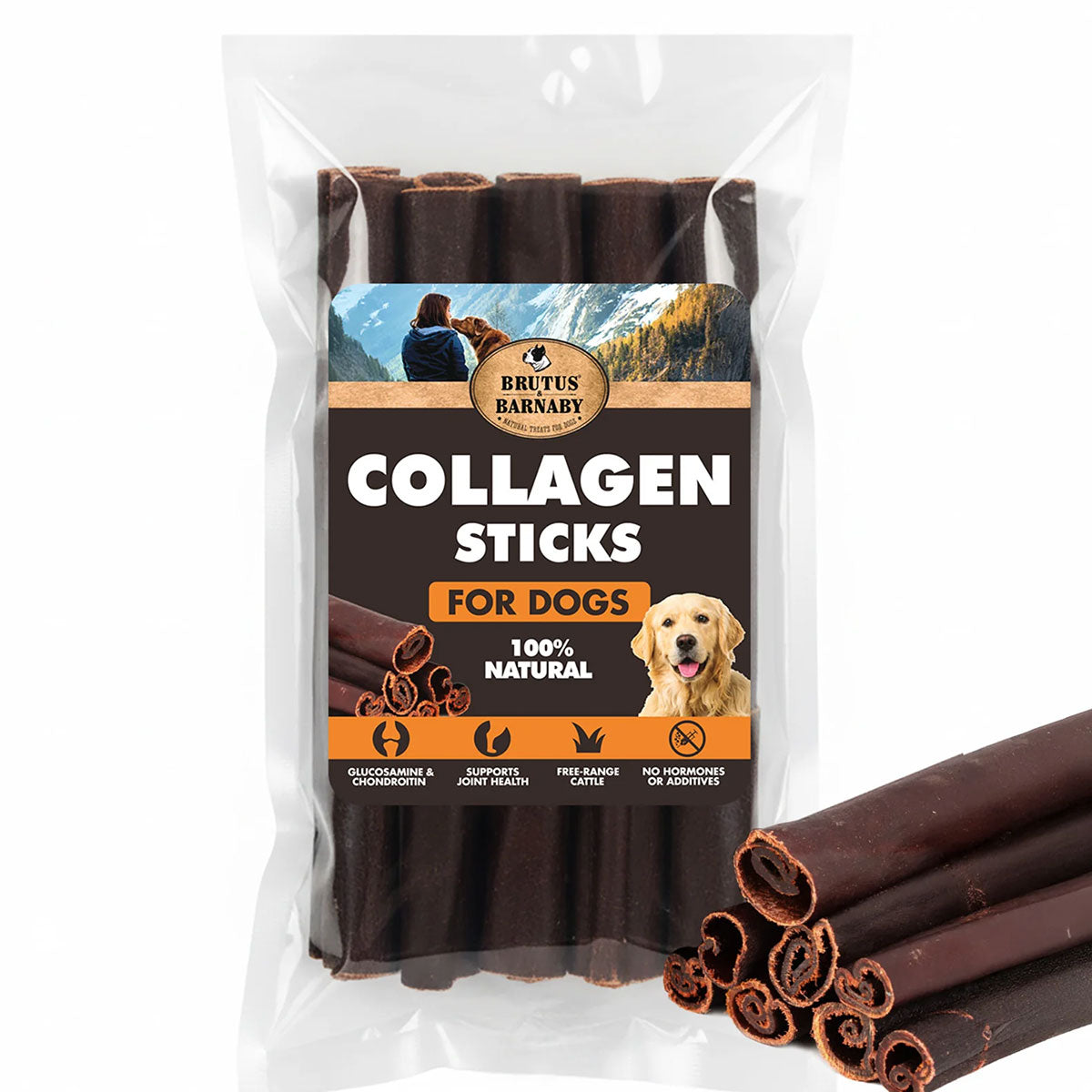
Beef Collagen Sticks for Dogs | Long-Lasting Rawhide-Free Chews
The current listing describes these as six-inch, single-ingredient chews made from 100% all-natural beef collagen. They are currently available in 5-, 10-, and 25-pack options.
- Ingredient: 100% all-natural beef collagen
- Listed crude protein: 82.2%
- Listed crude fat: 2.4%
- Listed calorie content: 110.6 calories per ounce
- Intended as a supervised treat, not a replacement for regular meals
Product ingredients, packaging, analysis, pack sizes, images, availability, and feeding information can change. Review the current product page and package before serving.
Shop Beef Collagen SticksTrusted reading
- VCA Animal Hospitals: Dog Treats Guidance on treat calories, diet balance, and the 10% limit.
- UC Davis Veterinary Medical Teaching Hospital: Treat Guidelines for Dogs Veterinary nutrition guidance on keeping at least 90% of calories in a complete and balanced diet.
- Cornell University College of Veterinary Medicine: Risks From a Fractured Tooth Signs, causes, and dental considerations associated with very hard chewing objects.
- Merck Veterinary Manual: Gastrointestinal Obstruction in Small Animals Veterinary reference for signs associated with gastrointestinal obstruction.
Related Brutus & Barnaby guides
- How Long Do Collagen Sticks Last for Dogs? Understand why chew time varies with technique, jaw strength, size, and stick density.
- Can Puppies Have Collagen Sticks? Learn how development, teething, mouth size, and behavior affect puppy readiness.
- Collagen Sticks vs. Beef Cheek Rolls Compare starting shape, size, softening pattern, calories, and handling considerations.
Collagen-stick feeding FAQs
Can dogs have collagen sticks every day?
Some healthy adult dogs may tolerate more frequent supervised sessions, but daily use should not be assumed to be appropriate. The amount eaten must fit within the dog’s total treat calories, and digestion, body condition, teeth, chewing style, and other treats must remain suitable. Ask your veterinarian before making a collagen stick a daily routine.
Should my dog eat a whole collagen stick?
No. Dogs do not need to finish a whole stick. Remove it when the remaining portion becomes swallow-sized, loose layers develop, or your dog changes from deliberate chewing to gulping. A short session can provide chewing activity while limiting consumption.
How long should each collagen-stick session be?
There is no universal safe number of minutes. Supervise continuously and end according to chewing behavior, material condition, and amount eaten. The correct stopping point may arrive quickly for a dog that crushes or tears through the stick.
Can small dogs have collagen sticks?
Size alone does not provide an automatic yes or no. The chew must remain too large to swallow whole, while the amount consumed must fit the smaller calorie budget. A short session with an appropriately oversized chew may be preferable to giving a tiny swallowable piece.
How many calories are in a collagen stick?
The current Brutus & Barnaby listing states 110.6 calories per ounce but does not currently list calories per individual stick. Weigh the grams consumed and multiply by approximately 3.9 to estimate calories using the listed metabolizable energy value.
Can puppies have collagen sticks?
There is no universal minimum age. Teething stage, tooth development, weaning, mouth size, chewing control, digestion, and veterinary guidance all matter. Very young, actively teething, or gulping puppies may need softer rewards or puppy-designed enrichment instead.
What should I do if a collagen stick causes diarrhea?
Stop giving the chew and provide no additional collagen while you assess the response. Contact your veterinarian for persistent diarrhea, repeated vomiting, blood, pain, lethargy, reduced appetite, dehydration, or concern that a large piece was swallowed.
What if my dog swallows part of a collagen stick?
Contact your veterinarian with your dog’s size, the estimated piece size, when it happened, and any symptoms. Seek emergency care for choking, breathing difficulty, collapse, blue or pale gums, repeated gagging, severe distress, persistent vomiting, or marked abdominal pain.
Frequency should follow intake and tolerance—not the calendar
For a healthy adult dog new to collagen sticks, begin with one short supervised session and wait at least 24 hours before considering another. Once or twice weekly can be a conservative starting routine, but it is not a universal prescription.
Measure how much your dog consumes, count those calories with every other treat, and stop before the chew becomes swallow-sized. Reduce frequency or discontinue the chew if digestion, teeth, body condition, or chewing behavior raises concern. Dogs with relevant medical histories should follow an individualized veterinary plan.
Plan a supervised collagen-chew session
Explore Brutus & Barnaby Beef Collagen Sticks and review the current ingredients, analysis, pack options, and feeding information before choosing them for your dog.
View Beef Collagen Sticks