



Can Puppies Have Collagen Sticks? Age, Teething, and Chew Safety
There is no universal birthday when every puppy becomes ready for a dense edible chew. Readiness depends on weaning, teeth, mouth size, chewing technique, digestion, and whether the puppy can work the chew without trying to gulp it.
A puppy’s need to chew does not automatically mean a collagen stick is the right teething tool. Young dogs can be enthusiastic without having the dental development, patience, or swallowing control needed for a dense six-inch edible chew.
Some puppies can have collagen sticks, but age alone should never decide.
Consider a collagen stick only after the puppy is fully weaned, eating solid food and firm treats comfortably, has no known dental or digestive problem, and can chew deliberately instead of crushing or gulping. Ask your veterinarian before introducing one, especially during active teething. Choose a piece that cannot fit fully inside the puppy’s mouth, begin with a short closely supervised session, remove loose layers and shortened ends, and stop if the puppy tries to swallow large pieces. Soft training treats or puppy-appropriate rubber enrichment are often better choices for very young puppies or sore teething mouths.
How This Guide Differs From Existing Puppy Articles
Brutus & Barnaby already has articles about gentle teething treats, puppies refusing treats, and puppy bully-stick safety. Those pages cover broad teething choices or another chew type. This article answers one narrower search question: when is an individual puppy developmentally and behaviorally ready for a collagen stick?
Dental Readiness
Baby teeth, loose teeth, erupting adult teeth, sore gums, retained teeth, and broken teeth can all change whether a dense chew is appropriate.
Behavioral Readiness
A puppy must be able to settle, hold the chew appropriately, and work it gradually instead of panicking, racing, or swallowing.
Owner Readiness
The adult must actively supervise, inspect the chew repeatedly, use a practiced trade, and end the session before the puppy decides the stopping point.
What Age Can a Puppy Have a Collagen Stick?
There is no evidence-based universal minimum age that makes collagen sticks appropriate for every puppy. Breed size, jaw strength, tooth development, weaning history, chewing style, previous swallowing behavior, and health status vary too much for one number to be reliable.
| Development Stage | What Is Happening | Collagen-Stick Direction | Often Better Instead |
|---|---|---|---|
| Recently weaned or still learning solid food | Eating skill, digestion, and mouth control are still developing | Usually defer unless the puppy’s veterinarian specifically recommends otherwise | Part of the balanced puppy food, tiny soft rewards, or puppy-safe food enrichment |
| Young puppy with complete baby teeth | Deciduous teeth are small and can be sharp but are not adult teeth | Dense collagen is not automatically appropriate because the puppy can bite it | Soft training treats and flexible puppy toys matched to the mouth |
| Active teething, often around 3–6 months | Baby teeth loosen while permanent teeth erupt; gums may be sore | Ask the veterinarian; many puppies need gentler options during this period | Cold puppy-safe rubber toys, soft treats, or veterinarian-approved teething options |
| Most adult teeth erupted, often around 6 months | Dental development is further along, but new teeth and chewing habits still need assessment | A short supervised trial may be reasonable when the veterinarian agrees and the puppy chews deliberately | Continue a mix of soft rewards and appropriate non-edible enrichment |
| Adolescent puppy with adult teeth | Jaw strength may increase faster than judgment or self-control | Reassess size frequently; a chew that worked last month may now be destroyed or swallowed faster | Larger appropriately designed enrichment and structured reward-based training |
AKC and VCA describe most puppies beginning to lose baby teeth around 12–16 weeks, with permanent teeth generally present by about six months. Those milestones help explain the teething period, but they do not certify a particular edible chew as safe for an individual puppy.
Readiness ChecklistSeven Signs a Puppy May Be Ready for a Supervised Trial
1. Fully Weaned and Eating Solid Food
The puppy eats an age-appropriate complete and balanced diet comfortably and can manage ordinary firm food without coughing, gagging, or struggling.
2. The Veterinarian Has No Dental Concern
No known broken, retained, loose, painful, malformed, or recently treated teeth are present, and the veterinarian has no concern about the mouth or jaw.
3. The Puppy Chews Rather Than Gulps
The puppy settles and works an item from the end instead of repeatedly repositioning it for a whole-piece swallow.
4. A Truly Oversized Piece Is Available
The six-inch chew cannot fit fully inside the mouth or slide deeply toward the throat. Length alone is not enough; diameter and mouth shape matter.
5. The Puppy Can Trade Calmly
The puppy has practiced moving away from low-value items for a better reward without chasing, cornering, or hands reaching into the mouth.
6. Digestion Is Stable
The puppy is not currently experiencing vomiting, diarrhea, appetite loss, abdominal discomfort, or a recent food transition that would make reactions difficult to interpret.
7. A Controlled Chew Area Is Ready
The session can happen away from children and other pets on a washable surface, with the adult close enough to intervene immediately.
The Trial Can Stay Short
The owner is willing to stop based on behavior and condition rather than expecting the puppy to consume the whole stick or reach a promised duration.
Signs Your Puppy Is Not Ready for a Collagen Stick
Chewing and Swallowing Concerns
- Tries to swallow the stick whole or push most of it into the mouth
- Crushes, snaps, or tears off large sections immediately
- Coughs, gags, repeatedly retches, or has trouble coordinating chewing
- Frantically speeds up when a person or pet moves nearby
- Has previously swallowed socks, toys, chew ends, rocks, or other objects
- Cannot release an item through a calm practiced trade
Dental and Health Concerns
- Loose, retained, fractured, discolored, or painful teeth
- Bleeding gums beyond minor normal teething spotting
- Pawing at the mouth, one-sided chewing, or dropping food
- Vomiting, diarrhea, abdominal pain, or appetite changes
- Beef allergy, prescription diet, or veterinary elimination diet
- Previous obstruction, pica, swallowing disorder, or digestive disease
Are Collagen Sticks Good for Teething Puppies?
They are not automatically the best teething option. Chewing can help puppies cope with sore gums, but VCA notes that hard objects can fracture both baby and adult teeth and emphasizes that no chew item is completely safe. A dense edible chew may feel satisfying to one older puppy while being too firm, too exciting, or too easy to gulp for another.
For Sore Gums
A flexible puppy toy designed to be chilled or filled with softened balanced puppy food may be gentler than a dense adult-style chew.
For Loose Teeth
Pause hard or dense chewing and ask the veterinarian about the mouth. Do not use the chew to “help” a baby tooth come out.
For Redirecting Nipping
Use appropriate toys, naps, calm redirection, and reward-based training. An edible stick should not become the only way the puppy can settle.
Watch What the Puppy Does—Not Just What the Package Says
| What You Observe | What It Suggests | What to Do |
|---|---|---|
| Holds the stick between the paws and works slowly from one end | More controlled chewing technique | Continue close observation and inspect the material frequently |
| Repeatedly flips the stick and pushes it deep into the mouth | Possible attempt to position it for swallowing | Trade it away and choose a larger or different format |
| Peels thin softened layers while staying relaxed | The rolled material is changing under saliva and pressure | Remove detached layers and stop before loose material becomes easy to swallow |
| Snaps off a thick chunk | The puppy is crushing or tearing rather than steadily softening | End the session immediately and do not return the loose piece |
| Freezes, stiffens, growls, or runs away when approached | Possible guarding or fear of losing the chew | Do not grab or punish; increase management and seek reward-based behavior help |
| Chews faster when another dog enters | Competition may be increasing swallowing risk | Use complete physical separation and visual privacy |
| Coughs, gags, drools excessively, or paws at the mouth | Possible oral pain, lodged material, or swallowing problem | Remove access safely and contact a veterinarian; use emergency care for breathing distress |
How to Introduce a Collagen Stick to a Puppy
Ask at the puppy’s veterinary visit
Bring up teething stage, retained baby teeth, current diet, allergies, digestion, breed-related mouth considerations, and any history of swallowing objects.
Inspect one natural stick
Check its actual length, diameter, density, edges, odor, and condition. Natural pieces vary, so suitability must be reassessed for every stick rather than assumed from the bag.
Use a quiet separated area
Keep children, dogs, cats, and distractions out. Use a washable mat on a hard floor and remain within immediate reach throughout the trial.
Begin with a brief observation—not a full chew session
Watch grip, jaw pressure, pace, breathing, swallowing, and body language. The first goal is learning how the puppy handles the item, not maximizing chew time.
Pause and inspect the worked end
Look for softened curls, detached strips, cracks, sharp fragments, thick chunks, and how much shorter the stick has become. End early when uncertain.
Use a practiced trade-up
Offer a separate higher-value reward away from the stick. Pick up the collagen only after the puppy moves away. Do not chase, corner, pry the mouth open, or punish growling.
Monitor the puppy afterward
Note how much material was consumed and watch for vomiting, diarrhea, abdominal pain, lethargy, appetite loss, repeated gagging, or difficulty passing stool.
How Long Should the First Session Last?
There is no universal number of minutes. For a first introduction, keep the observation deliberately short and stop as soon as you have enough information about chewing style. A puppy that creates loose material within two minutes should not continue simply because another puppy chewed for fifteen.
Stop by Condition
Remove the chew when it becomes damaged, softened into detachable material, shortened, or difficult for the puppy to hold safely.
Stop by Behavior
End the session for gulping attempts, frantic chewing, guarding, hiding, overstimulation, or inability to disengage.
Stop by Comfort
Stop for mouth bleeding beyond expected minor teething spotting, pain, head shyness, sudden refusal, coughing, gagging, or distress.
What Size Collagen Stick Is Appropriate for a Puppy?
The current Brutus & Barnaby Beef Collagen Stick is listed as a six-inch rolled chew. Six inches is a product length—not a universal puppy size. A large-breed adolescent may fit most of the stick inside the mouth, while a small puppy may struggle to hold the same diameter appropriately.
| Sizing Question | Safer Direction | Unsafe Shortcut |
|---|---|---|
| Can the full stick fit inside the mouth? | Choose a larger-format chew or a different activity | Assuming six inches is automatically large enough |
| Is the diameter easy to swallow? | Skip the stick when the puppy can line it up like food | Focusing only on length |
| Can the puppy grip it without jaw strain? | Use a shape the puppy can hold calmly and work from the end | Choosing the thickest chew available because the puppy is powerful |
| Should the stick be cut shorter? | Avoid creating a piece that can fit fully inside the mouth | Cutting a long stick into swallow-sized sections |
| Is the remaining end still safe? | Trade it away before it becomes easy to gulp | Waiting until the puppy finishes everything |
When Exactly Should You Remove the Collagen Stick?
Remove It When
- The remaining section can fit fully inside the puppy’s mouth
- A strip, curl, sheet, or chunk separates from the roll
- The puppy begins swallowing rather than chewing
- The stick cracks, splinters, or develops a sharp edge
- The puppy becomes frantic, defensive, or unable to settle
- The puppy shows mouth pain, coughing, gagging, or distress
Do Not Wait For
- A universal “last two inches” rule
- The puppy to consume the whole chew
- A timer or advertised chew-duration target
- A loose piece to disappear before checking
- Another pet to create competition
- An actual choking event before ending the session
How Much Collagen Stick Can a Puppy Have?
The current Brutus & Barnaby product page lists 110.6 calories per ounce. The puppy does not necessarily consume a full ounce in one session, so track the actual amount removed from the stick as closely as practical. Treats, chews, toppers, and other extras generally should remain within about 10% of daily calories, while at least 90% comes from complete and balanced food.
Start after the regular diet is stable
Do not introduce a dense new chew during a food change, gastrointestinal upset, or the same day as several other new treats.
Limit the first exposure
The puppy only needs a small amount to reveal chewing technique and initial digestive tolerance.
Count all training rewards too
Puppies often receive many treats for house training, recall, handling, and socialization. The chew shares the same daily extras budget.
Ask before adjusting puppy food
Growing puppies need reliably balanced nutrition. Do not reduce complete puppy food substantially just to make room for chews without veterinary guidance.
Collagen Stick or Training Treat: Which Does Your Puppy Need?
| Your Goal | Better Starting Format | Why |
|---|---|---|
| House-training reward | Small soft training treat | Fast delivery and quick swallowing preserve reward timing |
| Grooming and handling practice | Small soft training treat | Many tiny repetitions are more useful than one long chew |
| Very sore active-teething mouth | Puppy-safe soft or flexible option approved by the veterinarian | A dense chew may be uncomfortable or risky for loose teeth |
| Calm chewing practice for a ready older puppy | Short supervised collagen trial | Allows observation of grip, pacing, softening, and release |
| Puppy that gulps edible items | Neither unsupervised edible chew nor small loose end | Use veterinarian-approved enrichment that cannot be swallowed easily |
| Frequent reward-heavy class | Pre-portioned soft training treats or tiny lung pieces | Portion and timing are easier to control |
Choose the Product by Development Stage and Purpose
These current products serve different jobs. A collagen stick is a dense chew to consider only for a ready puppy. Training treats and appropriately broken lung bites are reward formats—not substitutes for supervised chew management.
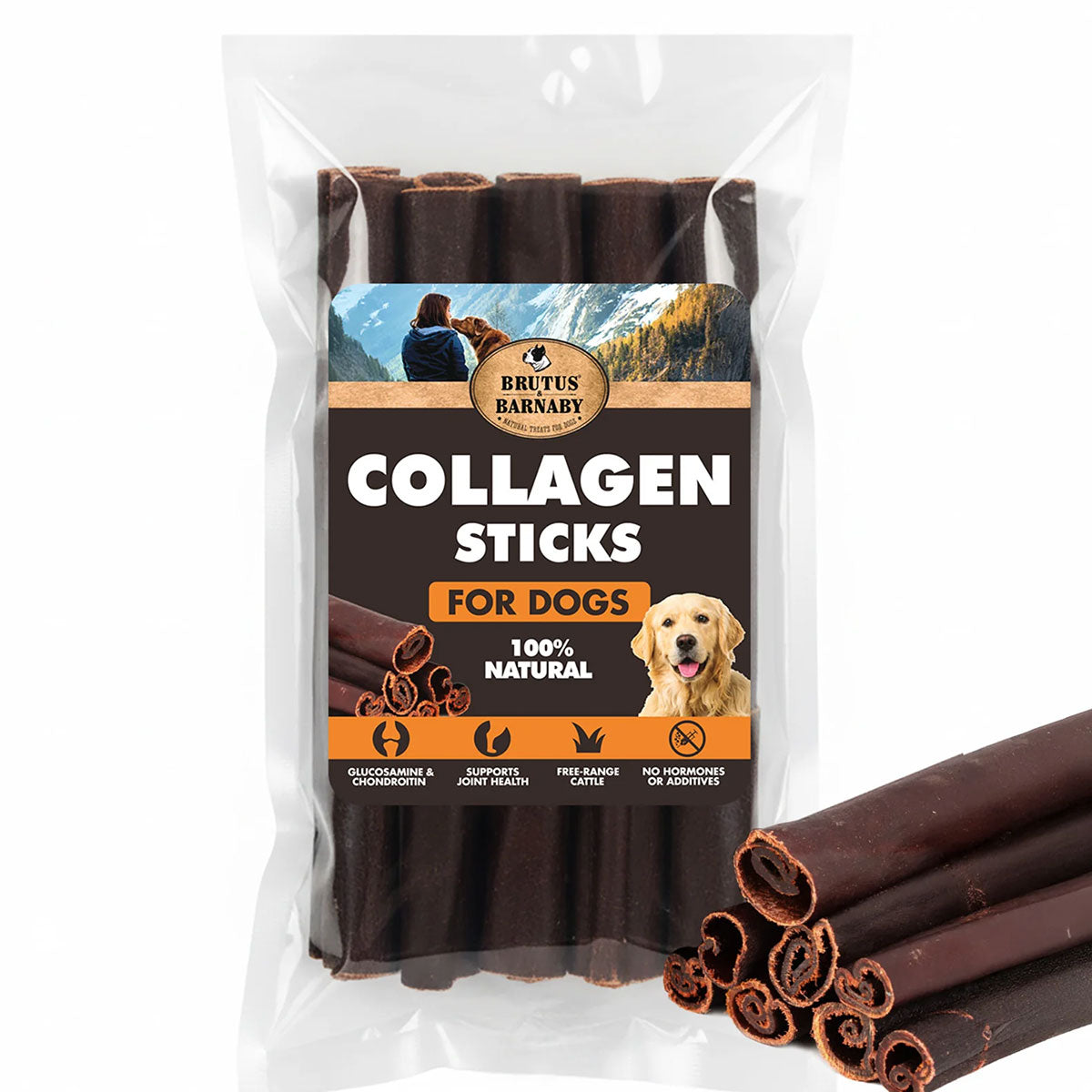
Beef Collagen Sticks
A dense six-inch rolled beef chew for puppies that have veterinary approval and demonstrate controlled chewing rather than gulping.
- 100% beef collagen
- Six-inch stick format
- 5-, 10-, and 25-pack options
- 110.6 calories per ounce
Beef Lung Bites
A single-ingredient crunchy reward that can be broken smaller before training for puppies able to manage a light dry texture.
- 100% USA beef lung
- 6 oz, 12 oz, and 32 oz sizes
- Break before training when needed
- 119.1 calories per ounce
Build a Puppy Chew Plan That Does Not Depend on One Product
Puppy-Safe Toy Rotation
Use flexible, age-appropriate toys in several shapes and textures. Inspect them before every session and discard damaged items.
Small Training Rewards
Use tiny quick rewards to reinforce house training, calm handling, leave it, drop it, settling, and appropriate chewing choices.
Occasional Supervised Chews
Introduce firmer edible chews only as the puppy’s teeth, mouth size, digestion, and self-control make them appropriate.
Teach “Drop It” Before You Need It
Do not wait until the puppy has a valuable collagen stick to introduce trading. Practice with safe low-value toys first.
Offer a low-value toy
Let the puppy engage briefly in a quiet room with no other pets present.
Present a separate higher-value reward
Hold or toss the reward away from the object so the puppy moves voluntarily rather than being crowded.
Mark and reward the release
Use a calm cue such as “drop,” then reward as soon as the mouth opens and the puppy moves away.
Return safe practice toys sometimes
This helps the puppy learn that releasing an item does not always mean permanent loss. Never return an unsafe chew end.
When to Contact a Veterinarian or Behavior Professional
Pause edible chew trials and seek individual help when:
- The puppy has a broken, retained, loose, discolored, or painful tooth
- Chewing causes persistent mouth bleeding, crying, head shyness, or food refusal
- The puppy repeatedly swallows large pieces or non-food objects
- A large collagen section may have been swallowed
- Vomiting, abdominal pain, lethargy, appetite loss, persistent diarrhea, or constipation develops
- The puppy freezes, growls, snaps, bites, or guards chews from people or animals
- The puppy has allergies, digestive disease, pica, a restricted diet, or a prior obstruction
- You cannot safely remove the chew through management and a calm trade
Use a qualified reward-based trainer or veterinary behaviorist for serious guarding, fear, aggression, or panic. Do not punish growling, forcibly open the puppy’s mouth, pin the puppy, or use dominance methods.
Continue Building a Safer Puppy Routine
Puppy Teething, Chewing, and Nutrition Resources
These external resources provide additional veterinary and training guidance on puppy dental development, supervision, appropriate chewing, and treat-calorie limits.
Puppies and Collagen Sticks FAQ
What is the minimum age for collagen sticks?
There is no universal minimum age. Readiness depends on weaning, solid-food skill, tooth development, mouth size, chewing behavior, digestion, and veterinary guidance. Very young or actively teething puppies often need gentler options.
Can an 8-week-old puppy have a collagen stick?
A recently weaned eight-week-old puppy is generally better served by complete puppy food, tiny soft rewards, and puppy-designed enrichment. Ask the puppy’s veterinarian before introducing a dense edible chew at this stage.
Can a 4-month-old puppy have a collagen stick?
Four months commonly falls within active teething, so age does not provide automatic approval. Ask the veterinarian to assess the mouth and use a collagen stick only when the puppy chews deliberately, the size is appropriate, and the trial is closely supervised.
Are collagen sticks too hard for puppy teeth?
They can be too dense for some puppies, particularly with loose, sore, damaged, or newly erupting teeth. Stop if the puppy bites down violently, shows pain, bleeds excessively, or cannot work the chew comfortably.
How long should a puppy chew a collagen stick?
There is no universal time. Keep the first introduction short and stop according to the chew’s condition, the amount consumed, and the puppy’s behavior. Remove it immediately for loose pieces, gulping attempts, pain, or distress.
What if my puppy swallows a piece of collagen stick?
Contact your veterinarian promptly with the puppy’s size, the estimated piece size, the time, and any symptoms. Seek emergency care for breathing trouble, collapse, blue or pale gums, repeated gagging, severe distress, persistent vomiting, or marked abdominal pain.
Are collagen sticks good for puppy teething?
They are not automatically the best teething option. A flexible puppy-safe toy or soft reward may suit sore gums better. Ask the veterinarian before using dense edible chews while baby teeth are loose and adult teeth are erupting.
What can I give instead of a collagen stick?
Use age-appropriate rubber enrichment, softened balanced puppy food in a suitable toy, tiny soft training treats, or light breakable rewards that match the puppy’s chewing ability and diet. Continue supervision and portion control.
A Puppy Is Ready Because of Development and Behavior—not a Date on the Calendar
Collagen sticks can fit some older puppies, but they should never be treated as a default teething product or unattended activity. Wait for solid-food readiness, assess dental development, ask the veterinarian, choose an oversized piece, observe a brief first trial, and remove the chew before the puppy can gulp an end or detached layer.
Choose Softer Rewards
Use complete puppy food, soft training treats, and puppy-designed flexible enrichment.
Test Briefly and Closely
Observe how the puppy grips, chews, softens, and releases one oversized collagen stick.
Skip the Dense Chew
Use a veterinarian-approved alternative rather than trying to force a collagen routine.
Use Soft Rewards for Learning and Collagen Only When Readiness Is Clear
Build a puppy routine around development, calm chewing, positive reinforcement, and active adult supervision—not around finishing the biggest chew.
Shop Natural Dog Treats