



Can Puppies Have Beef Cheek Rolls? Age, Safety & Chewing Tips
Learn when an older puppy may be ready for a beef cheek roll, why dental development matters, and how to manage size, calories, supervision, and swallowing risks.
Can puppies have beef cheek rolls? The careful answer is that some older puppies may be able to handle one, but age alone does not make a dense edible chew appropriate. Your puppy’s dental development, mouth size, chewing technique, health, diet, and tendency to gulp matter more than reaching a particular birthday.
Quick Answer: Can Puppies Have Beef Cheek Rolls?
Very young or actively teething puppies should generally use softer, flexible puppy-safe teething options instead of a dense beef cheek roll. An older puppy may be a candidate after the permanent teeth have erupted, the mouth is healthy, and the puppy has demonstrated calm chewing without trying to swallow large pieces.
There is no universal safe age. Ask your veterinarian if you are uncertain, then use an appropriately large roll, introduce it during a short observation session, and remove it before it becomes small or damaged.
Age Is Only the Starting Point
Puppies experience major dental changes during their first several months. The Merck Veterinary Manual explains that permanent teeth usually begin appearing at approximately four to five months and are generally present by seven months.
That timeline is useful, but it is not an automatic green light at seven months. Toy breeds, retained baby teeth, abnormal bites, sore gums, broken teeth, and individual development can change the decision. A veterinarian can examine the mouth instead of relying on age alone.
| Developmental stage | What may be happening | Practical approach |
|---|---|---|
| Young puppy with baby teeth | Small deciduous teeth and a developing chewing technique | Skip dense edible chews and choose a flexible, puppy-appropriate teething option. |
| Approximately 4–7 months | Baby teeth may be falling out while permanent teeth erupt | Usually defer the beef cheek roll if the mouth is tender or actively teething. Ask your veterinarian. |
| Older puppy with permanent teeth | Adult teeth may be present, but chewing behavior is still developing | Consider a supervised introduction only if the mouth is healthy and the puppy chews rather than gulps. |
Is Your Puppy Ready? Check These Five Factors
Dental condition
No loose baby teeth, visible fractures, bleeding, mouth pain, retained teeth, or recent dental procedures.
Chewing style
The puppy gnaws gradually instead of biting off large sections, guarding the chew, or attempting to gulp it.
Appropriate size
The roll is too large to fit completely inside the puppy’s mouth but remains manageable to hold and chew.
Digestive history
The puppy is not experiencing vomiting, diarrhea, appetite changes, or an unresolved reaction to beef.
Owner supervision
An adult can remain close enough to watch the puppy throughout the entire chewing session.
Veterinary restrictions
The chew does not conflict with a prescription diet, allergy trial, weight plan, or diagnosed health condition.
How to Introduce a Beef Cheek Roll to an Older Puppy
Confirm the mouth is ready
Wait until active teething has settled. Ask your veterinarian first if you see retained baby teeth, red or painful gums, a damaged tooth, or an unusual bite.
Start with the simpler recipe
When testing beef cheek for the first time, a single-ingredient Original roll creates fewer dietary variables than a flavored version.
Choose the size by mouth and behavior
Do not choose solely by body weight. The puppy should not be able to place the entire roll inside the mouth. Fast chewers and gulpers may need a larger starting format—or a different chew entirely.
Make the first session an observation
Offer the roll when your puppy is calm and you can watch closely. Use approximately 10 minutes as an early check, not as a guaranteed safe limit.
Inspect and remove the remainder
Take the roll away if it becomes small enough to swallow, develops loose pieces or sharp areas, or triggers frantic biting. Never leave it in a crate with an unsupervised puppy.
Watch what happens afterward
Monitor appetite, stool, vomiting, itching, facial swelling, discomfort, and energy level before deciding whether to offer the chew again.
Ingredients, Sizes and Calories Matter for Puppies
The current Brutus & Barnaby listings offer Original and Peanut Butter Beef Cheek Rolls in 5–7-inch and 10–12-inch options. Both live nutrition panels currently list 100 kcal per ounce—not 100 calories per complete roll. Because natural rolls can vary in weight and a puppy may consume only part of one, the amount actually eaten matters.
| Current product | Listed ingredients | Listed lengths | Calorie density | First-time consideration |
|---|---|---|---|---|
| Original Beef Cheek Rolls | 100% beef cheek | 5–7 inches and 10–12 inches | 100 kcal/oz | Simpler starting recipe for a puppy that has veterinary clearance to try beef cheek. |
| Peanut Butter Beef Cheek Rolls | Beef cheek and peanut butter flavoring | 5–7 inches and 10–12 inches | 100 kcal/oz | Added flavor creates another dietary variable; check all restrictions first. |
The World Small Animal Veterinary Association recommends keeping treats below 10% of a dog’s daily calories. Puppies have growth-specific nutritional needs, so ask your veterinary team how much room the complete diet leaves for edible chews.
Beef Cheek Roll Safety: When to Stop
Remove the chew immediately if your puppy:
- tries to swallow the roll or a large section whole;
- bites off chunks instead of gradually gnawing;
- develops bleeding, sudden mouth sensitivity, or a visibly damaged tooth;
- begins guarding the chew so intensely that safe removal is difficult;
- creates loose, sharp, slippery, or swallow-sized pieces; or
- vomits, develops diarrhea, becomes unusually itchy, or shows facial swelling.
Seek urgent veterinary help for:
- difficulty breathing, collapse, pale or blue gums, or obvious choking;
- repeated vomiting or unproductive retching;
- a swollen or painful abdomen, severe restlessness, or unusual lethargy;
- loss of appetite, difficulty swallowing, or inability to keep water down; or
- a known or suspected large swallowed piece.
Ask your veterinarian before offering beef cheek if your puppy has a diagnosed beef allergy, prescription diet, previous gastrointestinal obstruction, swallowing problem, dental disease, chronic digestive symptoms, pancreatitis risk, or another medical condition affecting treat choices.
Brutus & Barnaby Beef Cheek Roll Options
These products are most relevant for an older puppy that has passed the dental, health, size, and chewing-style checks above. They should not be treated as automatic choices for every puppy.
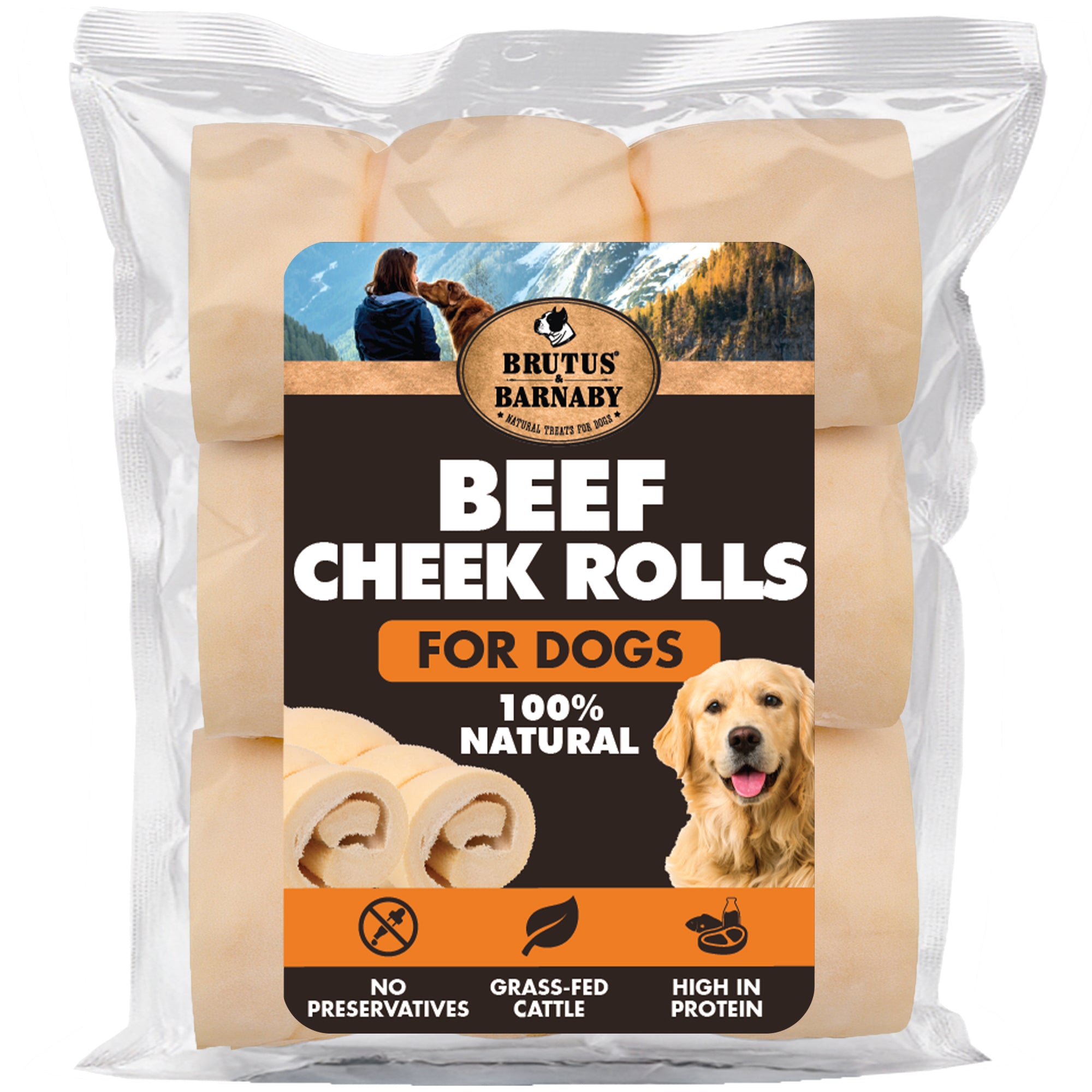
Original Beef Cheek Rolls for Dogs
A rawhide-free chew currently made with 100% beef cheek.
- Single listed ingredient
- 5–7-inch and 10–12-inch option
- Current panel lists 100 kcal/oz

Peanut Butter Beef Cheek Rolls for Dogs
A flavor-forward option currently listing beef cheek and peanut butter flavoring.
- Rawhide-free chew
- 5–7-inch and 10–12-inch options
- Current panel lists 100 kcal/oz
Continue Reading on Brutus & Barnaby
Trusted Reading
Frequently Asked Questions
What age can a puppy have a beef cheek roll?
There is no universal starting age. Permanent teeth are generally present by approximately seven months, but dental health, breed, chewing behavior, mouth size, and veterinary guidance still matter. Very young or actively teething puppies need gentler options.
Can an eight-week-old puppy have a beef cheek roll?
A dense beef cheek roll is not an appropriate default for an eight-week-old puppy with small baby teeth and an undeveloped chewing technique. Ask your veterinarian for flexible, age-appropriate teething options.
Can a teething puppy chew a beef cheek roll?
Actively teething puppies may have tender gums, loose baby teeth, and erupting permanent teeth. VCA recommends avoiding extremely hard items and using chew objects with some bend or that can be indented with a fingernail.
How long should a puppy chew a beef cheek roll?
There is no guaranteed safe duration. If an older puppy is cleared to try one, make the first session brief and closely observed. Approximately 10 minutes can be an early inspection point, but stop sooner if the puppy bites off pieces or tries to gulp.
What size beef cheek roll should I give my puppy?
Choose a roll the puppy cannot fit completely inside the mouth. Do not rely on length or body weight alone; mouth shape, roll thickness, and chewing style matter. When uncertain, ask your veterinarian before choosing a size.
Can my puppy eat the entire beef cheek roll?
Do not encourage a puppy to finish a whole roll in one sitting. Remove it before the remainder becomes small, slippery, loose, or easy to swallow. The calories consumed must also fit within the puppy’s complete diet.
How often can puppies have beef cheek rolls?
Frequency depends on the puppy’s calorie needs, amount consumed, digestive tolerance, and health. Treats should remain below 10% of daily calories, and a veterinarian can calculate an appropriate allowance for a growing puppy.
Are Peanut Butter Beef Cheek Rolls suitable for puppies?
They should only be considered for an older, chew-ready puppy without relevant dietary restrictions. The current product lists beef cheek and peanut butter flavoring, so Original provides the simpler first test when ingredient simplicity matters.
A Puppy’s Readiness Matters More Than a Birthday
Very young and actively teething puppies should use softer, flexible puppy-safe options. An older puppy may be able to try a beef cheek roll after the permanent teeth are in, the mouth is healthy, and calm chewing behavior has been demonstrated.
Choose a roll that cannot fit fully inside the mouth, supervise every second, inspect it regularly, remove small pieces early, and count the amount eaten toward the puppy’s treat calories.
Explore Beef Cheek Rolls
Compare the current Original and Peanut Butter options, available in multiple lengths for different chewing needs.
Shop Beef Cheek RollsPuppy safety notice: This article provides general educational information and cannot assess your puppy’s teeth, bite, swallowing ability, allergies, digestive health, or calorie needs. Ask your veterinarian before offering a dense edible chew, particularly during teething or when your puppy has a prescription diet, dental concern, previous obstruction, swallowing problem, beef allergy, chronic digestive symptoms, or pancreatitis risk. Products, packaging, ingredients, availability, sizes, and nutrition information can change; check the current product label before use.