



Dog Food Toppers vs. Supplements: What’s the Difference?
Comparing dog food toppers vs. supplements starts with one question: what do you want the addition to accomplish? A topper usually adds flavor, aroma, or texture to a meal. A supplement provides specific ingredients in measured amounts for a nutritional or other defined purpose.
Dog food toppers primarily enhance meals; supplements are selected for specific ingredients and amounts. The categories can overlap: a supplement powder may be sprinkled over food, and a topper may contain added functional ingredients. Neither the product’s texture nor the word “topper” tells you whether it meets a particular nutritional need. Check its intended use, label, and feeding directions.
What Is a Dog Food Topper?
A dog food topper is something added to a dog’s usual meal. Examples include finely chopped ingredients, dried crumbles, powders, and wet meal mixers. Owners often use them to introduce a different smell or texture without replacing the main food.
Some toppers contain one ingredient, such as sweet potato or beef liver. Others combine several foods. A short ingredient list can make it easier to track what goes into the bowl, but it does not guarantee suitability for every dog.
“Topper” describes how a product is used, rather than proving nutritional completeness. Some complete dog foods can be served as toppers, while many dedicated meal enhancers are intended only as extras.
For practical ways to add mealtime interest, see our guide to dog food toppers for picky eaters. Keep the goal realistic: adding variety is different from addressing unexplained appetite loss.
What Is a Dog Supplement?
Products marketed as dog supplements may supply vitamins, minerals, fatty acids, probiotics, or other ingredients. They come in powders, liquids, capsules, tablets, and soft chews. Their intended purpose matters more than the format.
For example, an owner might discuss a particular fatty-acid product with a veterinarian, or use a precisely formulated vitamin-and-mineral mixture as part of a professionally designed homemade diet. These uses require more information than simply choosing a flavor.
In the United States, animal products do not fall under the same dietary-supplement framework as human products. The FDA’s explanation of pet-food regulation describes why the human Dietary Supplement Health and Education Act does not apply to products for animals.
Read beyond the category name: A label saying “supplement” does not establish that your dog needs the product, that its benefits are proven, or that it can replace veterinary care.
Dog Food Toppers vs. Supplements at a Glance
These are typical differences, rather than rigid boundaries. Always use the individual product’s label to confirm its role.
| Comparison | Food-Based Topper | Targeted Supplement |
|---|---|---|
| Main reason to use it | Add flavor, aroma, texture, or food variety | Provide selected ingredients for a defined purpose |
| What to check | Ingredients, calories, adequacy statement, and feeding directions | Ingredient amounts, directions, quality information, and suitability |
| How portions are decided | Product directions, calorie allowance, and individual tolerance | Product-specific directions and veterinary guidance when appropriate |
| Can it replace meals? | Only if it is itself complete and balanced and fed appropriately | Not as a stand-alone diet |
| Common mistake | Adding enough to crowd out balanced food | Assuming more ingredients or a larger amount means more benefit |
Can a Topper Also Be a Supplement?
Yes. A powder containing measured supplemental ingredients might be marketed as a topper because you sprinkle it onto food. Conversely, a food-based topper can contribute naturally occurring nutrients without being designed to deliver a targeted supplemental amount.
Think of the distinction this way: “sprinkle over dinner” describes the delivery method. It does not explain the nutritional purpose, ingredient concentration, or evidence behind a claim.
A food-based example
A small serving of sweet potato topper introduces a different ingredient and texture. It should not be assumed to deliver a prescribed fiber amount or correct a nutritional deficiency.
A targeted example
A supplement mixed into dinner may have a specified amount per serving. Its suitability depends on that formulation and the dog’s needs, rather than whether the dog enjoys its taste.
Does Your Dog Need Either One?
Start by reviewing the main diet. The FDA’s guide to complete and balanced pet food explains that the nutritional adequacy statement identifies foods intended to provide a pet’s sole diet.
A complete food appropriate for your dog’s life stage is the nutritional foundation. Adding a topper is optional, and a supplement should have a clear reason for being included. Neither is automatically required because a dog eats kibble.
For meal variety
A modest food-based topper may suit an otherwise healthy dog that tolerates the ingredients.
For a specific concern
Discuss the concern with your veterinarian before choosing a targeted supplement or changing the feeding plan.
For a homemade diet
Use a professionally formulated recipe. A general topper cannot be assumed to make an incomplete recipe balanced.
If your dog already eats comfortably and maintains an appropriate body condition, there is no need to keep adding products simply to make the bowl look more elaborate.
How to Read Topper and Supplement Labels
Compare products using information you can evaluate, rather than broad phrases such as “superfood” or “daily wellness.” Those phrases do not tell you the amount your dog receives.
- Identify the intended use. Is the product a meal enhancer, a complete food, or a source of specific supplemental ingredients?
- Read the entire ingredient list. Include flavorings and chew ingredients when checking a product against dietary restrictions.
- Check the serving information. Look for calories in food toppers and meaningful ingredient amounts in targeted products.
- Review directions and cautions. Do not transfer a serving amount from another brand or a similarly named product.
- Ask about missing information. Contact the manufacturer if calorie content, serving weight, or ingredient amounts are unclear.
If a product makes a specific benefit claim, ask what evidence supports that formulation and serving amount. Research on one ingredient does not automatically establish that every product containing it produces the same result.
Portions: Count Toppers Alongside Other Extras
A small-looking scoop can still add meaningful calories. Include food-based toppers in the same allowance as training treats, edible chews, and table-food extras.
The WSAVA guide to feeding treats recommends keeping treats below 10% of daily calories. Noncomplete food toppers belong within that general extras allowance; some dogs need a more restrictive plan.
Illustrative calculation: For a dog whose veterinary feeding plan provides 600 calories daily, 10% is 60 calories. A 20-calorie topper plus 40 calories of treats would already reach that amount. These numbers illustrate the calculation, not a recommended intake for your dog.
This calorie guideline does not determine supplement dosage. A low-calorie supplement can still supply a substantial amount of an ingredient. Follow its specific directions rather than increasing the serving because calories are low.
For ingredient-specific preparation and portion considerations, read our sweet potato dog food topper serving guide.
Introduce Additions Carefully
For a new food topper, start with a small amount and introduce one dietary change at a time. Keep track of what you offer, the portion, and any changes in appetite or stool. Provide fresh water and follow storage instructions.
When considering a supplement, give your veterinarian the full product label and a list of existing foods, supplements, and medications. This helps them assess overlapping ingredients and whether the proposed addition fits the feeding plan.
Puppies, pregnant or nursing dogs, and dogs on prescription or elimination diets need particular care. Do not add a topper or supplement to a controlled diet without approval from the veterinarian managing it.
A topper is not an answer to unexplained appetite loss. Contact your veterinarian for sudden or persistent food refusal, recurring vomiting or diarrhea, weight loss, or other concerning changes. Seek prompt care if your dog appears seriously unwell.
Two Brutus & Barnaby Topper Options to Compare
If your goal is modest mealtime variety, these products offer different food ingredients. Choose according to your dog’s tolerance and feeding plan. Neither should be treated as a complete meal or a substitute for a targeted supplement.
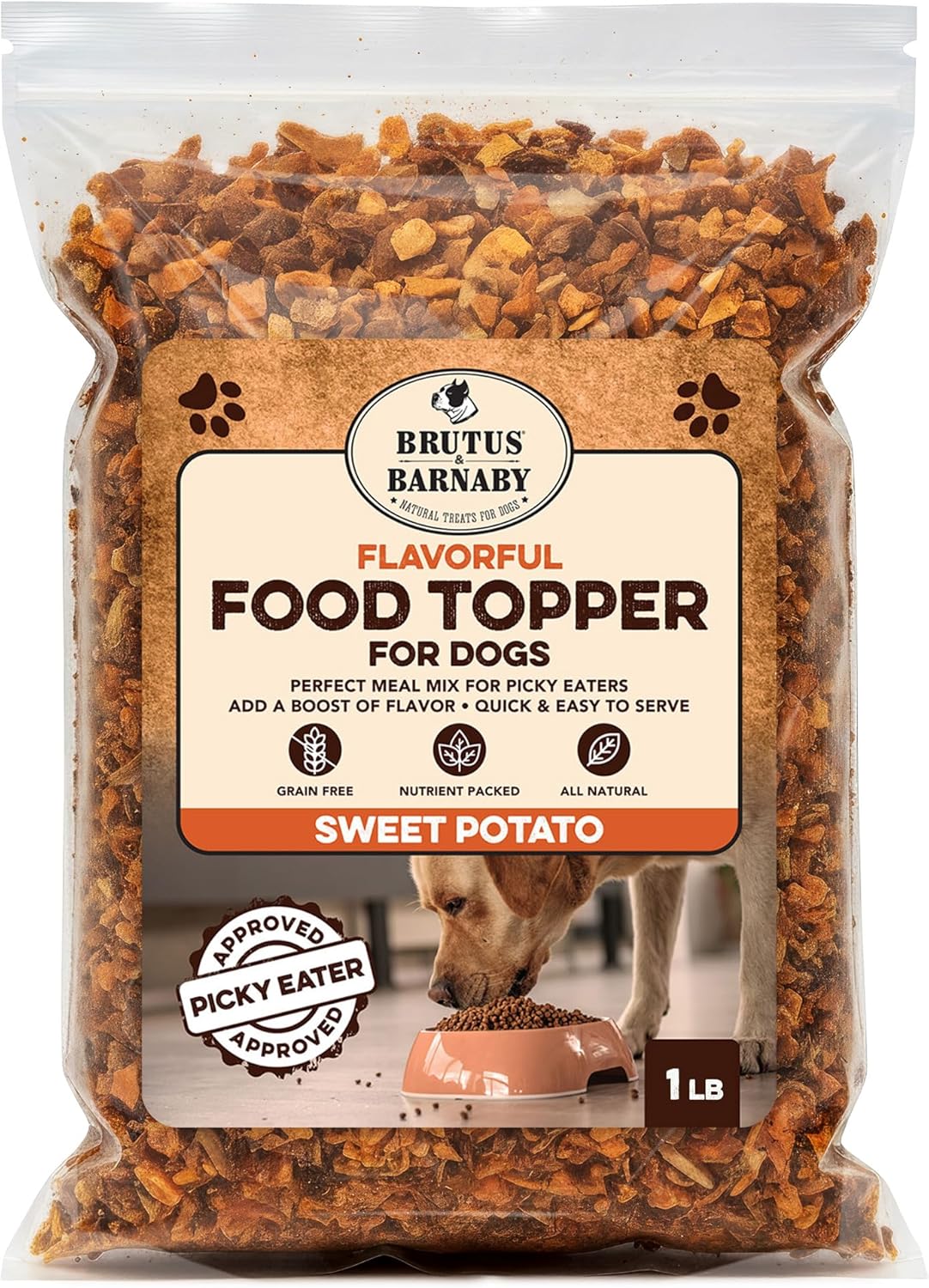
Sweet Potato Dog Food Topper | High-Fiber Meal Enhancer for Dogs
The product page lists sweet potato as its single ingredient. Consider it when you want a plant-based addition to your dog’s usual meal, provided sweet potato suits their diet.
Use a measured portion and follow the current package directions. Its naturally occurring fiber does not make it a prescribed digestive supplement.
View Sweet Potato Dog Food Topper
Beef Liver Dog Food Topper | High-Protein Meal Enhancer for Dogs
The product page lists beef liver as its single ingredient. It provides a different flavor and aroma for dogs whose feeding plans allow beef.
Keep portions modest. Being made from a nutrient-containing food does not make this topper a measured multivitamin or a way to balance a homemade diet.
View Beef Liver Dog Food TopperDog Food Topper and Supplement FAQs
Are dog food toppers the same as supplements?
Not necessarily. Most food-based toppers add mealtime variety, while targeted supplements provide particular ingredients in specified amounts. Some products combine both roles, so check the label rather than relying on the product name.
Can I give my dog a topper and a supplement together?
Sometimes, but suitability depends on the products and the dog. Review ingredients, calories, and directions, and ask your veterinarian about the combination when using a targeted supplement or managing a medical condition.
Can a topper replace a dog’s vitamin supplement?
Do not substitute a topper for a veterinarian-recommended supplement. Food ingredients can supply nutrients without delivering the specific amounts required by a prescribed feeding plan.
Can dogs have food toppers every day?
Some dogs can tolerate a measured topper regularly. Daily use should fit their calorie allowance, ingredient tolerance, and main diet. An optional topper does not need to become a progressively larger part of dinner.
Is a powder a topper or a supplement?
It could be either. Powder describes the physical form. Check whether the product is intended mainly to add food flavor or to provide defined supplemental ingredients, and use the corresponding serving directions.
Match the Addition to Your Dog’s Needs
When comparing dog food toppers vs. supplements, focus on purpose, label information, and portion size. A food-based topper can add variety; a targeted supplement requires a specific reason and appropriate directions.
For a simple mealtime addition, compare Brutus & Barnaby’s Sweet Potato Dog Food Topper and Beef Liver Dog Food Topper. Keep complete and balanced food at the center of the feeding routine.
This article provides general educational information, not an individualized veterinary feeding plan. Consult your veterinarian about supplements, restricted diets, medical concerns, or persistent changes in appetite or digestion.