



Collagen Stick Calories for Dogs: Portions, Frequency & Feeding Guide
Collagen stick calories for dogs are best managed by the amount actually eaten, not simply by counting sticks. Learn how calorie density, portion size, other treats, feeding frequency, and your dog's individual needs fit together.
An edible chew still contributes calories even when you give it mainly for enrichment or chew time. For calorie planning, the useful question is not simply “How many collagen sticks can my dog have?” but “How much of the chew did my dog actually consume?”
Brutus & Barnaby Beef Collagen Sticks currently list 3,900 kcal/kg, or approximately 110.6 calories per ounce. That equals about 3.9 calories per gram consumed. Treats, edible chews, table scraps, toppers, and other extras should generally remain within about 10% of a healthy adult dog's daily calorie intake unless your veterinary team recommends a different plan. Because dogs and chew sessions vary, there is no universal number of collagen sticks every dog should receive per day or week.
How Many Calories Are in a Collagen Stick for Dogs?
A fixed “calories per stick” number is not always the most useful way to calculate collagen stick calories for dogs. The current Brutus & Barnaby Beef Collagen Sticks listing gives calorie density by weight: 3,900 kcal/kg and 110.6 kcal per ounce.
That allows you to calculate the calories in the amount your dog actually consumes, even when one chew session ends with part of the stick remaining.
About 3.9 calories per gram consumed
Because 3,900 kcal/kg equals approximately 3.9 kcal per gram, you can estimate calories by multiplying the weight eaten in grams by 3.9. For example, 10 grams consumed would contribute approximately 39 calories.
Important: These calculations are calorie conversions, not recommended serving sizes. The appropriate amount depends on your dog's total daily calorie requirement and the rest of the diet.
Why “One Collagen Stick” Is Not a Reliable Portion
Counting chews can be convenient, but calorie planning works better when you pay attention to weight and consumption. A dog that gnaws for fifteen minutes and leaves most of the chew has consumed a different amount from a dog that finishes a substantial section.
Amount eaten
Chew time alone does not tell you how many calories entered the diet. Measure the edible amount consumed.
Dog's calorie needs
A small dog and a large dog can have very different daily energy requirements, even when both enjoy the same chew.
Other treats
Training rewards, toppers, table scraps, edible chews, and food used for medication all share the same overall treat budget.
Use the 10% Treat-Calorie Rule as a Guardrail
The World Small Animal Veterinary Association recommends keeping treats below 10% of a dog's daily calorie intake, with the main complete and balanced diet supplying the remaining calories. AAHA likewise recommends keeping total treat intake at or below 10% of daily caloric intake.
The 10% figure is a ceiling for all extras combined, not an instruction to deliberately fill 10% of your dog's diet with collagen sticks.
Daily treat budget ≈ daily calorie requirement × 10%
If your veterinary team determines that your dog requires 600 calories per day, the general 10% ceiling would equal approximately 60 calories from all treats and extras combined. If 20 calories have already been used for training rewards, only about 40 calories remain before reaching that ceiling.
The following examples use WSAVA's published treat-calorie table for an average healthy adult dog in ideal body condition and compare those numbers with the current 110.6 kcal/oz Brutus & Barnaby collagen-stick listing.
* WSAVA states these example allowances are based on estimated daily requirements for an average healthy adult dog in ideal body condition. ** Equivalent collagen amounts are mathematical calorie comparisons only, assuming collagen were the only treat source. They are not recommended serving sizes.
How to Measure a Collagen Stick Portion
When calorie control matters, a small digital kitchen scale can give you more useful information than guessing from the length of the chew.
Example: if a chew weighs 42 grams before the session and 34 grams afterward, your dog consumed approximately 8 grams. At roughly 3.9 calories per gram, that represents about 31 calories.
How Often Can Dogs Have Collagen Sticks?
There is no universal feeding frequency that applies to every dog. A useful schedule depends on how much collagen your dog normally consumes during a session, how many calories are available for treats, how well the chew is tolerated, and whether other treats are also being fed.
For that reason, “one collagen stick every day” should not be treated as an automatic serving rule. A whole chew may fit one dog's overall plan but exceed another dog's treat allowance.
Frequency follows the portion
Track how much is usually eaten during a supervised session, calculate its approximate calories, subtract other treats, and adjust frequency so the complete treat budget remains manageable.
“One stick means one serving”
This ignores the dog's calorie requirement, how much of the stick is eaten, other food extras, digestive tolerance, and the dog's chewing behavior.
What Should Determine Feeding Frequency?
A Practical Collagen Stick Feeding Routine
Instead of choosing frequency first, build the routine in this order:
Beef Collagen Sticks for Dogs
If your dog tolerates beef and a firm edible chew fits their chewing style, Brutus & Barnaby's current Beef Collagen Sticks page provides the calorie information needed to include the chew in a measured treat plan.
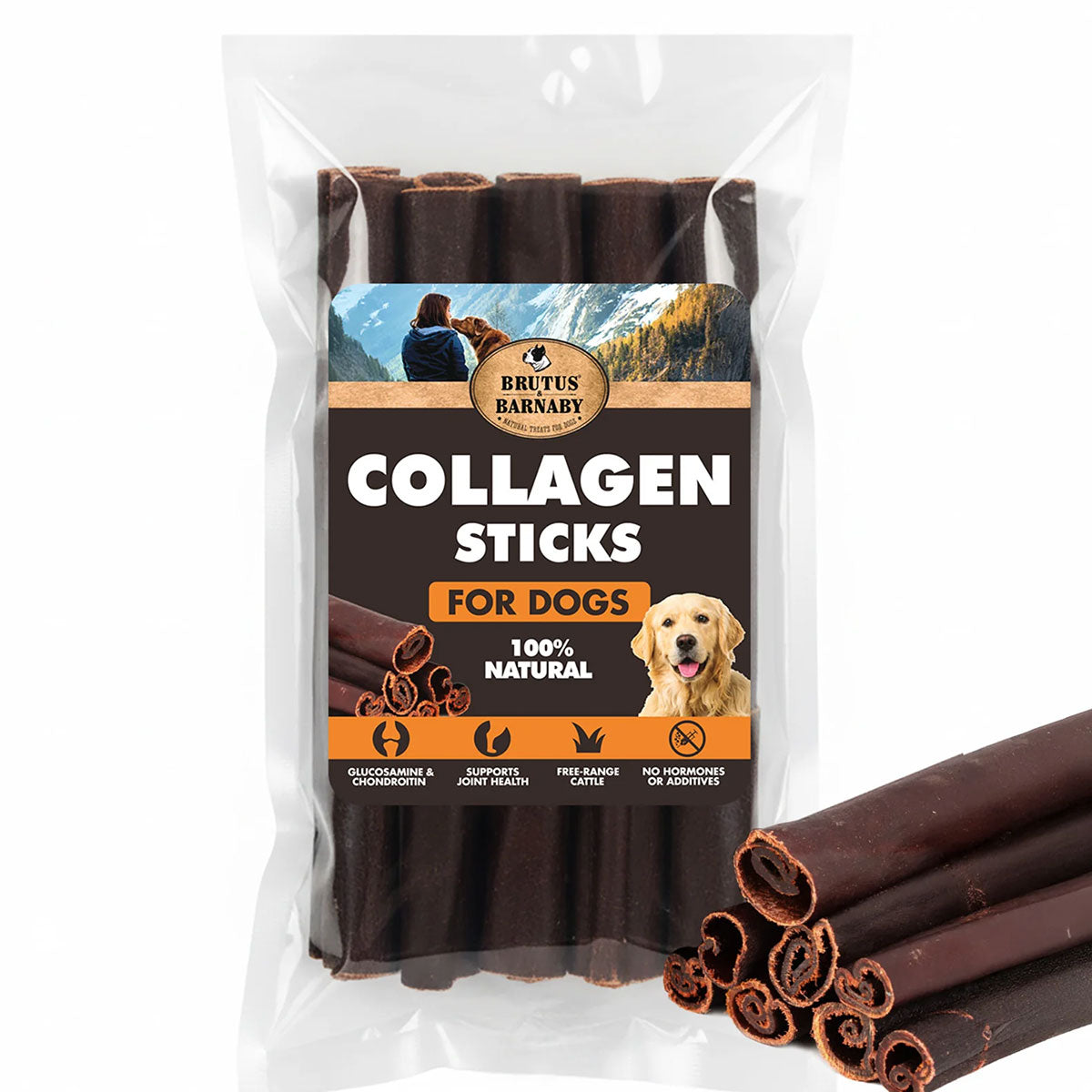
Beef Collagen Sticks for Dogs
A single-ingredient beef collagen chew that can be incorporated into a calorie-aware treat routine by tracking the edible portion consumed.
Calories Are Only One Part of a Safe Portion
A portion can fit mathematically within the dog's calorie allowance and still be inappropriate if the dog cannot chew it safely, gulps large pieces, develops digestive upset, or has a medical condition that changes which treats are suitable.
A routine may be easier to manage when
Ask your veterinarian before routine feeding when
How to Introduce Collagen Sticks Without Overdoing the Portion
Calorie planning is easier when you introduce a new chew deliberately rather than allowing unlimited consumption on the first day.
Introduce gradually
Keep the rest of the diet stable and avoid introducing several unfamiliar treats at the same time.
Watch digestion
Monitor appetite, stool quality, vomiting, gas, itching, and other changes after introducing the chew.
Change portion or frequency
If too much is being consumed or the chew crowds out other calories, shorten sessions or offer the chew less often.
Do Not Forget Chewing and Swallowing Safety
A collagen stick is an edible chew, but calorie calculations do not remove physical chewing risks. Choose a chew appropriate for your dog's size and chewing strength, supervise the entire session, and remove pieces that become small enough to swallow without adequate chewing.
The current Brutus & Barnaby product instructions recommend supervised treat use, fresh water, manageable pieces when appropriate, and removing small fragments that could present a choking concern.
Calorie control never overrides chew safety: if a piece becomes loose, damaged, or small enough for your dog to gulp, end the session even when there are still calories available in the day's treat budget.
When to Stop the Chew and Contact a Veterinarian
Contact your veterinarian promptly
Seek urgent veterinary help
Build a Better Collagen Stick Routine
Continue with guides covering feeding frequency, chew duration, digestive tolerance, and choosing collagen sticks for different chewing styles.
Helpful External Resources
Use these veterinary resources for treat-calorie guidance, weight management, and information about possible problems after swallowing foreign material.
World Small Animal Veterinary Association — Feeding Treats to Your Dog Guidance on the 10% treat-calorie limit, calorie awareness, appropriate treat sizing, and supervised chewing. AAHA — Nutrition and Weight Management Veterinary guidance on calorie management, treats, body condition, and preventing excess weight gain. VCA Animal Hospitals — Ingestion of Foreign Bodies in Dogs Learn common warning signs associated with swallowed foreign material and gastrointestinal obstruction.Collagen Stick Calories for Dogs: Common Questions
How many calories are in a collagen stick for dogs?
The calorie count depends on the product and the amount consumed. Brutus & Barnaby Beef Collagen Sticks currently list 3,900 kcal/kg, or approximately 110.6 calories per ounce. That equals about 3.9 calories per gram.
Can my dog eat a whole collagen stick?
A collagen stick is edible, but an entire stick is not automatically an appropriate serving for every dog. Consider the dog's calorie requirement, the weight of the chew, other treats, digestive tolerance, chewing behavior, and the size of the remaining piece.
Can dogs have collagen sticks every day?
There is no universal daily schedule. Daily use may add too many calories for some dogs depending on how much is consumed and what other treats are fed. Base frequency on actual consumption, total calorie needs, digestion, body condition, and veterinary guidance.
How do I calculate collagen stick calories?
For the current Brutus & Barnaby product, weigh how many grams your dog consumes and multiply that amount by approximately 3.9. Ten grams eaten, for example, equals about 39 calories.
How much of my dog's calories can come from treats?
General veterinary nutrition guidance recommends keeping treats and other extras at or below approximately 10% of daily calories, with the dog's complete and balanced diet providing the large majority of nutrition. Individual dogs may need a different plan.
Do I count the whole collagen stick if my dog only chews part of it?
For calorie tracking, estimate the edible amount actually consumed. Weighing the chew before and after the session can provide a more useful estimate than counting the entire stick when a substantial portion remains.
Are collagen sticks good for dogs on a weight-loss diet?
Do not assume an edible chew automatically fits a weight-loss plan. Its calories must be included in the dog's prescribed daily intake. Ask the veterinarian managing the weight-loss program how much room, if any, should be reserved for collagen sticks or other treats.
What if my dog gets diarrhea after a collagen stick?
Stop the chew while symptoms are present and contact your veterinarian if diarrhea repeats, becomes severe, contains blood, or occurs with vomiting, pain, poor appetite, dehydration, or lethargy. A large consumed portion, a new food, individual intolerance, or an unrelated digestive problem may all need consideration.
Measure the Portion, Not Just the Number of Sticks
Collagen stick calories for dogs are easiest to manage when you track how much is actually eaten. Brutus & Barnaby Beef Collagen Sticks currently provide approximately 110.6 calories per ounce, or 3.9 calories per gram. Keep collagen calories together with every other treat and extra when applying the general 10% treat-calorie guideline. Then adjust the portion and feeding frequency to your dog's calorie needs, body condition, digestion, health, and chewing behavior rather than treating one whole stick as a universal serving.
Build a Calorie-Aware Collagen Stick Routine
Review the current product page, calorie information, ingredients, guaranteed analysis, feeding instructions, and chew guidance before adding collagen sticks to your dog's treat routine.
Educational disclaimer: This article provides general educational information and is not veterinary, nutritional, diagnostic, or emergency advice. Appropriate calorie intake, treat allowance, portion size, and feeding frequency depend on your dog's age, size, body condition, activity, health, regular diet, digestive tolerance, chewing behavior, and medical history. Always supervise edible chews, provide fresh water, remove pieces that become a swallowing concern, and consult your veterinarian for individualized feeding advice—especially for puppies, senior dogs, dogs with weight-management needs, prescription diets, recurring digestive symptoms, pancreatitis, food reactions, or other health conditions. Product ingredients, guaranteed analysis, calorie information, packaging, availability, and feeding directions may change, so review the current product page and package before feeding.