



Cow ear chew-time guide
How Long Do Cow Ears Last for Dogs? Chew Time by Dog Size
Get a realistic cow-ear chew-time estimate, learn why size is only part of the answer, and find the right format for safer supervised chewing.
If you are wondering how long cow ears last for dogs, the most honest answer is that dog size alone cannot give you an exact number. A calm 60-pound dog may work through an ear more slowly than a determined 20-pound chewer. Ear thickness, moisture, chewing technique, and whether your dog grinds or gulps all influence the clock. The useful goal is not to promise a certain number of minutes; it is to estimate a safe range, watch the first session, and build a reliable baseline for your own dog.
Quick Answer: How Long Do Cow Ears Last for Dogs?
Brutus & Barnaby’s general chew comparison describes cow and pig ears as shorter, crunchy chews that may occupy a dog for roughly 15–45 minutes, depending on the individual dog. Treat that as a broad planning benchmark, not a guarantee. Small, calm chewers often take relatively longer; medium dogs commonly finish during one supervised session; and large or powerful chewers may finish much faster—sometimes in only a few minutes.
Chewing style is usually more predictive than body weight. Time your dog’s first cow ear, watch for large pieces or gulping, and remove it once the remaining piece could be swallowed whole.
Cow Ear Chew Time by Dog Size
The table below uses relative expectations because there is no published, universal minute range for each weight class. Natural ears vary, and dogs within the same size category can chew very differently. Use the 15–45-minute overall benchmark as context, then adjust from what you observe.
| Dog profile | Relative chew time | Practical starting format | What to watch |
|---|---|---|---|
|
Toy and small dogs Up to about 20 lb |
Often toward the longer side of the overall range when the dog chews calmly. | A cow ear sliver or manageable half may offer better portion control than a whole ear. | Make sure the piece is still too large to swallow whole. Small format does not mean unsupervised. |
|
Medium dogs About 21–50 lb |
Often a single supervised chew session, with major variation between nibblers and strong chewers. | A half or whole ear may fit, depending on mouth size, chewing strength, and daily calorie allowance. | Notice whether the dog softens and works the ear or snaps off and swallows chunks. |
|
Large and giant dogs Over about 50 lb |
Often shorter relative to small dogs because larger jaws can break down the thin cartilage faster. | A large whole ear is generally easier to manage than a small piece, provided it cannot be swallowed whole. | Fast gulpers may turn an ear into a brief snack rather than a useful chew session. |
| Power chewers of any size | Potentially much shorter than the broad 15–45-minute benchmark. | Choose a suitably large piece and consider a denser chew if the ear disappears very quickly. | Stop if the dog fractures off large sections, tries to swallow the end, or becomes possessive when you approach. |
What Actually Determines How Long a Cow Ear Lasts?
Factor 1
Chewing style
A slow grinder may soften and work across the ear. A crusher may snap sections quickly, while a gulper may try to swallow pieces before chewing enough. These behaviors can matter more than breed or weight.
Factor 2
Natural variation
Cow ears are not identical molded biscuits. Thickness, weight, shape, and moisture can vary from ear to ear, so two pieces from the same bag may not last the same amount of time.
Factor 3
Format and portion
A whole ear generally contains more chewable material than a half or sliver, but bigger is not automatically better. The format must suit the dog’s mouth, portion needs, and chewing behavior.
Factor 4
Experience
Dogs often become more efficient with a familiar chew. Your dog’s first cow ear may last longer than later ears after the dog learns where and how to bite.
Factor 5
Teeth and comfort
Dental disease, missing teeth, sore gums, or age-related changes can alter chewing. Ask your veterinarian before offering a firm chew if your dog has known oral pain or dental problems.
Factor 6
Interruptions
A dog that carries, hides, or revisits the ear may make it appear longer-lasting than a dog that chews continuously. Compare active chewing minutes, not merely elapsed time.
How to Measure Your Dog’s Real Cow-Ear Chew Time
A personal chew-time record is more useful than a generic breed chart. You need only one carefully supervised session to get a much better estimate.
- Choose the starting piece. Select a whole ear, half, or sliver that cannot fit entirely inside your dog’s mouth. If you are uncertain about sizing, ask your veterinarian or the product manufacturer.
- Start a timer when active chewing begins. Pause it if your dog walks away, hides the chew, or lies beside it without chewing. This gives you active chew time rather than room time.
- Watch how material comes off. Calm scraping and small softened bites differ from cracking off large chunks. Remove the ear immediately if your dog is gulping pieces.
- End the session before the final nub. Do not wait for the last bite. Take the chew away when the remaining piece could be swallowed whole or when it becomes damaged, contaminated, or difficult to hold safely.
- Record the result. Note the format, approximate thickness, active minutes, amount eaten, stool changes, and whether your dog tried to gulp. Use that record to choose the next portion.
Is a Cow Ear Long-Lasting Enough for Your Dog?
Cow ears are best viewed as crunchy edible chews, not the densest option for every power chewer. If your dog gets an enjoyable, controlled session without swallowing large pieces, the ear may be a good fit even if it does not last close to 45 minutes.
If a large or powerful dog finishes a whole ear in only a few minutes, the product may function more like a calorie-containing snack than an extended activity. That does not automatically make it unsuitable, but it does mean you should reconsider the portion, the purpose of the treat, and whether a denser chew would better match your goal.
Duration is also not the same as safety. A chew that lasts longer is not automatically safer, and an edible chew should never be used as an unattended babysitter.
Chew Time Does Not Change the Calories Eaten
A dog may spend 30 minutes on an ear or finish it in five, but the calories depend on the amount consumed—not the time taken. The current Brutus & Barnaby whole Cow Ears and Cow Ear Halves labels list approximately 96.3 calories per ounce. Because natural ears differ in weight, there is no reliable single calorie figure for every whole ear.
VCA and WSAVA nutrition guidance recommends keeping treats and other extras to no more than about 10% of a dog’s total daily calories, unless your veterinary team directs otherwise. For a small dog, a whole ear may represent a meaningful share of that allowance even when it takes a long time to finish.
Cow Ear Safety: When to Stop and When to Call a Vet
Stop the chew session if:
- The remaining piece is small enough to swallow whole.
- Your dog is biting off and gulping large chunks instead of chewing them down.
- The ear develops an unexpectedly sharp, hard, or damaged edge.
- Your dog coughs, gags, paws at the mouth, drools excessively, or appears distressed.
- The chew causes bleeding from the mouth or appears painful to bite.
- Your dog guards the chew in a way that makes safe removal difficult; use a calm trade rather than grabbing near the mouth, and seek qualified behavior support if guarding persists.
Get veterinary advice promptly if:
- Your dog may have swallowed a large piece, especially with repeated vomiting, reduced appetite, abdominal pain, lethargy, diarrhea, or difficulty passing stool.
- There is choking or trouble breathing. This is an emergency.
- Vomiting, diarrhea, facial swelling, hives, or marked itching follows the chew.
- Your dog has a diagnosed beef allergy, prescription diet, chronic digestive disease, previous gastrointestinal obstruction, swallowing disorder, dental disease, or pancreatitis risk.
Introduce any new animal-protein chew gradually, provide fresh water, and supervise from start to finish. Puppies need extra caution because their teeth, jaws, and chewing habits are still developing; ask your veterinarian whether a cow ear is appropriate for your individual puppy.
Brutus & Barnaby Cow Ear Formats
These three live product pages offer the same basic chew in different formats. Product details, packaging, ingredients, nutrition information, availability, and images can change, so check the current page and package before feeding. At the time this article was prepared, the live Cow Ears collection showed all three formats as out of stock.
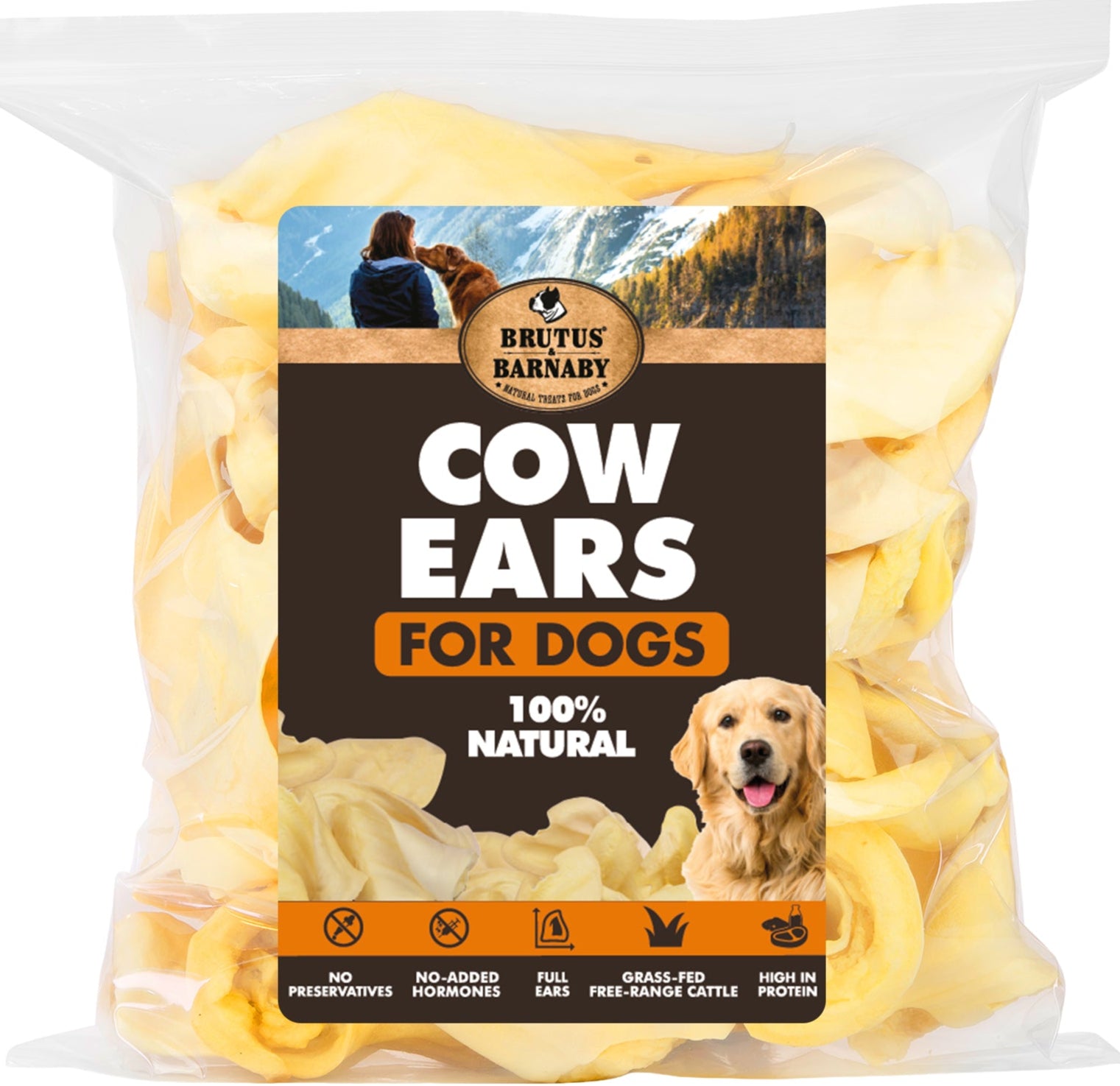
Whole-ear format
Cow Ears for Dogs | Natural Single Ingredient Dog Treats
The current product page lists 100% free-range cow ears and options of 12, 30, or 100 large ears. A whole ear is the most relevant starting format for medium or large dogs when it is too large to swallow whole.
- Single animal ingredient
- Rawhide-free format
- Current label: 96.3 kcal/oz
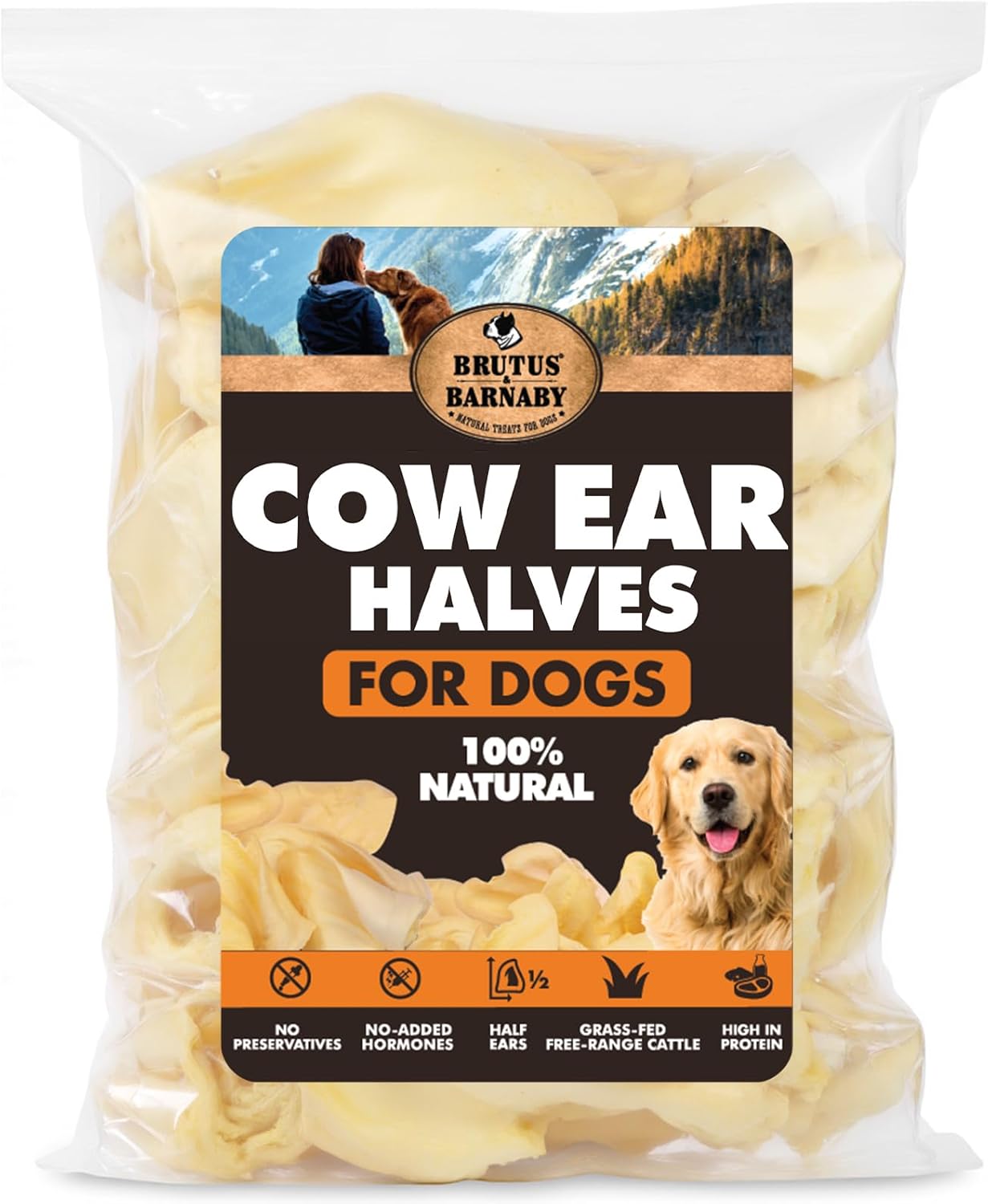
Half-ear format
Cow Ear Halves for Dogs | Thick-Cut Long-Lasting Dog Chews
The live product page lists 100% grass-fed cow ears with options of 12, 30, or 100 halves. Halves can help owners choose a smaller serving while still selecting a piece that suits the dog’s mouth.
- Single animal ingredient
- Smaller than a whole ear
- Current label: 96.3 kcal/oz

Small-piece format
Cow Ear Slivers for Dogs | Low-Fat Easy-to-Chew Dog Treats
The current page lists 100% grass-fed cow ears in 100-gram and 250-gram options. Slivers are positioned for smaller dogs and smaller portions, but every piece must still be too large to swallow whole.
- Single animal ingredient
- 100 g and 250 g options listed
- Current label: 96.3 kcal/oz
Trusted Reading
AKC: Choosing Edible Dog Chews
Practical guidance on chew size, hardness, durability, ingredients, and why a chew should be too large to fit entirely in the dog’s mouth.
Read the AKC guidanceVCA: Dog Treats
Veterinary guidance on treat calories and the recommendation that treats remain within about 10% of daily calorie intake.
Read the VCA articleWSAVA: Global Nutrition Guidelines
Resources supporting an individualized nutrition plan and appropriate veterinary nutrition assessment.
Explore WSAVA nutrition guidanceVCA: Ingestion of Foreign Bodies in Dogs
Signs associated with a possible obstruction and why vomiting, abdominal pain, appetite loss, or lethargy after swallowing an object needs prompt attention.
Read the VCA safety resourceRelated Brutus & Barnaby Guides
Frequently Asked Questions
How many minutes should a cow ear last?
There is no guaranteed number. Brutus & Barnaby’s general comparison guide uses roughly 15–45 minutes as a broad expectation for crunchy ear chews, but a power chewer may finish much faster and a calm small dog may take longer.
Do cow ears last longer for small dogs?
Often, but not always. Smaller jaws may work through the material more slowly, while chewing intensity can reverse that pattern. A determined small dog may finish before a relaxed large dog.
Are cow ears long-lasting for aggressive chewers?
They may be too quick for some aggressive or power chewers because an ear is thinner and crunchier than a dense roll or thick stick. Supervise the first trial and reconsider the chew if large sections break off or the ear disappears in minutes.
Can I let my dog finish the entire cow ear?
Do not allow the dog to swallow the final piece whole. Remove the chew while the remainder is still large enough to retrieve safely. The exact removal point depends on the dog’s mouth and behavior.
Can I save a partly chewed cow ear for later?
Follow the storage directions on the package. If the label does not provide reuse instructions, contact the manufacturer. Discard a chew that is dirty, spoiled, damaged, or has been left where contamination is possible, and wash your hands after handling pet treats.
How often can a dog have a cow ear?
Frequency depends on the amount eaten, the dog’s daily calorie needs, the rest of the diet, and individual tolerance. Count cow ears with all other treats and extras, which generally should stay within about 10% of daily calories unless your veterinarian advises differently.
Are cow ear halves better for small dogs?
A half or sliver may make portioning easier, but the piece must remain too large to swallow whole. “Smaller dog” does not automatically mean “smallest chew”; safe mouth fit comes first.
When should I avoid cow ears?
Ask your veterinarian first if your dog has a diagnosed beef allergy, prescription diet, swallowing difficulty, dental pain, chronic digestive symptoms, previous obstruction, or pancreatitis risk. Avoid the chew if your dog habitually gulps large pieces.
Final Takeaway
So, how long do cow ears last for dogs? About 15–45 minutes is a useful broad benchmark for many dogs, but it is not a size-based promise. Small calm chewers may take longer, while large dogs and power chewers may finish much faster. The safest, most accurate estimate comes from timing one supervised session and watching how your dog handles the material.
Choose a format that cannot be swallowed whole, count the amount eaten toward daily treat calories, and remove the ear before the final piece becomes a choking hazard. If your dog gulps chunks or finishes so quickly that the chew no longer serves its purpose, choose a different format or ask your veterinarian about alternatives.
Find the Right Cow Ear Format
Compare whole ears, halves, and slivers to match your dog’s size, chewing style, and portion needs.
Browse Cow Ear Treats