



Can Puppies Have Dog Food Toppers? What to Check Before Adding Extras
Can puppies have dog food toppers? Some fully weaned puppies can have a suitable, measured addition to their meals. The important checks are whether the product fits their age, how it affects their daily intake, and whether they continue eating enough complete puppy food.
Yes, some puppies can have dog food toppers, but toppers are optional. Choose a product appropriate for your puppy, follow its directions, count it alongside training treats, and keep complete growth nutrition central. Ask your veterinarian first for very young puppies, feeding difficulties, medical diets, or uncertainty about portions.
Can Puppies Have Dog Food Toppers at Any Age?
There is no universal starting age that applies to every topper. A fully weaned puppy eating solid food has different needs from a puppy still nursing or transitioning away from milk. General dog topper directions should not be used to improvise a weaning diet.
Check the specific product for a minimum age, puppy instructions, preparation requirements, and any restrictions. If those details are missing, contact the manufacturer and discuss suitability with your veterinarian. A statement such as “for dogs” does not answer every puppy-feeding question.
For a newly arrived puppy, first establish what food they were eating and how well they tolerate it. Changing the main food, adding a topper, and introducing several training rewards together makes it harder to identify what caused a problem.
A topper is not a required puppy milestone. If your puppy eats an appropriate complete diet comfortably and grows as expected, there may be no reason to add one.
Protect the Nutrition That Supports Growth
Puppies need more than appealing ingredients. Their main food must supply nutrients in appropriate amounts and proportions for growth. Adding vegetables, meat, or a vitamin-containing powder does not automatically improve that balance.
The FDA explains nutritional adequacy statements and life stages, including the distinction between growth and adult maintenance. Check the statement on your puppy's main food rather than relying only on the package design or product name.
Complete nutrition for growth
The nutritional adequacy statement should cover your puppy's life stage. For a puppy expected to become a large dog, confirm that the food is appropriate for growth of large-size dogs.
A supplemental meal addition
A product sold as a topper may add flavor or texture without supplying complete growth nutrition. Do not assume it can replace puppy food or correct a nutritional deficiency.
Our guide to whether dog food toppers can replace a meal explains this distinction in more detail. For puppies, the practical priority is preserving the complete growth diet.
Five Checks Before Adding a Puppy Food Topper
| Check | What to Look For | Why It Matters |
|---|---|---|
| Age and intended use | Puppy directions, age restrictions, and whether the product is supplemental | Adult-dog marketing does not establish suitability for every puppy |
| Full ingredient list | Every ingredient, including flavorings and added supplements | A familiar headline ingredient does not describe the whole formula |
| Calories and measurement | Calories per gram or defined serving and a clear measuring method | An undefined spoonful is difficult to fit into a feeding plan |
| Finished texture | Particle size, hard pieces, and any required preparation | A puppy must be able to manage the actual meal comfortably |
| Handling and storage | Resealing, refrigeration, and directions after adding water | Prepared food may need different handling from the dry product |
Words such as “natural,” “superfood,” or “high-protein” do not settle these questions. A short ingredient list may simplify comparison, but it does not guarantee tolerance or make a product a complete puppy diet.
Count Toppers Alongside Training Treats
Puppy extras can accumulate quickly: rewards for sitting, treats during grooming, a chew, food inside a toy, and a sprinkle at dinner. These share the same daily allowance rather than each receiving a separate budget.
AAHA's feeding-plan guidance recommends that complete and balanced nutrition provide at least 90% of total calories, with treats and other foods supplying no more than 10%. Your veterinarian can adapt that framework to your growing puppy.
Ten percent is a ceiling for extras, not a target to reach. If training rewards already use the allowance, there may be little room for a supplemental topper. Using some of the puppy's measured daily food as rewards can help preserve the balance.
Ask for calorie information when it is unclear. Do not assume that a small-looking scoop is insignificant, and avoid replacing puppy food with the same volume of topper. Equal spoonfuls can contain different calories and nutrients.
Choose a Format Your Puppy Can Manage
Check the particles
Inspect for large or hard pieces. Mix a suitable measured amount through the food rather than offering loose powder for your puppy to lick directly.
Follow preparation directions
Add water only as appropriate for the product. Check temperature and texture before serving; wetting a topping does not necessarily soften the kibble underneath.
Check its nutritional role
A complete wet puppy food and a supplemental gravy are different products. Count both correctly rather than assuming every moist addition is interchangeable.
Supervise your puppy while eating a new preparation. Coughing, gagging, or difficulty swallowing calls for veterinary advice rather than further texture experiments. Trouble breathing or an active choking episode requires emergency care.
A Brutus & Barnaby Option to Review
If a plant-based sprinkle fits your puppy's feeding plan, Brutus & Barnaby's Vegan Dog Food Topper | Meal Enhancer for Picky Eaters is an option to discuss. Its listed ingredients are sweet potato, blueberry, spinach, and carrot. The current online directions mention puppies and identify it as a meal enhancer.
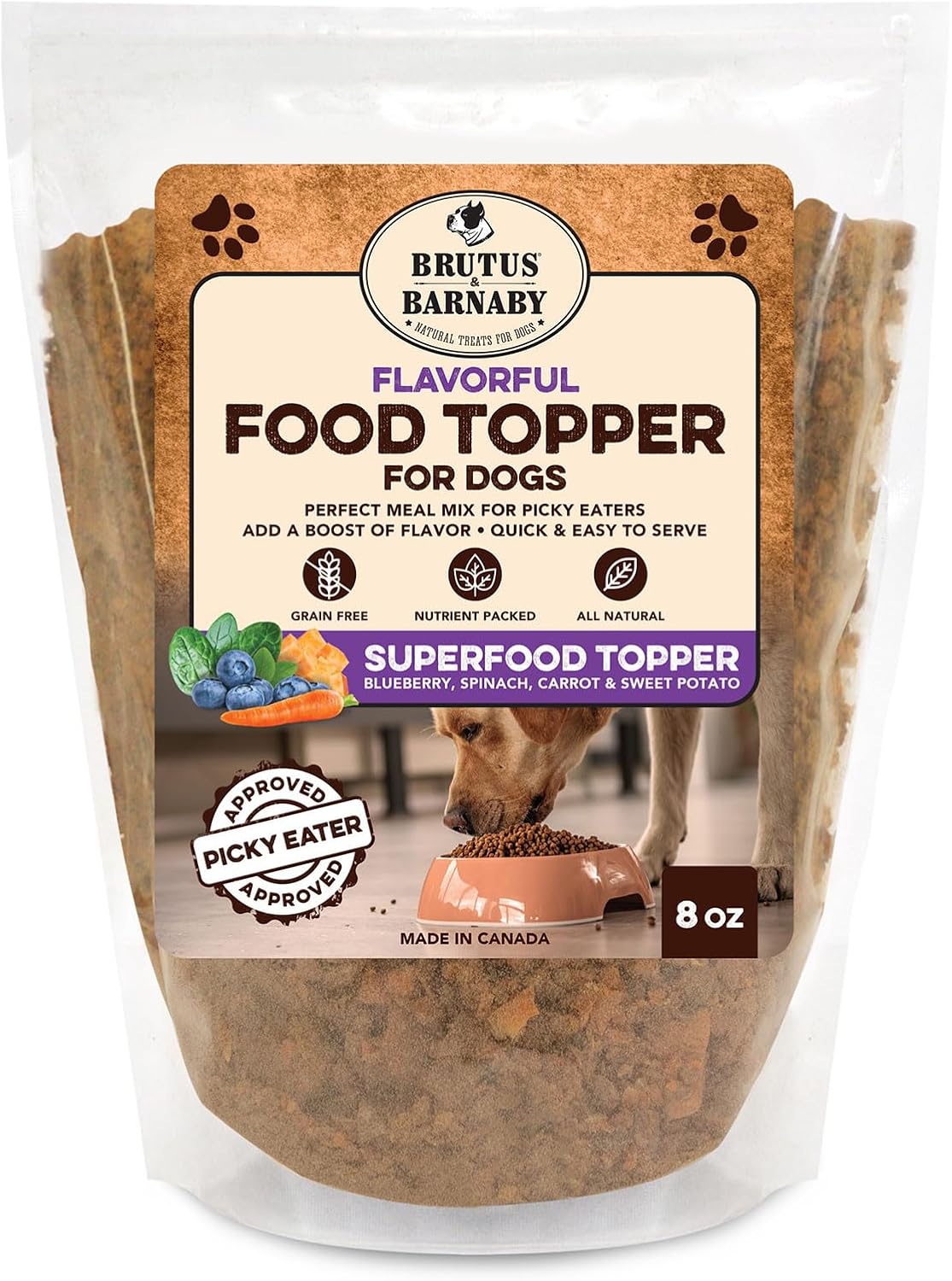
Vegan Dog Food Topper | Meal Enhancer for Picky Eaters
View Vegan Dog Food Topper | Meal Enhancer for Picky EatersThe online directions do not establish a minimum puppy age or define the weight of a “spoonful.” Confirm those details before choosing a serving. For ingredient-specific considerations, our sweet potato dog food topper guide offers additional context.
Introduce One Addition at a Time
- Confirm the baseline. Your puppy should already be eating their usual food comfortably, with no unexplained appetite or digestive changes.
- Choose one suitable product. Avoid introducing a new topper, several treats, and a different main food together.
- Start conservatively. Follow verified product directions and your veterinarian's advice rather than borrowing another dog's serving.
- Measure and mix. Record the amount and watch whether your puppy eats the complete meal instead of selecting only the topping.
- Watch tolerance. Stop the addition if concerning changes occur and contact your veterinarian for guidance.
Keep utensils and bowls clean. The FDA's pet-food handling recommendations include handwashing, cleaning feeding equipment, and promptly refrigerating or discarding unused canned or pouched food. Follow the manufacturer's instructions for any prepared or moistened meal.
When to Pause Before Adding Extras
A puppy refusing food needs attention to the cause, not an increasingly elaborate bowl. Contact your veterinarian promptly if your puppy skips meals unexpectedly, eats substantially less, or shows vomiting, diarrhea, unusual tiredness, or apparent discomfort. Very young and small puppies warrant particular caution.
Seek urgent veterinary care for collapse, breathing difficulty, repeated vomiting, bloody diarrhea, or suspected ingestion of a dangerous substance. Do not wait for a topper to restore appetite.
Avoid using raw meat as an informal appetite experiment. The FDA identifies bacterial contamination risks associated with raw pet food, including risks to people handling it. Freeze-drying alone should not be treated as proof that a raw product is pathogen-free.
Get approval before supplementing a managed diet. This includes elimination diets and feeding plans for medical concerns. Do not add calcium, vitamin powders, or other growth supplements unless your veterinarian recommends them.
Puppy Food Topper FAQs
Can an 8-week-old puppy have a food topper?
Do not decide from age alone. Check weaning status, current food tolerance, and the specific product's puppy directions. At this young age, confirm suitability with your veterinarian before adding an unfamiliar supplemental product.
Can puppies have toppers every day?
Daily use may fit if the product is appropriate, tolerated, and measured within the feeding plan. It is not necessary, and the amount should be reviewed as training rewards, food intake, and growth change.
Are adult dog toppers suitable for puppies?
Some supplemental products include puppy directions; others do not. Check the individual label. An adult-maintenance food does not become an appropriate main puppy diet simply because it is served as a topping.
What if my puppy eats only the topper?
Track how much complete puppy food remains and contact your veterinarian if this continues. Increasing the topping may crowd out growth nutrition. Avoid withholding food for prolonged periods to try to force acceptance.
Can toppers cause loose stools in puppies?
A new ingredient or excessive amount may contribute to digestive upset, but loose stools can have other causes. Stop the new addition and seek veterinary advice, especially for persistent, recurring, severe, or bloody diarrhea or other symptoms.
A Small Extra Starts With the Right Checks
Can puppies have dog food toppers? Some can, when the product, portion, and preparation suit the individual puppy. Keep complete puppy food central, include training rewards in the same extras budget, and introduce changes gradually.
If a plant-based meal enhancer fits your veterinarian's advice, review Brutus & Barnaby's current ingredients and feeding directions before adding it.
View Vegan Dog Food Topper | Meal Enhancer for Picky EatersEducational disclaimer: This article provides general information, not an individualized veterinary feeding plan. Puppy needs vary with age, expected adult size, health, and growth. Consult your veterinarian about appropriate foods and portions and for concerning appetite or digestive changes. Follow current product labels and provide fresh drinking water.