



Made-in-USA Collagen Sticks for Dogs: What to Look For
Made-in-USA collagen sticks for dogs should offer more than an American flag on the package. Learn how to read the origin claim, ingredient list, nutrition details, size information, and safety directions before choosing a chew.
A country-of-origin statement can be useful, but it is only one part of the buying decision. The chew still needs clear ingredients, usable nutrition information, an appropriate shape, and directions that acknowledge real chewing risks.
When shopping for Made-in-USA collagen sticks for dogs, read the exact origin wording first. Then check for a specific ingredient list, product identity, net quantity or pack count, calorie information, guaranteed analysis, manufacturer contact details, feeding directions, and a size and texture that fit your dog’s chewing behavior. No origin claim makes a chew automatically suitable for every dog, so supervision and individual tolerance still matter.
What Does “Made in USA” Mean on a Dog Chew?
Origin language is not interchangeable. A U.S. company address, a flag graphic, “packaged in USA,” “processed in USA,” and an unqualified “Made in USA” statement do not all communicate the same thing.
The Federal Trade Commission’s Made in USA guidance says an unqualified claim is held to an “all or virtually all” standard. The FTC explains that final processing and all significant processing must occur in the United States, with all or virtually all ingredients or components made and sourced domestically. A qualified claim, such as “made in USA with imported ingredients,” describes a narrower situation.
Practical rule: read the words next to the origin claim, then look for product-specific sourcing details. If the package and product page leave an important question unanswered, ask the manufacturer instead of filling the gap with an assumption.
How to Evaluate Made-in-USA Collagen Sticks for Dogs
Use the origin statement as the first checkpoint, not the last. A useful label and product page should help you answer all eight questions below.
Is the origin statement exact?
Look for a clear claim attached to the specific collagen chew. Note any qualifying words. A brand story about being American-owned is not a substitute for product-origin wording.
Does the ingredient list identify the chew?
“Beef collagen” is more informative than vague phrases such as “animal material.” If flavorings, colors, preservatives, binders, or other ingredients are present, they should appear on the list rather than being hidden behind broad marketing language.
Can you identify the product and the company?
The FDA’s pet food overview lists core labeling elements such as product identity, net quantity, manufacturer or distributor information, and an ingredient list. A working phone number or email makes follow-up possible.
Are calories and nutrition details available?
Collagen sticks are edible treats, not calorie-free toys. Look for calories per unit, per ounce, or per kilogram plus the guaranteed analysis. If calories are missing, ask the manufacturer before making the chew a regular part of the diet.
Does the size fit the way your dog chews?
Length alone is not enough. Consider diameter, density, the dog’s mouth size, jaw strength, tendency to gulp, and how quickly the chew softens. Choose a starting piece that cannot be swallowed whole and stop before the remainder becomes gulpable.
Are the safety directions specific?
Useful directions mention supervision, fresh water, manageable portions, gradual introduction, and removal of loose or shortened pieces. Be cautious when the only instruction is a vague “give your dog a chew.”
Is the chew appropriate for your dog’s teeth?
A power chewer can apply heavy force even to a product marketed as digestible. Avoid a chew that seems excessively hard for your dog, and ask your veterinarian before offering firm chews to a puppy, senior, or dog with worn, fractured, painful, or recently treated teeth.
Can you preserve traceability?
Keep the original package, lot information, best-by date, and purchase record while the product is in use. Those details matter if you need to ask a quality question, report a problem, or check a recall notice.
A Clear Label Matters More Than Front-of-Bag Buzzwords
Words such as “premium,” “natural,” or “long-lasting” may describe how a company positions a chew, but they do not answer the practical questions a dog owner needs. Turn the package over and look for specific, checkable information.
Specific and verifiable
Vague or unsupported
Match the Collagen Stick to the Dog in Front of You
There is no universal “best” length or chew session. Two dogs of similar weight can handle the same collagen stick very differently. Watch what your dog actually does with it.
If duration is your main concern, use our focused guide to how long collagen sticks last for different chewing styles. This buying guide focuses on origin and label quality rather than promising a minute count.
Calories and Frequency Still Count
A collagen stick may occupy a dog like an enrichment item, but the swallowed portion counts as food. The WSAVA treat guide says treats should remain below 10% of a dog’s daily calories, should not replace a complete and balanced meal, and should be offered in an appropriate size and shape under supervision.
That 10% is the combined allowance for every chew, training treat, topper, table scrap, and other extra food. It is not a daily target and does not mean every dog should receive a whole collagen stick. A dog’s appropriate intake depends on total calorie needs, body condition, health, and how much of the chew is actually eaten.
Need a schedule? Read how often dogs can have collagen sticks for a separate discussion of calories, consumed amounts, gradual introduction, and individual tolerance.
How to Introduce a New Collagen Stick
Even a single-ingredient chew can be new to an individual dog. Introduce one product at a time so you can connect any change in digestion or chewing behavior with a specific item.
- Read the current package. Confirm the ingredient, origin wording, calories, analysis, best-by date, and feeding directions.
- Choose a manageable starting piece. It should be large enough that your dog cannot swallow it whole, while still allowing controlled chewing.
- Start with a brief session. Watch how the chew softens, whether pieces loosen, and how much is consumed instead of setting a universal timer.
- Remove the shortened end. End the session before the remaining piece becomes small enough to gulp or develops loose sections.
- Provide fresh water. Keep it available during and after the session.
- Watch the whole dog afterward. Stop feeding the chew and contact your veterinarian if you see persistent vomiting or diarrhea, pain, appetite loss, unusual tiredness, or concern that a large piece was swallowed.
Emergency warning: Seek emergency veterinary care for difficulty breathing, active choking, collapse, pale or blue gums, severe distress, or repeated gagging after a piece may have been swallowed. Do not attempt to force food, water, or another object down the throat.
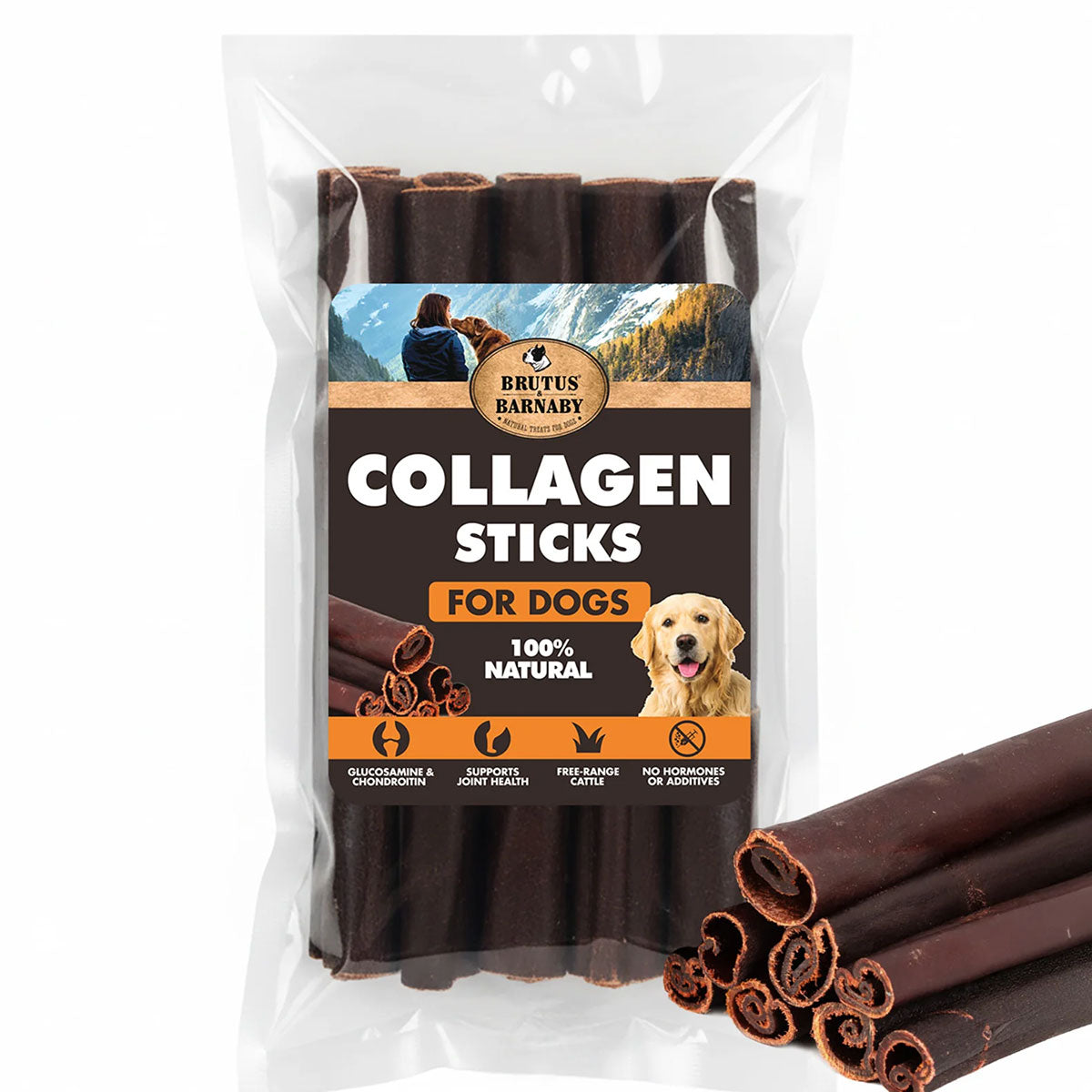
Beef Collagen Sticks for Dogs
The current Brutus & Barnaby listing displays a Made in USA badge and identifies the chew as a single-ingredient, rawhide-free product made from 100% all-natural beef collagen from grass-fed, free-range cattle.
The product detail block does not separately state the cattle’s country of origin, so this article does not describe the cattle as USA-raised. Product details and availability can change; review the current page and package before serving.
Questions a Transparent Brand Should Be Able to Answer
You do not need a technical report for every purchase, but clear customer support is valuable when the label does not answer a question important to your dog.
Origin and processing
Feeding and quality
Helpful External Resources
These government and veterinary resources explain origin claims, pet-food labeling, treat portions, and chew selection.
FTC — Complying With the Made in USA Standard How unqualified and qualified U.S.-origin claims differ. FDA — Pet Food Labeling Overview Core federal labeling elements and the roles of FDA and state regulation. WSAVA — Feeding Treats to Your Dog Guidance on calorie limits, supervision, size, shape, and complete diets. VCA Animal Hospitals — Choosing a Chew General guidance on size, hardness, swallowed pieces, and supervision.Made-in-USA Collagen Sticks: Common Questions
Are all collagen sticks made in the USA?
No. Manufacturing and sourcing vary by product. Read the specific label or current product page rather than assuming that all collagen chews, or every product from one brand, share the same origin.
Does “Made in USA” mean the same as “packaged in USA”?
No. The FTC treats an unqualified Made in USA claim as a broad origin statement under its “all or virtually all” standard. A packaging statement describes packaging, not necessarily where the chew or its ingredient originated.
What should be in a collagen stick ingredient list?
It should name the actual ingredients. A single-ingredient beef collagen chew should list beef collagen. If the product contains flavors, binders, colors, preservatives, or other ingredients, those should also be disclosed.
Are collagen sticks rawhide?
Products marketed as collagen sticks are commonly sold as rawhide-free, but product construction and labeling can vary. Check the ingredient list and the specific manufacturer’s description instead of relying only on the product category name.
Are Made-in-USA collagen sticks safe for every dog?
No chew is appropriate for every dog. Origin does not remove choking, swallowing, dental, calorie, allergy, or digestive concerns. Suitability depends on the dog, the specific product, and continuous supervision.
How do I choose the right collagen stick size?
Consider more than body weight. The piece should be too large to swallow whole, but its thickness, density, and hardness must also fit your dog’s mouth, teeth, jaw strength, and chewing behavior. Ask your veterinarian if you are unsure.
What if the country of origin is unclear?
Contact the manufacturer and ask what the claim covers, where significant processing occurs, and whether ingredient sourcing is stated separately. Keep the response with the package details if origin is important to your purchase.
Origin Is One Checkpoint in a Complete Buying Decision
A useful Made in USA claim is clear and product-specific. A useful collagen chew also tells you what it contains, how much food energy it provides, who stands behind it, and how to serve it responsibly.
The right choice combines transparent origin language with a clear label and a chew format your individual dog can manage.
Explore Brutus & Barnaby Beef Collagen Sticks
Check the current ingredients, analysis, calorie content, pack options, origin badge, and feeding directions before deciding whether this chew fits your dog.
Shop Beef Collagen SticksDisclaimer: This article is for general educational purposes only and does not replace veterinary, nutritional, dental, legal, or regulatory advice. Every dog is different. Chew suitability depends on age, size, diet, health, allergies, ingredient tolerance, dental condition, eating behavior, and individual calorie needs. Treats should not replace a complete and balanced diet. Introduce new chews gradually, use manageable portions, provide fresh water, and supervise continuously. Stop feeding the product and contact your veterinarian if your dog develops persistent vomiting or diarrhea, appetite changes, unusual tiredness, pain, or any other concerning reaction. Seek emergency veterinary care for choking, breathing difficulty, collapse, pale or blue gums, severe distress, or suspected obstruction. Product ingredients, claims, analysis, packaging, and availability can change, so always review the current label and product page before serving.