



Sweet Potato Slices vs. Fres vs. Sticks for Dogs: Which Is Best?
Compare ingredients, texture, calorie density, portioning, and everyday uses so you can select the sweet potato format that fits your dog—not simply the one with the most appealing shape.
Choosing among sweet potato slices vs. fries vs. sticks for dogs can be confusing because all three sound similar. The meaningful differences are not just their shapes. Texture, piece size, added ingredients, calorie density, and how easily a treat can be divided all affect where it fits in your dog’s routine.
There is no universal winner. A broad slice may suit a supervised chewy snack, a fry-cut piece may be easier to divide or scatter, and a crunchy stick may work well when you want a clean snap for portioning. Your dog’s size, eating speed, dental comfort, dietary restrictions, and daily calorie allowance should guide the choice.
Quick Answer: Sweet Potato Slices vs. Fries vs. Sticks for Dogs
Choose slices for a broader, chewy treat; choose fries for smaller fry-cut pieces that can work as snacks, toppers, or divided rewards; and choose sticks for a crunchy, snap-apart format. For the Brutus & Barnaby products compared here, slices and fries contain only sweet potato and list 79.4 kcal per ounce. The Pumpkin & Cinnamon Sticks contain three ingredients and list 90.2 kcal per ounce. The best option is the one whose ingredients, texture, piece size, and portion fit your individual dog.
What Actually Changes Between the Three Formats?
Sweet Potato Slices
Brutus & Barnaby Sweet Potato Slices are broad pieces made from dried North American sweet potato. The product page describes them as slow-dried, double-baked, and naturally chewy.
Full and half-slice options provide more choice over the starting piece size. However, natural slices can vary in dimensions and should not be assumed to last a particular amount of time.
Sweet Potato Fries
The fries use the same listed single ingredient and guaranteed analysis as the slices, but come in narrower, fry-cut pieces. That format may be more convenient for small rewards, scattering, or crumbling over food.
“Fries” describes the cut—not human French fries. These are dehydrated dog treats rather than salted, seasoned, or oil-fried food from your plate.
Pumpkin & Cinnamon Sticks
These sticks combine sweet potato, pumpkin, and cinnamon in a crunchy shape that can be snapped into smaller pieces. They offer a different texture and ingredient list from the single-ingredient options.
Because the sticks contain additional ingredients and have a different calorie density, owners managing allergies or calories should compare the label rather than treating all sweet potato formats as interchangeable.
Sweet Potato Treats for Dogs: Side-by-Side Comparison
| Format | Verified ingredients | Listed texture and use | Listed sizes | Calories | Best fit |
|---|---|---|---|---|---|
| Slices | 100% North American dried sweet potato slices | Chewy; available as full or half slices | Full: 8 oz, 14 oz, 2 lb, 5 lb Half: 14 oz, 2 lb, 5 lb |
79.4 kcal/oz | Supervised chewy snacks and owners seeking a single-ingredient option |
| Fries | 100% North American sweet potato | Narrow fry-cut pieces; suitable for smaller rewards or use as a topper | 14 oz, 2 lb, 5 lb | 79.4 kcal/oz | Smaller portions, treat games, gentle eaters, or topping food |
| Pumpkin & Cinnamon Sticks | Sweet potato, pumpkin, cinnamon | Crunchy; designed to snap into smaller pieces | 14 oz, 2 lb | 90.2 kcal/oz | Crunchy rewards and owners who want a breakable flavored stick |
Label note: The listed guaranteed analyses are 0.3% fat, 5.4% fiber, 5.2% protein, and 14.1% moisture for both slices and fries. Pumpkin & Cinnamon Sticks list 1.2% fat, 6.1% fiber, 7.5% protein, and 15.9% moisture. These percentages and calorie values describe the products, but they do not prove that one format will be better tolerated by every dog.
Which Sweet Potato Format Is Best for Your Dog?
How to Choose and Introduce a Sweet Potato Treat
- Read the complete ingredient list. Choose slices or fries if you specifically need the currently listed single-ingredient recipe. Check every stick flavor separately because ingredients differ.
- Match the texture to your dog. Consider chewing speed, dental comfort, age, and whether your dog carefully chews or attempts to swallow pieces whole.
- Select a manageable starting piece. Break or cut the treat before serving when appropriate. The finished piece should be easy for your dog to handle but not so small that it encourages immediate swallowing.
- Start with a small amount. Introduce one new product at a time. This makes it easier to notice whether stool quality, appetite, skin, or behavior changes.
- Supervise from start to finish. Remove small remnants, overly hard pieces, or any portion your dog is trying to gulp. Keep fresh water available.
- Count the calories. Include sweet potato treats with every other snack, chew, topper, and food used to give medication.
Calories, Fiber, and the 10% Treat Guideline
WSAVA and UC Davis veterinary nutrition guidance recommends that treats and other extras generally provide no more than 10% of a dog’s daily calories. The remaining calories should come from a complete and balanced diet. Your veterinarian can help determine the appropriate calorie target for your dog.
At the currently listed values, one ounce of slices or fries provides 79.4 kcal, while one ounce of Pumpkin & Cinnamon Sticks provides 90.2 kcal. This does not mean one product is universally “low calorie.” What matters is how many calories your dog receives in the portion actually served.
Sweet potato products also contain fiber. A sudden increase may cause gas, loose stool, or digestive discomfort in some dogs. Begin with a small amount instead of introducing several pieces at once.
Sweet Potato Treat Safety
Even a dog-friendly treat needs an appropriate portion and active supervision. Individual tolerance, health history, eating style, and total diet matter more than the name or shape of the treat.
Stop giving the treat if your dog:
- Coughs, gags, repeatedly retches, or tries to swallow a large piece
- Breaks off pieces that are too small to chew safely
- Develops vomiting, diarrhea, marked gas, or abdominal discomfort
- Develops itching, facial swelling, hives, or another possible allergic reaction
- Shows mouth pain, bleeding, or difficulty chewing
Contact a veterinarian when:
- Vomiting or diarrhea is repeated, severe, bloody, or accompanied by lethargy
- Your dog may have swallowed an obstructive piece
- Your dog has trouble breathing, blue or pale gums, weakness, or collapse—seek emergency care
- Your dog has diagnosed food allergies, diabetes, a prescription diet, pancreatitis risk, a previous obstruction, chronic digestive symptoms, or swallowing problems
- You are selecting treats for a young puppy, a dog with dental disease, or a dog with a medically restricted calorie intake
Brutus & Barnaby Sweet Potato Options
The following product information was verified from the current Brutus & Barnaby product pages. Always recheck the live label before ordering because recipes, sizes, packaging, nutrition information, availability, and product images can change.
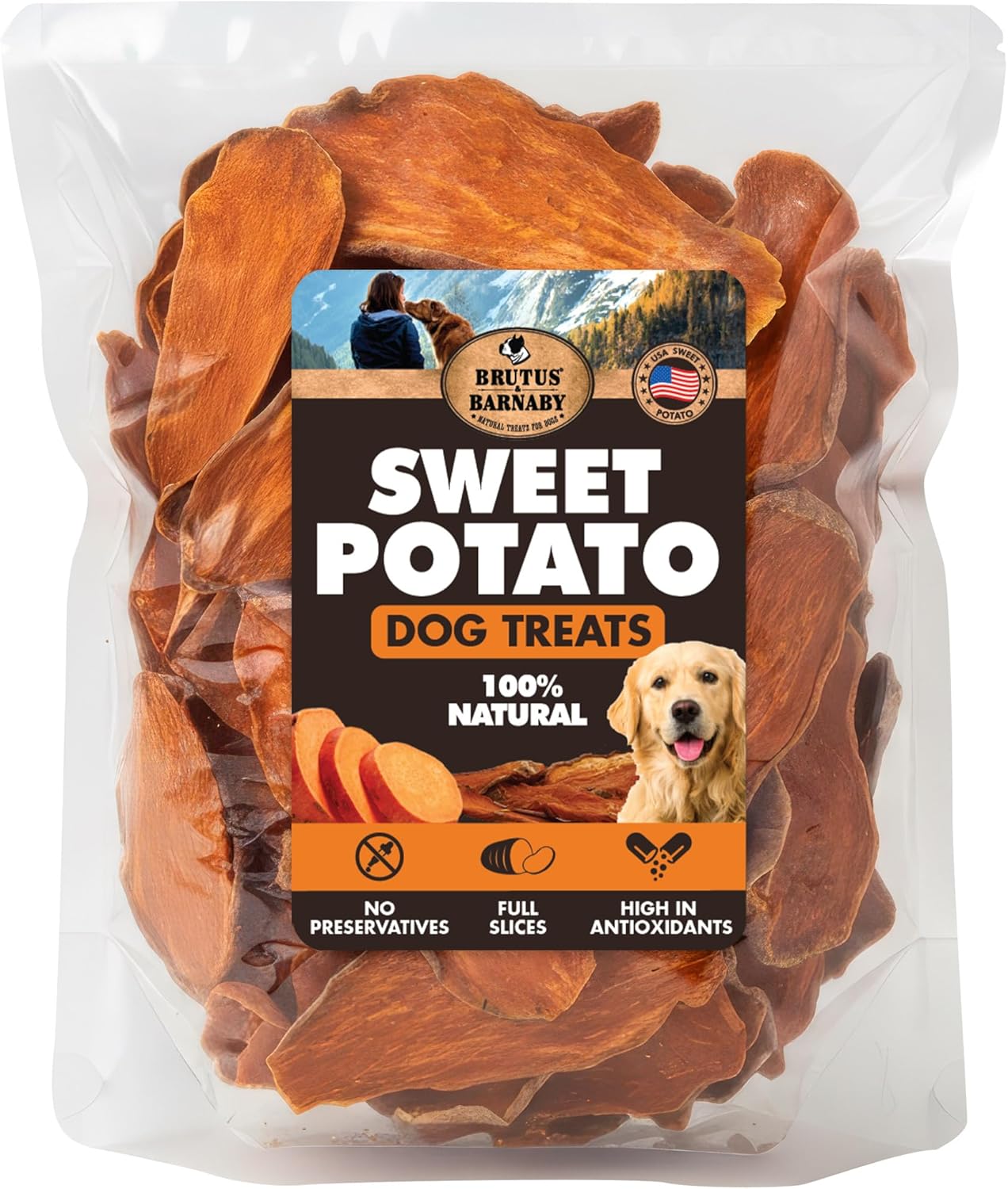
Sweet Potato Dog Treats Slices
Broad, chewy treats made with one listed ingredient: North American dried sweet potato.
- Full and half-slice options
- 79.4 kcal per ounce
- 0.3% crude fat and 5.4% crude fiber

Sweet Potato Fries for Dogs
Single-ingredient, fry-cut sweet potato pieces designed for smaller snack portions or use as a food topper.
- 100% North American sweet potato
- 14-ounce, 2-pound, and 5-pound options listed
- 79.4 kcal per ounce

Pumpkin & Cinnamon Sweet Potato Sticks
Crunchy sticks made with sweet potato, pumpkin, and cinnamon that can be snapped into smaller reward pieces.
- Three listed ingredients
- 14-ounce and 2-pound options listed
- 90.2 kcal per ounce
Related Brutus & Barnaby Guides
Can Dogs Eat Sweet Potatoes?
Learn the difference between plain, properly prepared sweet potato and raw, seasoned, buttery, or human-style sweet potato dishes.
How Much Sweet Potato Can I Give My Dog?
Review portion considerations and why treats must be counted within the dog’s total daily calorie intake.
DIY Sweet Potato Treats for Dogs
Explore homemade soft, baked, frozen, and dehydrated options with preparation and storage guidance.
Trusted Reading
Frequently Asked Questions
Are sweet potato slices, fries, or sticks best for small dogs?
Small dogs may find narrow fries or pre-broken stick pieces easier to portion, but shape alone does not guarantee suitability. Choose a manageable piece, account for its calories, and watch how your dog chews. A half slice may also work when divided before serving.
Which sweet potato treat is best for training?
Fries and crunchy sticks can be convenient because they can be divided into small rewards. Prepare the session’s total portion in advance and use tiny pieces where practical. For rapid, repeated reinforcement, a purpose-made small training treat may be more convenient.
Are sweet potato fries for dogs the same as human fries?
No. The Brutus & Barnaby fries compared here are dehydrated, single-ingredient sweet potato treats. Human fries are commonly cooked in oil and may contain salt, garlic, onion, sauces, or other seasonings that are inappropriate for dogs.
Are slices more filling or longer-lasting than fries?
A broad slice may take some dogs longer to chew than a small fry-cut piece, but chew time and satisfaction have not been established by shape alone. Piece thickness, moisture, natural variation, dog size, and chewing style all affect the experience.
Which option has the simplest ingredient list?
The current slices and fries pages list only North American sweet potato. The Pumpkin & Cinnamon Sticks list sweet potato, pumpkin, and cinnamon. Always check the package you receive because ingredients can change and different stick flavors have different recipes.
Can dogs with food allergies have sweet potato treats?
A short ingredient list can make it easier to identify what a treat contains, but sweet potato treats are not guaranteed to be hypoallergenic. Dogs can react to different ingredients. Follow your veterinarian’s diet plan if your dog has diagnosed or suspected food allergies, especially during an elimination trial.
Can puppies or senior dogs eat these treats?
Some puppies and seniors may be able to enjoy appropriately sized pieces, but age does not determine suitability by itself. Consider dental development, existing dental disease, swallowing ability, digestion, and calorie needs. Ask your veterinarian when those factors are uncertain.
Can I give my dog a sweet potato treat every day?
Daily use may fit some dogs when the portion stays within their calorie allowance and causes no digestive problems. Treats and other extras should generally remain within 10% of daily calories. Dogs with medical or weight-management needs require individualized veterinary guidance.
Final Takeaway
There is no single winner in the sweet potato slices vs. fries vs. sticks comparison. Choose slices for a broad, chewy, single-ingredient treat; fries for narrower single-ingredient pieces that are easier to divide or use as a topper; and Pumpkin & Cinnamon Sticks for a crunchy, snap-apart treat with added ingredients.
Whichever format you choose, start small, supervise eating, remove unsafe fragments, provide water, and count the portion within your dog’s total treat calories.
Find the Right Sweet Potato Treat
Compare current flavors, formats, package sizes, ingredients, and availability in the Brutus & Barnaby sweet potato collection.
Shop Sweet Potato Treats